

Key Takeaways
Start here
What a Budget Actually Is (And Isn't)
Step 1
Step 1: Add Up Your Income
Step 2
Step 2: List Your Expenses
Step 3
Step 3: Assign Every Dollar a Job
Step 4
Step 4: Track and Adjust
Next steps
Where to Go From Here
What a Budget Actually Is (And Isn't)
A budget is not a punishment. It's not a strict rulebook that forbids you from ever buying coffee or enjoying a meal out. A budget is simply a written plan for your money - a record of what comes in, where it needs to go, and how much is left over.
Without a plan, money tends to vanish in ways that are hard to explain. A budget makes the invisible visible. It turns vague financial anxiety into specific, solvable numbers.
You don't need a finance degree, a high income, or special software to build one. You need to know two things: how much money arrives each month, and how much you spend. Everything else flows from there.
Take-home income
The money you actually receive after taxes and deductions are removed from your paycheck. This is the number you budget from, not your gross salary.
Fixed expense
A bill or cost that stays the same every month, such as rent, a car payment, or a streaming subscription. These are easy to plan for because the amount doesn't change.
Variable expense
A cost that changes from month to month, like groceries, gas, or dining out. These require more attention in a budget because they can creep upward without you noticing.
Budget surplus
The money left over after all expenses are subtracted from income. A surplus gives you room to save, invest, or pay down debt faster.
50/30/20 guideline
A simple budgeting framework suggesting you direct roughly 50% of take-home income to needs, 30% to wants, and 20% to savings and debt repayment. It's a starting point, not a strict rule.
Step 1: Add Up Your Income
Your starting point is your total monthly take-home income - the amount that actually lands in your bank account after taxes and any payroll deductions. This is not your gross salary on paper.
If you're paid every two weeks, multiply one paycheck by 26, then divide by 12 to get a monthly figure. If your income varies - freelance work, tips, or hourly shifts - use your lowest month from the past three to six months as a conservative baseline.
Include every reliable income source: a primary job, a side gig, child support received, or rental income. Write the total down. That single number is the ceiling your entire budget must work within.
Use Your Bank Statement, Not Your Memory
Before estimating your income, download the last two or three months of statements from your bank or payroll portal. Real numbers are almost always different from what people recall. Spending a few minutes here saves you from building a budget based on wishful thinking.
Step 2: List Your Expenses
Pull up two to three months of bank and credit card statements. Your goal is to capture every spending category, not to judge it.
Organize expenses into two groups:
- Fixed expenses - amounts that stay the same each month: rent or mortgage, car payment, insurance premiums, subscription services.
- Variable expenses - amounts that fluctuate: groceries, gas, dining out, clothing, entertainment.
Don't rely on memory alone. Real spending almost always surprises people. Common categories that get underestimated include groceries, personal care, and small recurring subscriptions that add up quietly.
Once your list is complete, add up the total. If it exceeds your income from Step 1, that's valuable information - not a reason to panic, but a clear signal that something needs to change.
Don't Skip Irregular Expenses
Car registration, annual subscriptions, holiday gifts, and medical co-pays don't show up every month - but they do show up. Divide annual or irregular costs by 12 and include that monthly portion in your expense list. Forgetting these is one of the most common reasons first budgets fall apart.
Step 3: Assign Every Dollar a Job
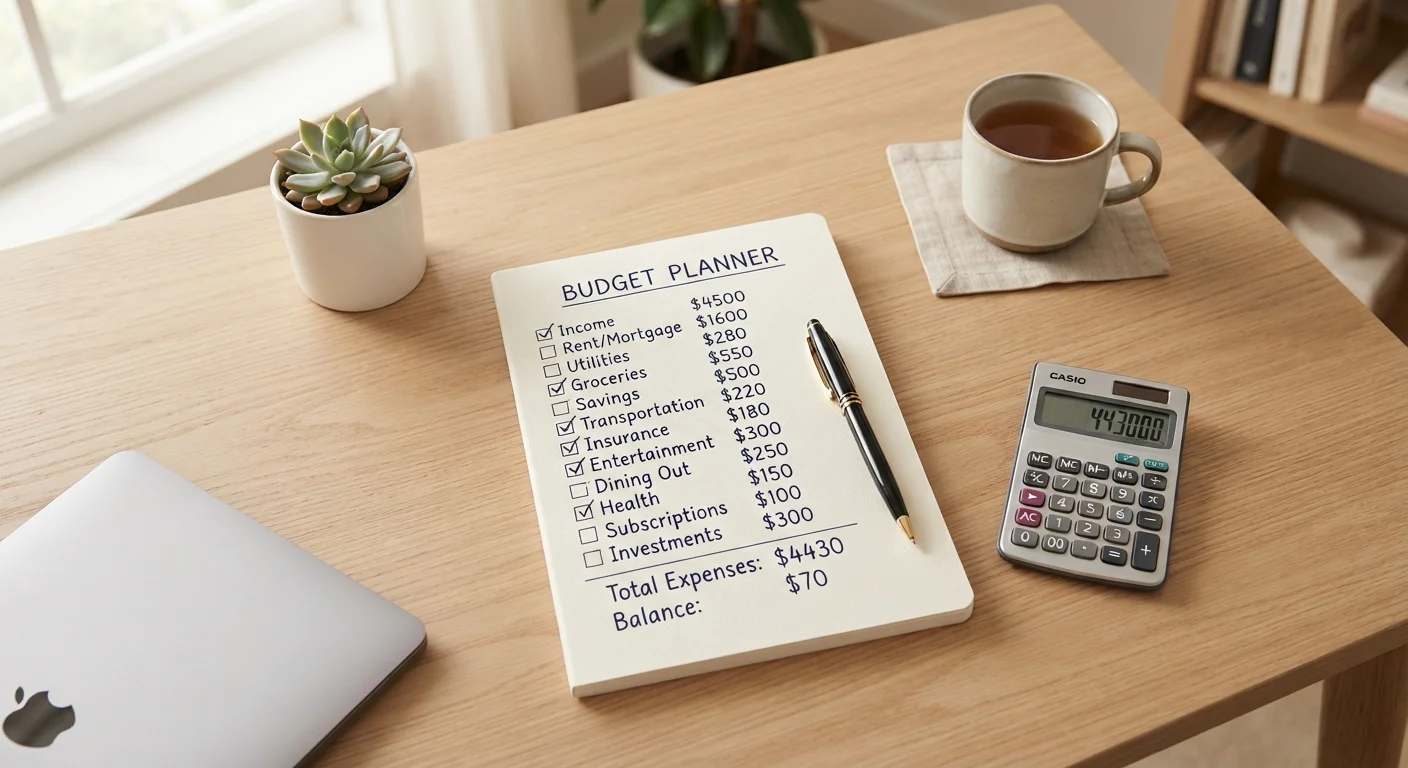
Now you align your income with your expenses. Subtract your total expenses from your total income. A positive number means you have money available to direct toward savings or debt repayment. A negative number means your current spending exceeds your income.
If you need a starting framework, the 50/30/20 guideline is a widely referenced approach: roughly 50% of take-home income toward needs (housing, utilities, food, transportation), 30% toward wants (dining, entertainment, hobbies), and 20% toward savings and debt repayment. This is a guideline, not a rule - your actual numbers may look quite different depending on where you live and your situation.
The key principle is that every dollar has a destination before the month begins. Money without a plan tends to get spent without intention. For a deeper look at budgeting vocabulary - terms like discretionary spending or sinking fund - see our plain-English budgeting glossary.
Step 4: Track and Adjust
Building the budget is the beginning, not the finish line. Throughout the month, track your actual spending against what you planned. A simple check-in every week or two is enough to stay on course.
Your first budget will be imperfect. You'll forget a category, underestimate groceries, or discover a bill you didn't account for. That's normal. The goal of the first month is awareness - you're learning your real financial patterns, not performing them perfectly.
At the end of the month, compare your plan to reality. Where did you overspend? Where did you underspend? Use those answers to build a more accurate budget for the following month. Over time, your budget becomes a reliable tool rather than a rough estimate. For a repeatable monthly process, see our step-by-step monthly budget guide.
Where to Go From Here
Once you have a working budget, you have the foundation for every other financial goal. The next natural steps most people take are building an emergency fund and addressing high-interest debt - both of which start with the surplus your budget identifies.
Our first emergency fund guide walks through setting a target and finding money to save, even when the margin feels small. When you're further along and ready to put money to work for the future, the Investing 101 hub covers foundational concepts in plain language.
The single most important thing you can do today is start - even if the numbers aren't pretty yet. A rough budget you actually use is worth far more than a perfect one sitting in a drawer.
This article is for general informational and educational purposes only. It does not constitute personalized financial, tax, or legal advice. Consult a qualified financial professional for guidance specific to your situation.
Consumer Financial Protection Bureau (CFPB) Budget Worksheet
The CFPB offers a free, printable budget worksheet that helps you list income and expenses in a structured format - a useful companion for your first draft.
Common Budgeting Terms, Defined Simply
A plain-English glossary of budgeting vocabulary - from discretionary spending to sinking funds - so unfamiliar terms don't slow you down.