

Key Takeaways
Our Verdict
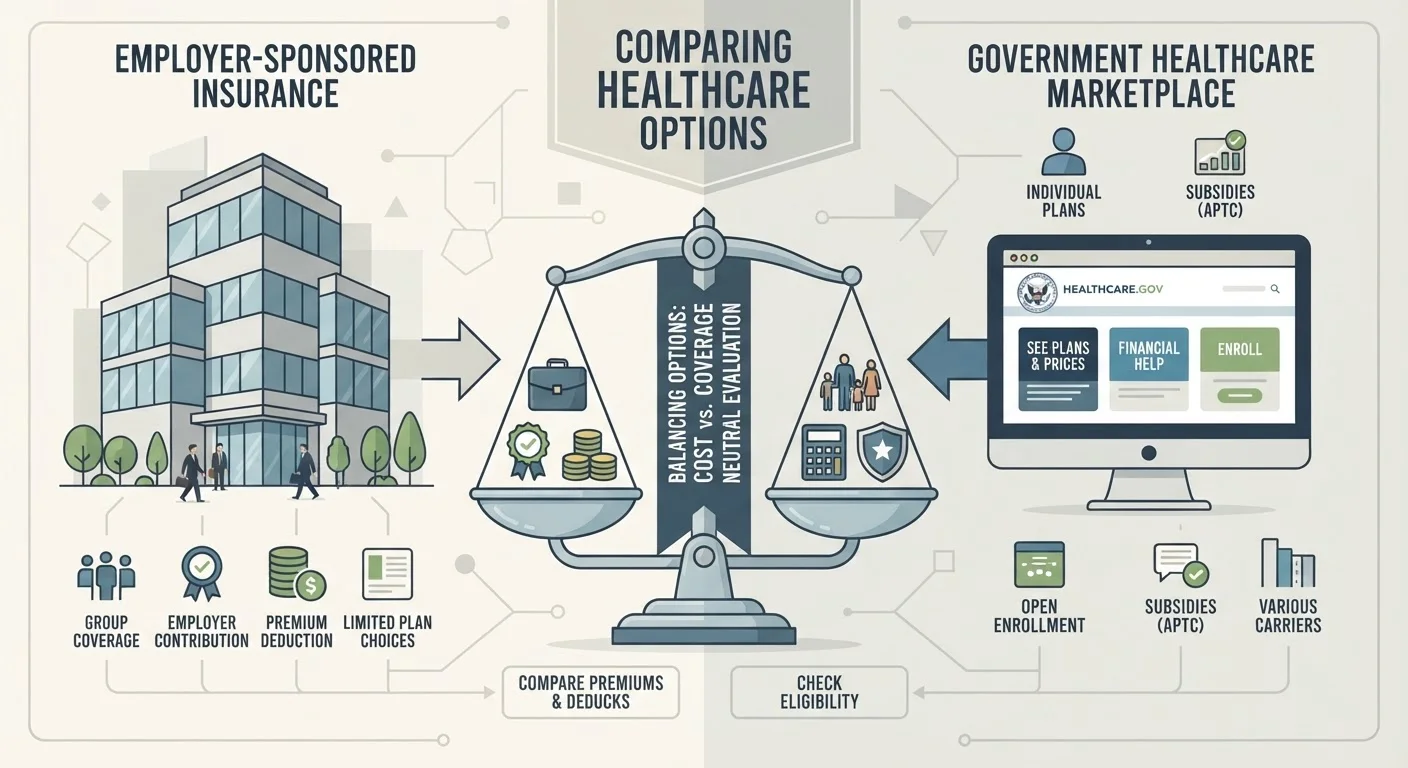
Employer-sponsored coverage is usually the more cost-effective choice when your employer contributes generously to premiums and the plan meets your medical needs. Marketplace plans become genuinely competitive - and sometimes cheaper - when employer coverage is unaffordable under ACA standards or when income-based subsidies apply. The right answer depends on your specific premium share, household income, and healthcare usage.
| Best for | Recommended |
|---|---|
| Workers whose employer pays a substantial share of premiums | Employer-Sponsored Insurance |
| Self-employed individuals or those whose job-based plan is unaffordable | Marketplace Insurance |
| Those needing a specific provider network or drug not covered by their employer plan | Marketplace Insurance |
| Employees with access to an HSA-eligible high-deductible employer plan | Employer-Sponsored Insurance |
How Each Coverage Type Works
Employer-sponsored insurance (ESI) is health coverage offered through a job. Your employer selects a plan or menu of plans, negotiates rates with an insurer, and typically pays a portion of the monthly premium. You pay the remainder through pre-tax payroll deductions. Under the Affordable Care Act (ACA), employers with 50 or more full-time equivalent workers are required to offer coverage that meets minimum value and affordability standards.
ACA Marketplace plans - sold through HealthCare.gov or a state-based exchange - are purchased directly by individuals and families. Premiums vary by plan tier (Bronze, Silver, Gold, Platinum), age, and location. Depending on household income, you may qualify for a premium tax credit (also called an advance premium tax credit, or APTC) that lowers your monthly cost, as well as cost-sharing reductions on Silver plans that reduce deductibles and copays.
Before digging into trade-offs, it helps to understand when Marketplace subsidies are even available to you. If your employer offers coverage that meets ACA affordability and minimum value thresholds, you are generally not eligible for Marketplace premium subsidies - even if you find a Marketplace plan you prefer. For plan year 2025, employer coverage is considered affordable if the employee-only premium doesn't exceed roughly 9.02% of household income.
Side-by-Side: Key Differences at a Glance
The comparison below covers the factors that most often tip the decision one way or the other. Keep in mind that plan specifics vary widely - these represent typical patterns, not guarantees.
| Employer-Sponsored Insurance | ACA Marketplace Insurance | |
|---|---|---|
| Premium cost to you | Reduced by employer contribution (often 50-80%) | Full premium minus any subsidy you qualify for |
| Premium tax credits | Not applicable | Available based on income if employer plan is unaffordable or not offered |
| Plan selection | Limited to what employer offers | Wide choice of plans and insurers on the exchange |
| Payroll deduction tax benefit | Premiums paid pre-tax, reducing taxable income | Tax credit applied; pre-tax payroll deduction not available |
| HSA eligibility | Available if employer offers a qualifying HDHP | Available only on qualifying HDHP Marketplace plans |
| Coverage portability | Ends or changes when you leave the job | Remains available regardless of employment status |
| Dependent coverage cost | Employer contribution typically covers employee only | Household-based subsidies may help cover dependents |
One factor the table can't fully capture is network access. Employer plans frequently use narrow networks to keep costs down, which can matter if you have established relationships with specific doctors or specialists. Marketplace plans also vary - some are broad PPOs, others are tightly managed HMOs. Understanding the HMO vs. PPO distinction is worth doing before committing to either route.
The Real Cost Calculation
Premium is only one piece of the cost puzzle. To compare options accurately, you need to look at the full picture:
- Your share of the monthly premium - after employer contribution or Marketplace subsidy
- Deductible - what you pay out-of-pocket before coverage kicks in for most services
- Copays and coinsurance - your share of costs after meeting the deductible
- Out-of-pocket maximum - the annual cap on what you can be required to pay
- Drug formulary - whether your medications are covered, and at what tier
Run the Numbers on Both Options
Don't rely on the monthly premium alone. Add up your expected annual out-of-pocket costs - deductible, copays, and prescriptions - under each option, then factor in your employer's contribution or any Marketplace subsidy. Healthcare.gov has a plan comparison tool that can help you model total annual costs for Marketplace options. Your HR department should be able to provide a Summary of Benefits and Coverage (SBC) for employer plan comparisons.
For workers whose employers contribute generously - say, 75-80% of the premium - the math usually favors staying on the job-based plan. But for workers at small employers that contribute little, or whose dependents aren't covered affordably, Marketplace plans can be genuinely competitive. Note that the ACA affordability test only applies to the employee-only premium, not the cost to add a spouse or children - a detail that catches many families off guard.
When reviewing your options each fall, use the Open Enrollment checklist to work through these cost layers methodically.
When Your Situation Changes
Coverage decisions aren't always made during open enrollment. Losing a job, getting married, having a child, or gaining or losing Medicaid eligibility all qualify as life events that trigger a Special Enrollment Period (SEP) - typically a 60-day window to enroll in a Marketplace plan outside of the standard enrollment season. Understanding what qualifies as a life event can help you avoid gaps in coverage during transitions.
If your income puts you near Medicaid eligibility thresholds, the choice may be between Marketplace plans and Medicaid rather than between employer and Marketplace coverage. That's a different set of trade-offs - covered in more depth in our Medicaid vs. Marketplace comparison.
83%
Workers at large firms offered health benefits
According to KFF's 2023 Employer Health Benefits Survey, 83% of workers at firms with 200 or more employees were offered health benefits.
$6,575
Average annual employee premium for single coverage
KFF's 2023 survey found workers contributed an average of $6,575 annually for family coverage and $1,401 for single coverage.
This article provides general health insurance information for educational purposes and is not personalized insurance, financial, or legal advice. Coverage terms, eligibility rules, and subsidy amounts vary by provider, plan, and individual circumstances. Read your actual policy documents carefully and consult a licensed insurance agent or adviser before making coverage decisions.