

Key Takeaways
Why a Simple Setup Often Works Better
Gym memberships and fully equipped home gyms carry real value for many people, but neither is a prerequisite for effective exercise. Barriers like cost, commute time, and schedule friction are among the most commonly cited reasons adults don't exercise consistently. A home space - even a modest one - removes many of those barriers at once.
The key insight is that the quality of your training depends far more on consistency, progressive challenge, and sound form than on the sophistication of your equipment. Whether you're exploring solo training versus group classes or simply trying to move more, a dependable home setup gives you a low-friction option that complements other approaches.
Budget constraints also force useful prioritization. When you can't buy everything, you tend to focus on what actually matters - movement patterns, consistency, and gradual progression.
What you will need
What You'll Need (and What You Won't)
The equipment list for an effective home workout space is shorter than most people expect. The tools below reflect genuine utility across a wide range of fitness goals, not marketing priorities. For budgeting purposes, it helps to distinguish required from optional items early - a principle that applies whether you're building a personal budget or outfitting a workout space.
Exercise mat
Provides cushioning and grip for floor exercises, stretching, and yoga.
Resistance bands (set)
Adds variable load to strength exercises without the weight or cost of dumbbells.
Adjustable dumbbells or a single pair of fixed-weight dumbbells
Enables a wide range of resistance training movements in a compact footprint.
Jump rope
Delivers effective cardiovascular conditioning in minimal space at very low cost.
Pull-up bar (door-mounted)
Allows upper-body pulling movements without a rack or dedicated structure.
Wall mirror or large reflective surface
Helps you monitor form during exercises to reduce injury risk.
Don't Let Equipment Become Clutter
Unused exercise equipment is a very common household purchase that ends up taking space without delivering value. Commit to trying bodyweight-only training for at least two to four weeks before purchasing anything. This gives you a realistic baseline for what you'll actually use - and helps you avoid spending that doesn't serve your goals. For a broader framework on distinguishing worthwhile investments from impulse purchases, this budgeting principle applies across many categories.
Step-by-Step: Setting Up Your Space
Follow these steps in order. Skipping ahead to equipment purchases before completing the earlier steps is the most common way people end up with gear they don't use.
Identify and clear your dedicated space
Walk through your home and look for any area - a bedroom corner, a section of the basement, a cleared garage bay, or even a living room - where you can unroll a mat and move freely in all directions. You don't need a separate room. A roughly 6-by-6-foot footprint accommodates the majority of bodyweight and resistance-band movements.
Remove trip hazards, secure loose rugs, and check overhead clearance for any jumping or overhead-press movements. If the floor is hard tile or concrete, note that you'll want an adequately thick mat for joint comfort.
Define your training goals before buying anything
Knowing whether you want to build general fitness, improve cardiovascular health, add strength, or rehabilitate from a period of inactivity will determine which - if any - equipment actually earns a place in your space. Buying gear before clarifying goals is the most common source of wasted spending.
If you're returning to exercise after a long break, rebuilding safely and gradually is a priority, and bodyweight exercises alone may serve you well for weeks or months before any equipment becomes necessary.
Start with bodyweight - add equipment only as needed
Push-ups, squats, lunges, planks, glute bridges, and mountain climbers require zero equipment and collectively train every major muscle group. Research consistently supports the effectiveness of progressive bodyweight training for improving strength and endurance, particularly for beginners and intermediate exercisers.
Once bodyweight movements feel manageable and you've identified specific gaps - for example, difficulty loading the upper body or adding progressive resistance - that's the signal to consider your first equipment purchase. Resistance bands are generally the most cost-effective starting point given their versatility.
Choose multi-use equipment over single-purpose items
When you do invest in equipment, prioritize items that serve multiple functions. A set of resistance bands, for instance, can substitute for cables, assist pull-up progressions, and add load to dozens of exercises. A single pair of moderately heavy dumbbells covers more ground than several specialized single-purpose tools.
If free weights interest you, understanding the trade-offs between free weights and machines can help you prioritize wisely given the space and budget constraints of a home setup.
Organize the space for consistency and safety
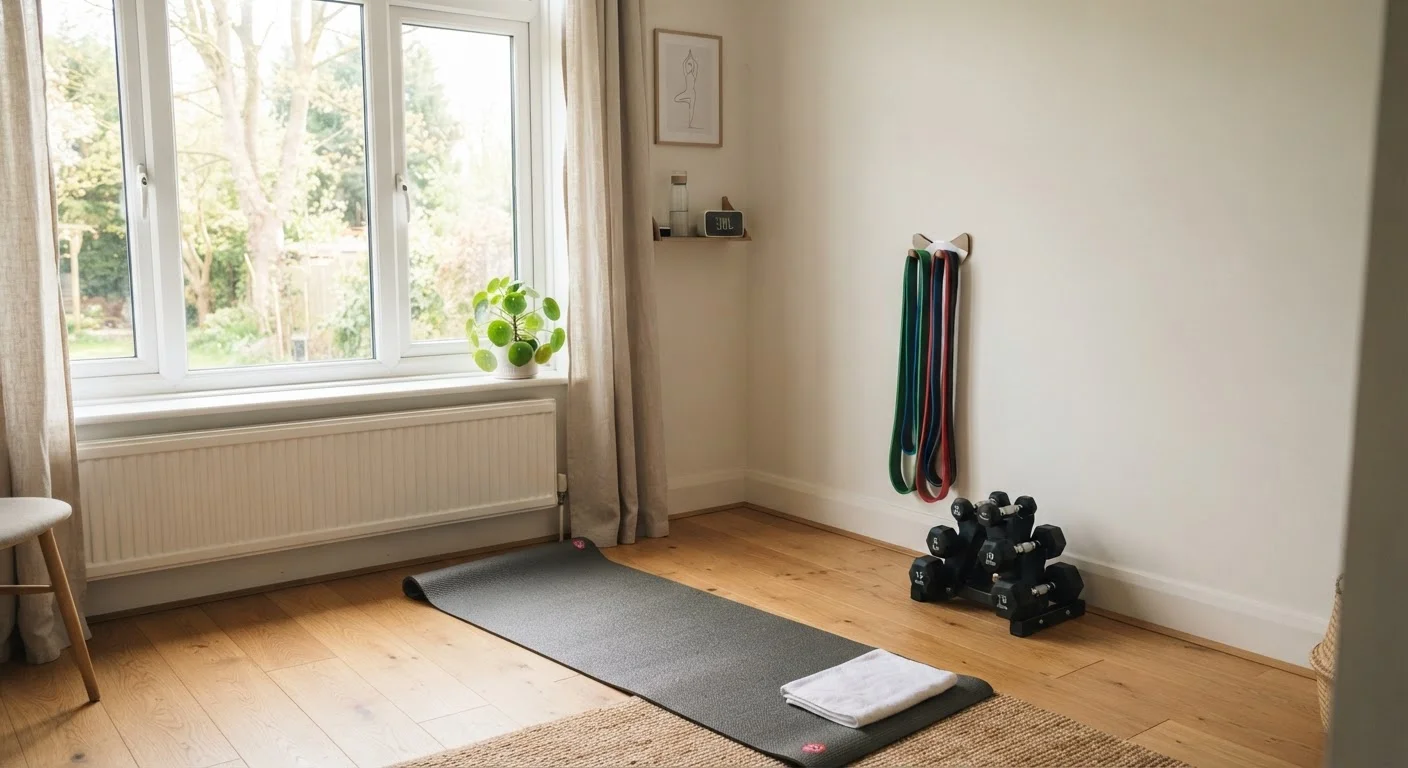
Store equipment so it's visible and accessible - gear buried in a closet rarely gets used. A small shelf, a wall hook, or even a dedicated corner keeps things orderly and removes friction from starting a session. Label or group items by use if sharing the space with others.
Ensure adequate ventilation and, where possible, natural light. These environmental factors have a measurable effect on exercise adherence over time. If you work a desk job and struggle to find workout time, a well-organized, ready-to-use home space significantly lowers the barrier to consistent movement - something desk workers in particular can benefit from.
This article is for general informational and educational purposes only. It is not a substitute for personalized advice from a qualified fitness professional or healthcare provider. If you have any health conditions, injuries, or concerns about beginning an exercise program, consult a qualified professional before starting.