

Key Takeaways
Why Sleep Hygiene Is Worth Taking Seriously
Sleep hygiene refers to the collection of behavioral and environmental practices that support consistent, restorative sleep. While the term can feel clinical, the underlying habits are straightforward - and a substantial body of research supports their effectiveness for most adults.
Poor sleep is associated with impaired memory consolidation, weakened immune response, mood dysregulation, and increased risk of chronic conditions over time. The good news is that many sleep difficulties are behaviorally driven, which means they're also behaviorally addressable. Sleep hygiene won't resolve every sleep disorder - conditions like insomnia disorder or sleep apnea require professional evaluation - but for everyday adults looking to sleep better, these practices are a sensible starting point.
This article covers evidence-informed habits that hold up to scrutiny, along with honest context about what the research does and doesn't confirm. If you're also building a broader evening routine, see our guide to winding down when your brain won't quiet for complementary strategies.
This article is for general informational purposes only and is not a substitute for medical advice. If you have persistent sleep difficulties, please consult a qualified healthcare professional.
Core Practices Backed by Research
The following practices are consistently supported across sleep science literature. They address the two most influential levers: circadian rhythm (your body's internal clock) and sleep pressure (the drive to sleep that builds throughout the day).
Keep a consistent wake time, even on weekends
Your circadian rhythm is anchored primarily by your wake time, not your bedtime. Sleeping in on weekends shifts this anchor, creating a form of social jet lag that can impair alertness and mood into the following week. Stability in wake time is one of the most consistently recommended strategies in sleep medicine.
Get morning light exposure within an hour of waking
Bright light in the morning helps set the circadian clock by suppressing residual melatonin and establishing a consistent timing signal. Research suggests even overcast outdoor light provides a stronger signal than most indoor lighting.
Avoid caffeine for at least six hours before your target bedtime
Caffeine blocks adenosine receptors, which are responsible for building sleep pressure throughout the day. With a half-life of five to six hours, caffeine consumed in mid-afternoon can still have a measurable effect on sleep onset and deep sleep stages by bedtime.
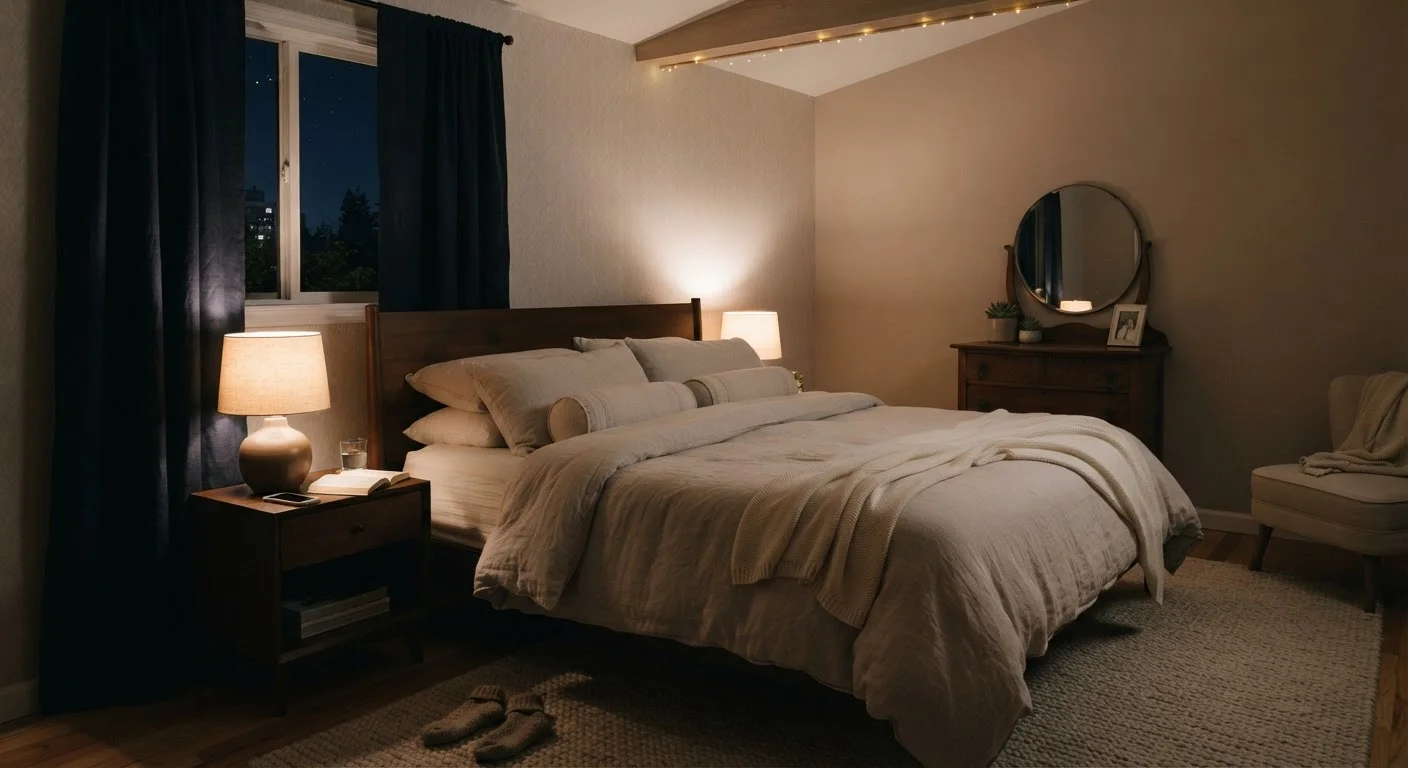
Keep your sleep environment cool, dark, and quiet
Core body temperature naturally drops during sleep initiation. A cooler room supports this process. Light and noise - even at low levels - can fragment sleep stages without fully waking you, reducing overall sleep quality.
Reserve your bed for sleep and intimacy only
Stimulus control - associating your bed exclusively with sleep - is one of the most evidence-supported behavioral strategies for insomnia and general sleep difficulty. Working, watching TV, or scrolling in bed can weaken the psychological association between bed and sleepiness.
~90 min
Melatonin delay from evening blue light exposure
Research published in peer-reviewed sleep journals has found that exposure to blue-wavelength light in the evening can delay melatonin onset by up to 90 minutes compared to dim light conditions.
1 in 3
U.S. adults not getting recommended sleep
The Centers for Disease Control and Prevention (CDC) has reported that approximately one-third of American adults regularly sleep less than the recommended seven hours per night.
5-6 hrs
Average caffeine half-life in the body
According to pharmacological research, caffeine has an average half-life of five to six hours in healthy adults, though individual metabolism varies considerably.
Your Sleep Environment and Evening Habits
Beyond timing, the conditions around sleep - your room, your pre-bed activities, and what you consume - interact directly with sleep quality. Research consistently points to a few modifiable environmental factors.
It's worth noting that no single habit works in isolation. Sleep responds to patterns rather than one-off efforts. If you're building these changes as part of a broader mental wellness approach, the guide to starting a mental wellness routine from scratch offers a useful framework for integrating sleep alongside other daily habits.
“Sleep is the single most effective thing we can do to reset our brain and body health each day. The evidence for this is overwhelming.”
— Matthew Walker, Professor of Neuroscience and Psychology, University of California, Berkeley; author on sleep science
Screen use before bed deserves particular attention. The connection between light exposure and melatonin suppression is one of the most replicated findings in sleep research. Dimming screens or switching to a warmer color temperature in the hour before bed is a low-effort adjustment with consistent support. For more on the difference between passive screen time and genuine rest, see why rest and relaxation aren't the same thing.
When Sleep Hygiene Isn't Enough
Sleep hygiene practices are appropriate for general sleep improvement in healthy adults, but they are not a treatment for clinical sleep disorders. Conditions such as obstructive sleep apnea, insomnia disorder, restless leg syndrome, and circadian rhythm disorders require professional evaluation and diagnosis. If you have experienced persistent difficulty falling or staying asleep for more than a few weeks, or if you frequently feel unrefreshed despite adequate time in bed, speak with a qualified healthcare provider.