

Key Takeaways
Why the Label Exists - and What It Can't Tell You
The Nutrition Facts label, regulated by the U.S. Food and Drug Administration (FDA), was designed to give consumers consistent, standardized information across packaged foods. It was updated most recently in 2016 to reflect current nutrition science and to make the most relevant numbers easier to read at a glance.
What the label can tell you: the nutrient composition of a food per serving, how that fits into general daily reference values, and how products compare to one another. What it cannot tell you is whether a food is right for your individual health needs. For personalized dietary guidance - especially if you manage a chronic condition - a registered dietitian or healthcare provider is your best resource.
Used as an educational tool rather than a rulebook, the label becomes genuinely useful. It pairs naturally with understanding what a balanced plate actually looks like at each meal.
What you will need
Step-by-Step: Reading Each Section of the Label
Work through the label from top to bottom. Each section builds on the one before it, so skipping ahead to a single number - say, calories - without context can be misleading.
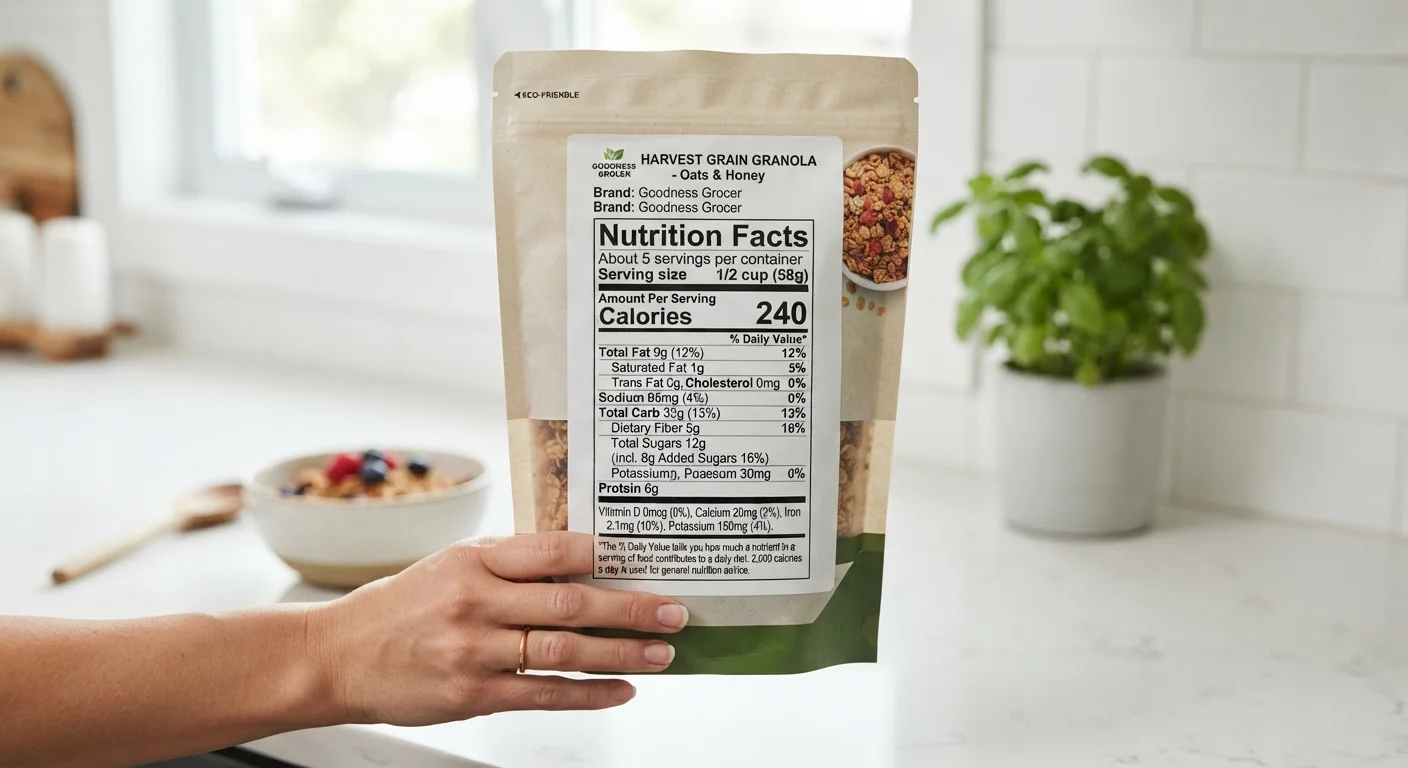
Start with serving size and servings per container
Every number on the label - calories, fat, sodium, everything - applies to one serving, not the entire package. The serving size is printed at the very top and reflects an amount the FDA considers a typical single-use portion, based on consumption data. It is not a recommendation.
Check the servings per container immediately below. A bag of chips labeled 150 calories with 3 servings per container contains 450 calories total. If you eat the whole bag, all figures on the label must be multiplied by three.
Look at calories in context
Calories measure the energy a food provides. The label displays calories prominently in large print. Rather than treating this as a pass/fail number, use it alongside your understanding of portion size. A 300-calorie food that provides substantial protein and fiber will affect your energy and fullness differently than 300 calories of a nutrient-light food.
Calories alone don't determine whether a food supports or hinders your health goals - nutrient density matters too.
Understand Percent Daily Value (%DV)
The % Daily Value column tells you what percentage of a day's recommended intake of each nutrient one serving provides, based on a standard 2,000-calorie diet. This reference point doesn't apply to everyone - calorie and nutrient needs vary by age, sex, activity level, and health status - but %DV is still useful for quick comparisons between products.
- 5% DV or less = low in that nutrient
- 20% DV or more = high in that nutrient
Read the fats section carefully
Total fat is broken down into subcategories: saturated fat, trans fat, and sometimes monounsaturated and polyunsaturated fats. Trans fat has no %DV because there is no safe established intake level - even small amounts are worth noting. Saturated fat has a %DV and most dietary guidelines recommend keeping it relatively low. Unsaturated fats are generally considered more favorable and are not specifically limited.
Distinguish total sugars from added sugars
Total sugars include both naturally occurring sugars (like those in milk or whole fruit) and sugars added during processing. Added sugars - which do carry a %DV - represent only what was introduced beyond what exists naturally. The American Heart Association and other health bodies suggest most Americans consume added sugars in excess of what current evidence supports for long-term health. A %DV of 20% or more for added sugars in a single serving is a meaningful signal worth noting. For more context on how to interpret sugar research, see separating nutrition science from sugar hype.
Check sodium, fiber, vitamins, and minerals
Sodium appears below the fat section. High sodium intake is associated with elevated blood pressure in some individuals; most packaged and processed foods contribute significantly to daily sodium totals. Use %DV to gauge how a single serving fits into your day.
Dietary fiber, vitamin D, calcium, iron, and potassium appear at the bottom of the label. These are nutrients public health data suggests many Americans don't get enough of. Higher %DV values here are generally favorable. Understanding which whole and minimally processed foods naturally supply these nutrients is worth exploring - see whole foods vs. processed foods for more context.
Use the Label as a Comparison Tool
You don't need to analyze every label exhaustively every time you shop. Instead, pick two or three nutrients most relevant to your eating habits - say, sodium and fiber - and use %DV to compare similar products quickly. This targeted approach keeps grocery shopping practical without becoming overwhelming.
Nutrients to Limit and Nutrients to Prioritize
The FDA organizes label nutrients into two broad categories based on typical American dietary patterns.
Generally limit: saturated fat, sodium, and added sugars. Most Americans consume these in excess relative to recommended intake levels. For a deeper look at the science behind sugar specifically, see the sugar debate explained.
Generally seek more of: dietary fiber, vitamin D, calcium, iron, and potassium - nutrients many Americans fall short on. A %DV of 20% or more is considered high; 5% or less is considered low. Use those thresholds as quick reference points when comparing similar products.
The Label Reflects a Reference Diet
All %DV figures are calculated against a 2,000-calorie daily reference diet established by the FDA. Your actual needs may be higher or lower depending on your age, body size, activity level, and health status. Use these figures for general comparison, not as a personal prescription. A registered dietitian can help translate label information into guidance suited to your specific situation.
Becoming familiar with these patterns makes grocery trips more efficient. You can build on this foundation with a weekly grocery nutrition checklist to keep your kitchen stocked with balance in mind.
This article is for general informational and educational purposes only and does not constitute medical or dietary advice. Consult a qualified healthcare professional or registered dietitian for guidance specific to your health needs.