

Key Takeaways
Option A
HMO (Health Maintenance Organization)
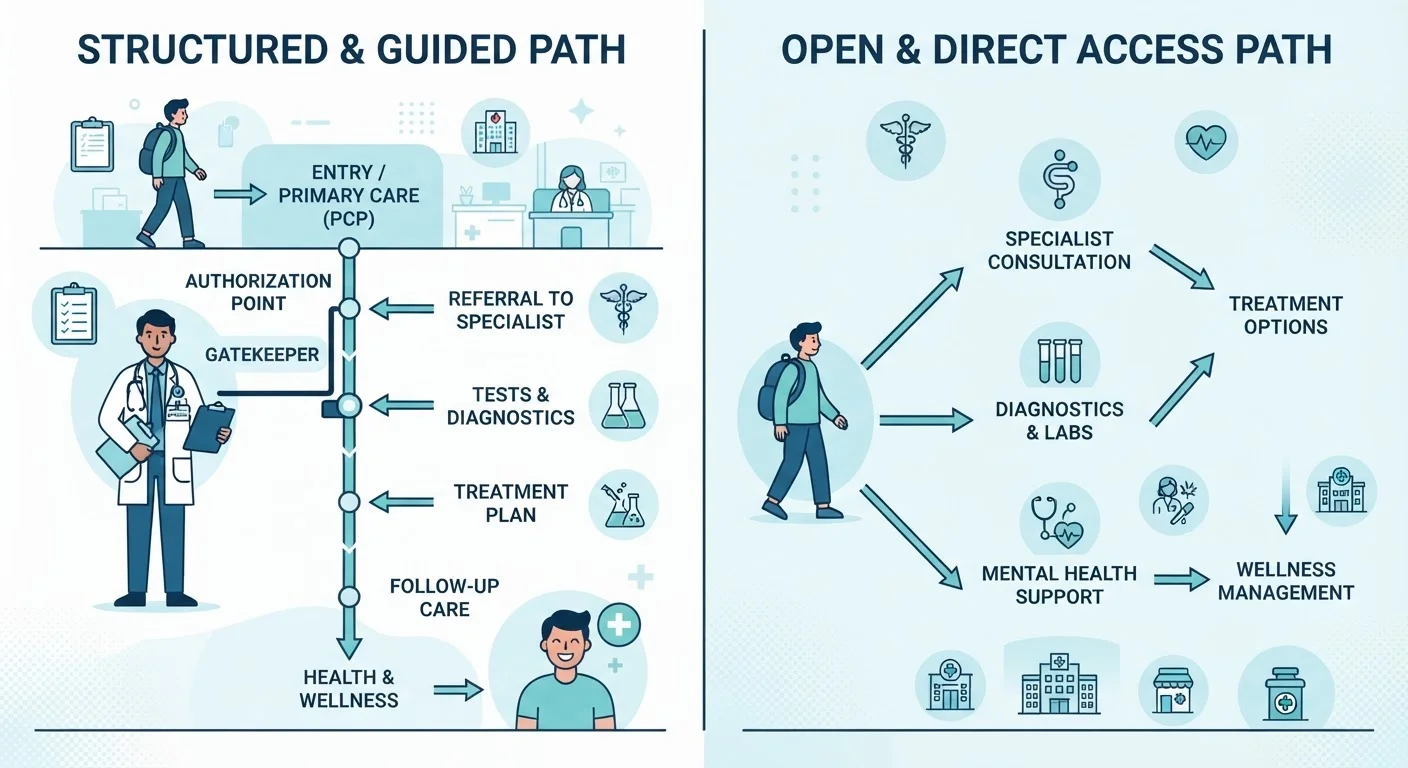
The structured, coordinated-care approach.
Best for: People who want lower premiums and don't mind working through a primary care physician to access specialists.
Option B
PPO (Preferred Provider Organization)
The flexible, open-access alternative.
Best for: People who want the freedom to see specialists or out-of-network providers without a referral.
If you want to keep monthly costs down and don't have complex care needs
HMO
HMOs generally offer lower premiums and predictable copays, making them a practical choice for people who use healthcare infrequently and are comfortable with a coordinated-care model.
If you manage a chronic condition and see multiple specialists regularly
PPO
PPOs allow direct access to specialists without referrals, which can reduce friction and delays when ongoing, multi-provider care is part of your routine.
If you travel frequently or split time between states
PPO
PPOs typically cover out-of-network care at a partial rate, giving you more options when your regular network providers are not accessible.
If you prefer a single doctor to oversee your overall health
HMO
The HMO model is built around a primary care physician relationship, which can mean more coordinated, consistent care over time.
The Core Structural Difference
Both HMOs and PPOs are types of managed care plans, but they manage care in very different ways. The distinction isn't just administrative - it affects which doctors you can see, whether you need permission to see a specialist, and how much you'll pay when something unexpected happens.
An HMO operates around a defined network of providers. You select a primary care physician (PCP) who becomes your medical home base. That doctor handles routine care and, critically, issues referrals when you need to see a specialist. If you go outside the HMO's network without an approved referral, the plan generally won't pay - except in a genuine emergency.
A PPO also has a preferred network, but the walls are lower. You can see any provider you choose - in-network or out-of-network - without a referral. In-network visits cost less, but out-of-network care is covered at a reduced rate rather than excluded entirely. This flexibility is the PPO's defining feature, and it's the main reason PPO premiums tend to be higher.
| Criterion | HMO | PPO |
|---|---|---|
| Primary care physician required | Yes, required | No, optional |
| Referrals needed for specialists | Yes, typically required | No referral needed |
| Out-of-network coverage | Emergency only | Yes, at higher cost-sharing |
| Monthly premiums | Generally lower | Generally higher |
| Network size | Smaller, defined network | Larger, more flexible network |
| Care coordination | Centralized through PCP | Self-directed by patient |
| Predictability of costs | Higher predictability | More variable, especially out-of-network |
What This Means Day-to-Day
In practical terms, the HMO model means more coordination but also more steps. If your knee is bothering you and you want to see an orthopedist, you typically start with your PCP, get a referral, and then book with an in-network specialist. That path can feel cumbersome, but it also means someone is tracking your overall care picture. Many people find that relationship with a single PCP genuinely useful.
With a PPO, you can call the orthopedist directly. There's no gatekeeper. If you want a second opinion at a well-regarded clinic that happens to be out-of-network, you can get it - you'll just pay a larger share of the bill. Understanding exactly how those costs stack up is important; our article on how deductibles, copays, and coinsurance work together explains the mechanics in detail.
~47%
US employer plan enrollees in PPOs
According to KFF's annual Employer Health Benefits Survey, PPOs consistently enroll the largest share of covered workers among all plan types.
~13%
US employer plan enrollees in HMOs
KFF employer survey data shows HMO enrollment has remained a smaller but stable share of employer-sponsored coverage in recent years.
It's also worth knowing that surprise bills can occur under either plan type. In-network facilities can still involve out-of-network providers, such as an anesthesiologist you didn't choose yourself. Federal protections under the No Surprises Act limit some of this exposure, but it's a factor to be aware of regardless of plan type.
Cost Trade-Offs to Weigh
On the premium side, HMOs are generally less expensive month to month. Their tighter networks allow insurers to negotiate more aggressively with a smaller set of providers, and the referral requirement helps control utilization. That cost discipline gets passed on, at least partially, to enrollees.
PPO enrollees pay for flexibility. Higher monthly premiums are the obvious cost, but out-of-network cost-sharing can add up fast if you use it frequently. A plan might cover 70% of an out-of-network bill after you meet a separate out-of-network deductible - meaning you owe 30% of whatever the insurer considers a reasonable charge, which may be less than what the provider actually bills.
Out-of-Network Billing: Read the Fine Print
PPO plans cover out-of-network care, but the insurer's payment is based on what it considers an 'allowable' or 'reasonable' charge - not necessarily what the provider bills. The gap between those two figures, sometimes called balance billing, can result in larger out-of-pocket costs than enrollees expect. Before seeing an out-of-network provider, it's worth calling the insurer to understand what cost-sharing will apply.
If a high-deductible structure is on the table for you, it's worth understanding that both HMOs and PPOs can be structured as high-deductible health plans. The HDHP and HSA pairing has its own logic that interacts with whichever network model you choose.
When comparing plans during open enrollment, don't look at premiums alone. Run a realistic scenario: what would you pay in a typical year given your expected doctor visits, prescriptions, and any planned procedures? The open enrollment checklist can help you do that comparison methodically.
This article provides general health insurance information for educational purposes only and is not personalized insurance, financial, or legal advice. Coverage terms, costs, and network rules vary by plan and insurer. Always read your plan documents carefully and consult a licensed insurance agent or adviser for guidance specific to your situation.