

Key Takeaways
HDHP + HSA Pairing
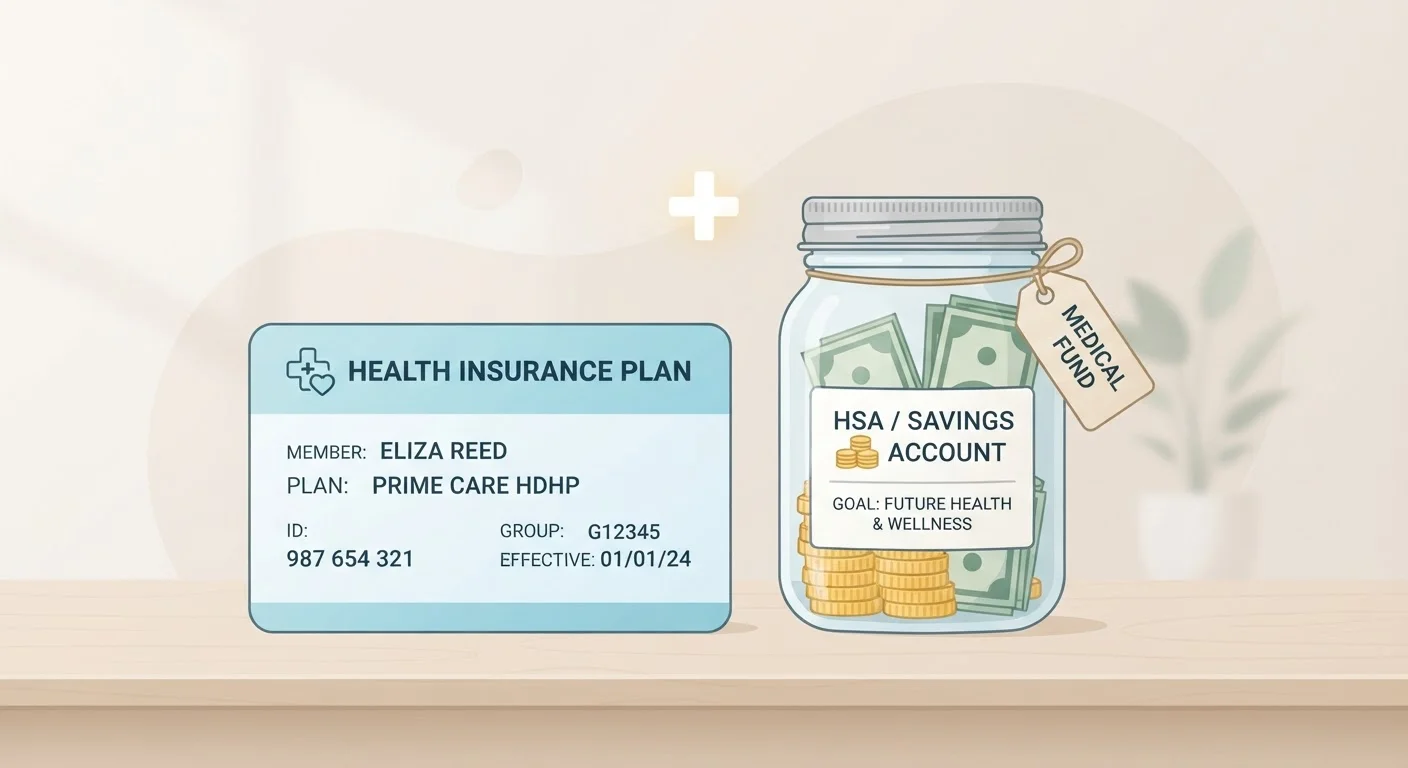
A High-Deductible Health Plan (HDHP) is a type of health insurance with lower monthly premiums but a higher deductible - meaning you pay more out of pocket before the plan starts covering most costs. A Health Savings Account (HSA) is a tax-advantaged savings account that can only be opened alongside an eligible HDHP. Together, they form a coordinated strategy: the HDHP keeps your premium low, and the HSA helps you set aside pre-tax money to cover the costs the plan doesn't pay right away.
The IRS sets minimum deductible thresholds and maximum out-of-pocket limits each year that a plan must meet to qualify as an HDHP for HSA-eligibility purposes. These figures are adjusted annually for inflation.
What Makes a Plan an HDHP
The term "high-deductible health plan" is a specific IRS designation, not just a description. Each year the IRS publishes minimum deductible amounts and maximum out-of-pocket limits that a plan must meet to qualify. As a general rule, HDHPs carry deductibles meaningfully higher than traditional plans, which is why monthly premiums tend to be lower - you are taking on more of the upfront financial risk.
Once you meet your deductible, the plan typically covers most remaining costs in the same way other health insurance does. Many HDHPs still cover preventive care - such as annual checkups and certain screenings - before the deductible is met, as required under the Affordable Care Act for in-network services.
For a broader look at how health coverage structures work, see our plain-language overview of US health insurance. And if you want to understand how your deductible interacts with copays and coinsurance throughout the year, this guide explains how those costs stack up.
How the HSA Fits In
An HSA is a savings account with three layers of tax benefit: contributions go in pre-tax (or are tax-deductible if made outside of payroll), the balance grows tax-free, and withdrawals for qualified medical expenses are also tax-free. That triple advantage is what makes the account unusual compared with most savings tools.
Crucially, you can only open and fund an HSA when you are enrolled in an HSA-eligible HDHP. The account belongs to you - not your employer - so it moves with you if you change jobs. There is no deadline to spend the money; balances accumulate indefinitely.
57%
Workers with employer coverage offered an HDHP
According to the Kaiser Family Foundation's Employer Health Benefits Survey, a majority of covered workers are offered at least one HDHP option by their employer.
3-in-1
Tax advantages built into an HSA
HSAs are the only savings vehicle with a pre-tax contribution, tax-free growth, and tax-free withdrawal for qualified expenses - commonly called a "triple tax benefit."
No deadline
HSA funds carry over each year
Unlike FSAs, HSA balances face no annual forfeiture rule - unused funds remain in the account indefinitely and can be invested and grown over time.
The annual contribution limits are set by the IRS and differ for individual and family coverage. Contributions can come from you, your employer, or both - but the combined total cannot exceed the annual limit.
The Logic of the Pairing
The HDHP-HSA combination is built on a straightforward trade-off: you accept a higher deductible in exchange for a lower premium, then use the premium savings - along with dedicated HSA contributions - to build a reserve that covers routine and unexpected costs before insurance steps in.
Start Contributing Early in the Plan Year
If you enroll in an HDHP, try to make HSA contributions as early as possible - ideally from your first paycheck. Building a cushion before you need care reduces the risk of an unexpected bill catching you underprepared. Even small, consistent contributions add up quickly across a plan year.
In practice this means your HSA becomes the first line of payment for most everyday medical expenses. Because you control those funds and spend them on actual costs (rather than pre-paying through a higher premium), some people find they spend less overall in years when medical needs are modest.
This approach differs significantly from a traditional low-deductible plan, where the insurer shares costs from an early point but charges more each month regardless of whether you use care. If you are weighing different plan structures, comparing HMO and PPO arrangements can also be a useful starting point, since HDHPs can be structured either way.
Real Considerations Before Choosing This Combination
The pairing is not ideal for everyone. If you expect significant medical costs - frequent specialist visits, ongoing prescriptions, or a planned procedure - the higher deductible could result in more out-of-pocket spending than a plan with richer up-front coverage. It is worth running through realistic scenarios before enrolling.
Liquidity also matters. An HSA balance helps, but it takes time to build. If you enroll in an HDHP without adequate savings to cover the deductible in an emergency, you could face a financial strain. The HSA's long-term accumulation benefit is real, but it requires contributions over time.
People who are generally healthy, have steady income, and can make consistent HSA contributions often find the combination works in their favor over several years. Those with chronic conditions, frequent care needs, or limited cash reserves may find a lower-deductible plan reduces financial unpredictability - even at a higher monthly premium.
This article provides general information only and is not personalized insurance, financial, or tax advice. Coverage terms, IRS limits, and plan availability vary. A licensed insurance agent or financial adviser can help you evaluate which approach fits your circumstances.
This article is for general informational and educational purposes only and does not constitute personalized insurance, financial, legal, or tax advice. Coverage rules, IRS contribution limits, and plan structures vary and change over time. Always consult a licensed insurance professional, financial adviser, or tax professional regarding decisions specific to your situation.