

Key Takeaways
Dollar-Cost Averaging
Dollar-cost averaging (DCA) is an investment strategy where you invest a fixed dollar amount at regular intervals - say, every week or month - regardless of what the market is doing. Because you're spending the same amount each time, you automatically buy more shares when prices are low and fewer shares when prices are high. Over time, this can result in a lower average cost per share compared to buying everything at once at the wrong moment.
DCA does not guarantee a profit or protect against loss in declining markets. Research, including studies by Vanguard, has found that lump-sum investing outperforms DCA on average over long periods, but DCA reduces timing risk and emotional decision-making.
How Dollar-Cost Averaging Works
The mechanics of dollar-cost averaging are straightforward. You decide on a fixed amount - say $200 - and invest it in the same fund or asset on the same day each month. When the share price is $20, your $200 buys 10 shares. When the price drops to $16, your $200 buys 12.5 shares. When it rises to $25, you get 8 shares.
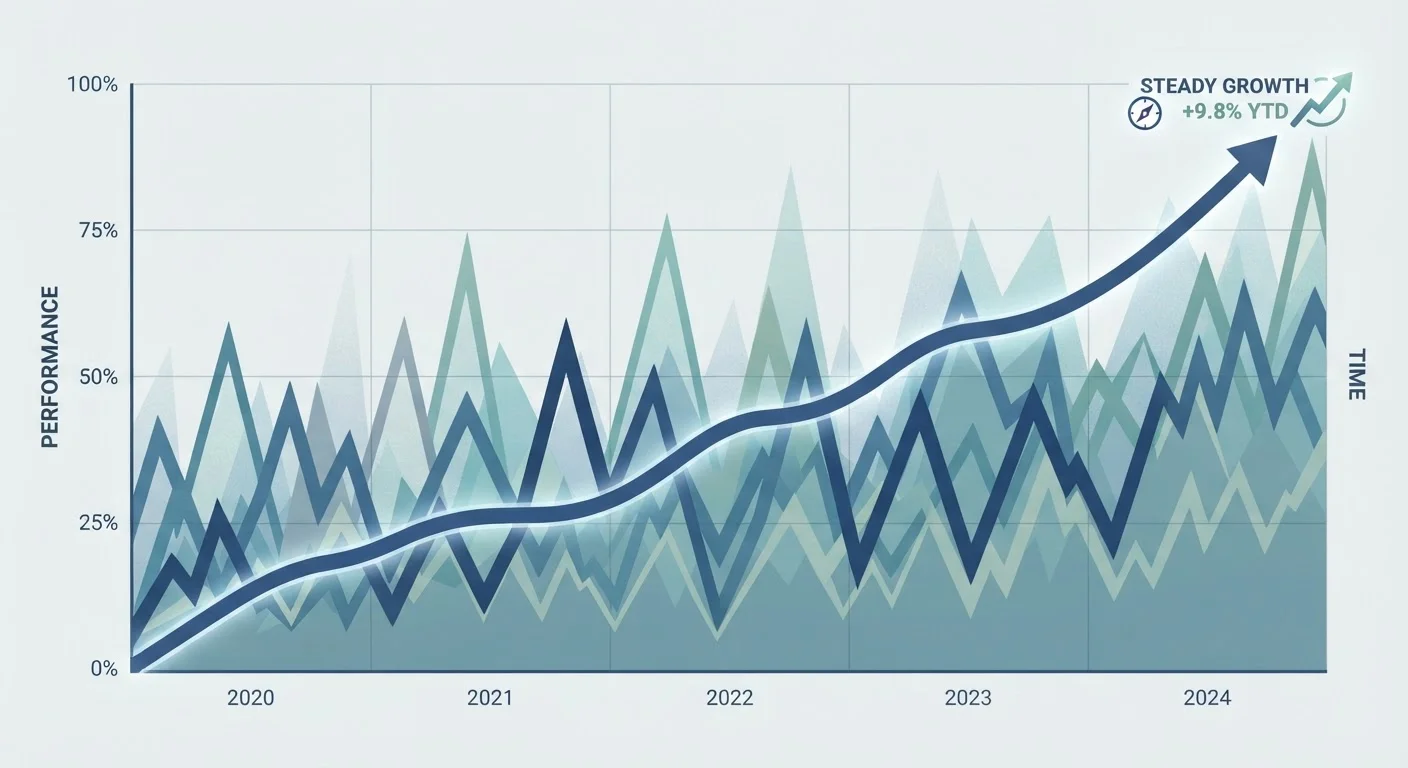
Over several months, your average cost per share reflects a blend of high and low prices, which is almost always lower than if you had tried to buy all your shares at a single price point. This is the core arithmetic advantage of DCA: it smooths out the impact of short-term price swings without requiring you to predict them.
This approach pairs naturally with automated investing. Just as automating your savings removes willpower from the equation, automating DCA contributions ensures you invest even when headlines make markets feel frightening.
Make It Automatic to Make It Stick
Set up automatic transfers from your checking account to your investment account on the same day each month - ideally the day after payday. Once contributions are automated, you remove the monthly temptation to skip investing when markets feel uncertain. Consistency is the engine that makes dollar-cost averaging work.
The Emotional Case for DCA
One of investing's most persistent enemies isn't a bad market - it's the investor's own reaction to one. Studies in behavioral finance consistently show that individual investors tend to buy when markets are rising (driven by optimism) and sell when they're falling (driven by fear). This pattern - buying high and selling low - erodes returns over time.
DCA acts as a behavioral guardrail. Because you commit to a fixed schedule and amount in advance, there's no decision to make each month. You don't have to assess whether now is a good time to invest. The strategy removes that judgment call entirely.
This is also why avoiding common early investing errors - like pausing contributions during downturns - is so critical. Stopping DCA during a market dip is precisely the moment when continuing has the most potential benefit.
DCA Is Already Built Into Most 401(k)s
If your employer deducts retirement contributions from every paycheck, you're already practicing dollar-cost averaging without having to think about it. This automatic, recurring structure is one reason 401(k) plans are widely regarded as an effective savings vehicle - they remove timing decisions from the process entirely.
DCA vs. Lump-Sum Investing: An Honest Comparison
DCA has real advantages, but intellectual honesty requires acknowledging its trade-offs. If you receive a large sum of money - an inheritance, a bonus, or the proceeds from a home sale - research suggests that investing it all at once tends to produce better results than spreading it out over time, roughly two-thirds of the time historically. The reason is simple: in a market that generally rises over the long run, the sooner money is invested, the more time it has to grow.
That advantage of compound growth is explained in detail in our piece on how compound interest builds long-term wealth. Time in the market, not timing the market, is the dominant factor.
However, lump-sum investing carries a specific risk: if you invest everything right before a significant market decline, the psychological and financial impact can be severe enough to cause you to sell at a loss. For many people, DCA's lower volatility makes it the strategy they can actually stick with - and sticking with a strategy consistently is often more valuable than the theoretically optimal one you abandon under stress.
~66%
Frequency lump-sum investing outperforms DCA
Vanguard research found that investing a lump sum immediately outperformed dollar-cost averaging over 12-month periods approximately two-thirds of the time across U.S., U.K., and Australian markets.
$7 trillion+
Assets held in U.S. 401(k) plans
According to the Investment Company Institute, Americans hold trillions in 401(k) accounts - the majority funded through automatic payroll contributions, a built-in form of dollar-cost averaging.
20+ years
Typical DCA advantage horizon
Financial planners generally note that the behavioral and risk-reduction benefits of DCA are most meaningful over multi-decade investment horizons, particularly for retirement savers.
Building DCA Into Your Financial Plan
For most Americans, dollar-cost averaging doesn't require a new account or a complex setup. If you contribute to a workplace 401(k), you're already doing it - a fixed percentage of each paycheck flows into your retirement account on a regular schedule. The same principle applies to IRAs or taxable brokerage accounts when you set up automatic monthly contributions.
The practical foundation is a budget that carves out a consistent investment amount each month. If you haven't yet structured your monthly spending, the step-by-step monthly budgeting process is a useful starting point for identifying how much you can reliably invest. Understanding your fixed versus variable expenses makes it easier to carve out a stable investment contribution.
The goal isn't to find the perfect entry point into the market - it's to build the habit of consistent investing across time, across market conditions, and across life changes. That consistency, compounded over years, is where the real benefit of dollar-cost averaging lies.
This article is for informational and educational purposes only and does not constitute personalized investment, financial, or tax advice. Past investment performance does not guarantee future results. Consult a qualified financial adviser before making investment decisions based on your individual circumstances.