

Key Takeaways
Option A
Debt Snowball
The motivation-first approach to debt repayment.
Best for: People who need early wins to stay engaged and build repayment momentum.
Option B
Debt Avalanche
The mathematically optimal path to debt freedom.
Best for: People who can stay disciplined without frequent milestones and want to minimize total interest paid.
If you've struggled to stick with repayment plans in the past
Debt Snowball
Paying off smaller accounts quickly provides tangible proof of progress, which research on behavioral finance suggests improves follow-through.
If minimizing total interest paid is your top priority
Debt Avalanche
By attacking high-interest balances first, you reduce the amount of interest accruing each month, lowering your total repayment cost.
If your debts carry similar interest rates but vary in balance size
Debt Snowball
When rates are close, the interest-cost difference between methods shrinks, making the motivational boost of quick payoffs more valuable.
If you carry one or two very high-rate balances alongside moderate ones
Debt Avalanche
A single high-APR balance can generate significant interest each month; eliminating it early produces meaningful savings that outweigh delayed motivational milestones.
How Each Strategy Works
Both the debt snowball and the debt avalanche share the same core mechanic: you make minimum payments on all your debts, then direct any extra money toward one target debt. Once that debt is eliminated, you roll its former payment into the next target - building force with each account you close. The critical difference is how you rank those targets.
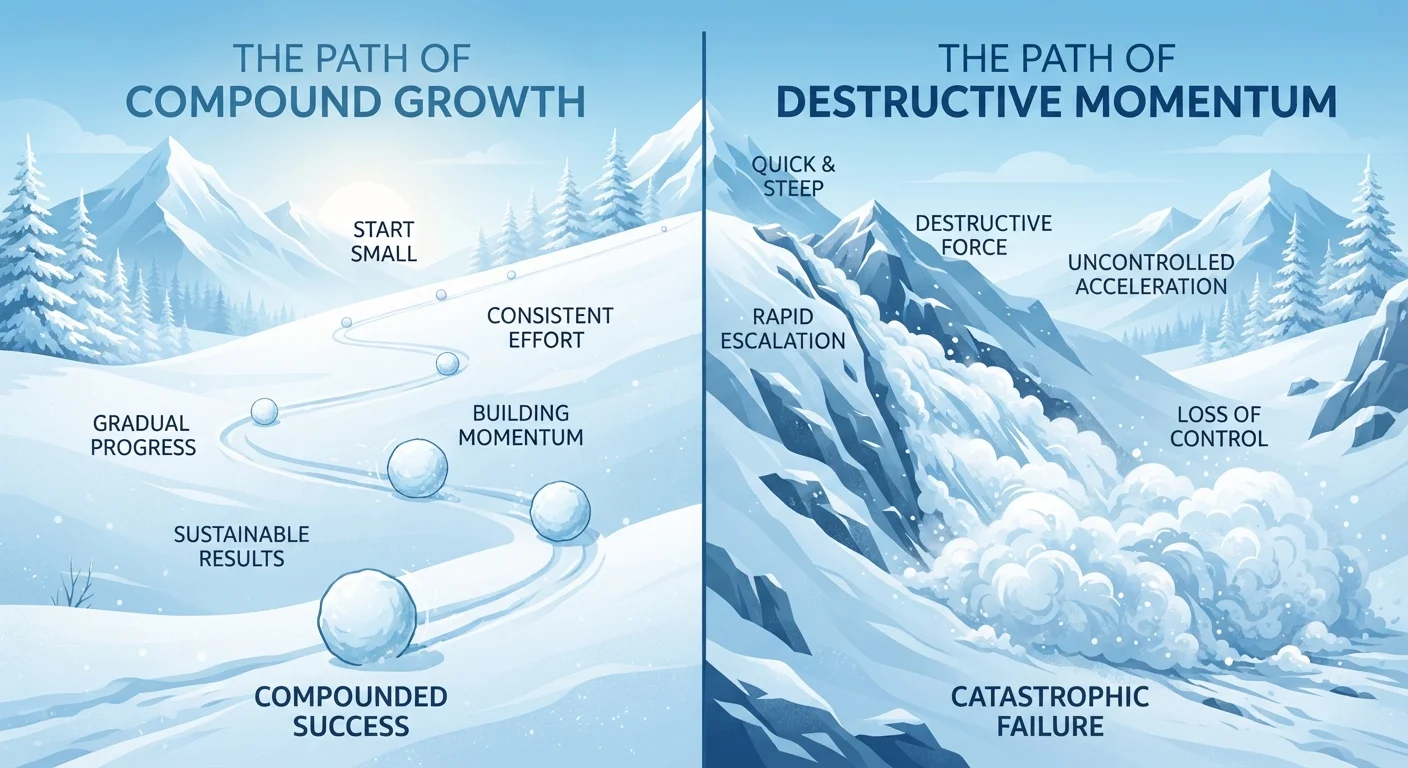
Debt Snowball: You rank debts from smallest balance to largest, regardless of interest rate. You attack the smallest first. Once it's gone, you take that freed-up payment and add it to the next-smallest debt. The balances get larger, but so does the payment you're applying - like a snowball rolling downhill and growing in size.
Debt Avalanche: You rank debts from highest interest rate (APR) to lowest. You attack the costliest debt first. This approach doesn't deliver payoffs as quickly in most cases, but it minimizes the total interest that accumulates across your repayment timeline.
| Criterion | Debt Snowball | Debt Avalanche |
|---|---|---|
| Repayment order | Smallest balance first | Highest interest rate first |
| Primary advantage | Faster early wins, stronger motivation | Lower total interest paid over time |
| Best psychological fit | Needs visible milestones to stay motivated | Can sustain effort without frequent payoffs |
| Total cost | Potentially higher if rates vary widely | Typically lower when rates differ significantly |
| Time to first payoff | Often faster | Often slower if high-rate debt is large |
| Complexity | Simple to rank and execute | Requires tracking APRs, equally straightforward |
For a broader look at structuring your money across competing priorities, see our budgeting basics hub for practical frameworks.
The Case for the Snowball: Psychology Over Math
The debt snowball became widely recognized in part because it acknowledges something the pure math ignores: most people don't fail at debt repayment because they lack financial knowledge - they fail because motivation collapses before the finish line.
Paying off a $400 medical bill or a $600 store card in the first few months delivers a concrete result. That closed account is real evidence that the plan is working. Behavioral research consistently shows that completing sub-goals reinforces continued effort on larger ones - a principle the snowball method is designed to exploit.
~$300B
U.S. revolving consumer debt outstanding
Federal Reserve data consistently shows hundreds of billions in revolving balances carried by American households, underscoring the scale of the challenge repayment strategies address.
20%+
Average credit card APR in recent years
According to Federal Reserve consumer credit data, average credit card interest rates have been above 20% in recent periods, making high-rate balance targeting increasingly impactful.
The trade-off is cost. If your smaller-balance debts carry lower interest rates than a large balance you're deferring, interest continues compounding on that higher-rate debt while you work through the queue. Depending on your specific balances and rates, this could mean paying meaningfully more overall.
The snowball works best when you have several small accounts that can be cleared relatively quickly, when past attempts at debt repayment have stalled, or when the psychological toll of debt is affecting your daily decision-making.
The Case for the Avalanche: Minimizing Cost
The debt avalanche is the approach most financial educators point to when the goal is minimizing total dollars paid. Because interest compounds continuously, a high-APR balance sitting unpaid generates more new debt every single month. Eliminating that balance first stops the bleeding at its source.
Consider a scenario where someone carries a credit card at 24% APR alongside an auto loan at 6% APR. Every month the high-rate card isn't being aggressively paid down, a significant share of their minimum payment is simply covering interest - not reducing principal. The avalanche method addresses this directly.
The challenge is patience. If your highest-interest debt also carries a large balance, it may take many months before you experience a complete payoff. During that time, account closures - the motivational milestones the snowball delivers - are absent. People who are goal-oriented and can track incremental progress (such as watching their principal drop each month) tend to sustain the avalanche more comfortably.
It's also worth noting that an avalanche doesn't require perfect execution. If you slip one month, you haven't derailed the strategy - you simply resume with the same target. Common myths about paying off debt faster is a useful read if you're weighing approaches and want to separate fact from folklore.
When Your Highest-Rate Debt Is Also Your Largest
In some debt profiles, the highest-interest account is also the one with the largest balance - meaning the avalanche's first payoff could be months or years away. In these cases, a hybrid approach can help: use the snowball to eliminate one or two small accounts quickly, then shift to avalanche ordering. This isn't a formal method, but it balances motivation and cost-efficiency for complex debt situations.
Choosing the Right Method - and Staying the Course
There's no universal answer. The best debt repayment strategy is the one you'll actually follow through on. If you're genuinely uncertain, consider your debt profile: how many accounts do you have, how close are the interest rates to one another, and how long will it likely take to close your first account under each method?
If the rates across your debts are similar, the mathematical advantage of the avalanche shrinks, making the snowball's motivational edge more compelling. If one debt carries a dramatically higher rate - say a payday loan or a penalty-rate credit card - the avalanche's cost savings become harder to ignore.
Whichever path you choose, a few principles apply to both: don't open new revolving credit during repayment, avoid dipping into targeted extra payments for discretionary spending, and consider whether a small emergency fund should be in place before you begin. Saving while in debt explores that trade-off in depth. If your debt load feels genuinely unmanageable, signs your debt has become unmanageable outlines when professional guidance may be warranted.
For some households, neither method alone is sufficient - debt consolidation may be worth understanding as a complementary tool that restructures multiple balances before applying a repayment strategy. As with all personal finance decisions, consider speaking with a qualified financial adviser about your specific situation.
This article is for general informational purposes only and does not constitute personalized financial or legal advice. Consult a licensed financial professional before making decisions about your debt repayment approach.