

Key Takeaways
Pet Food Label
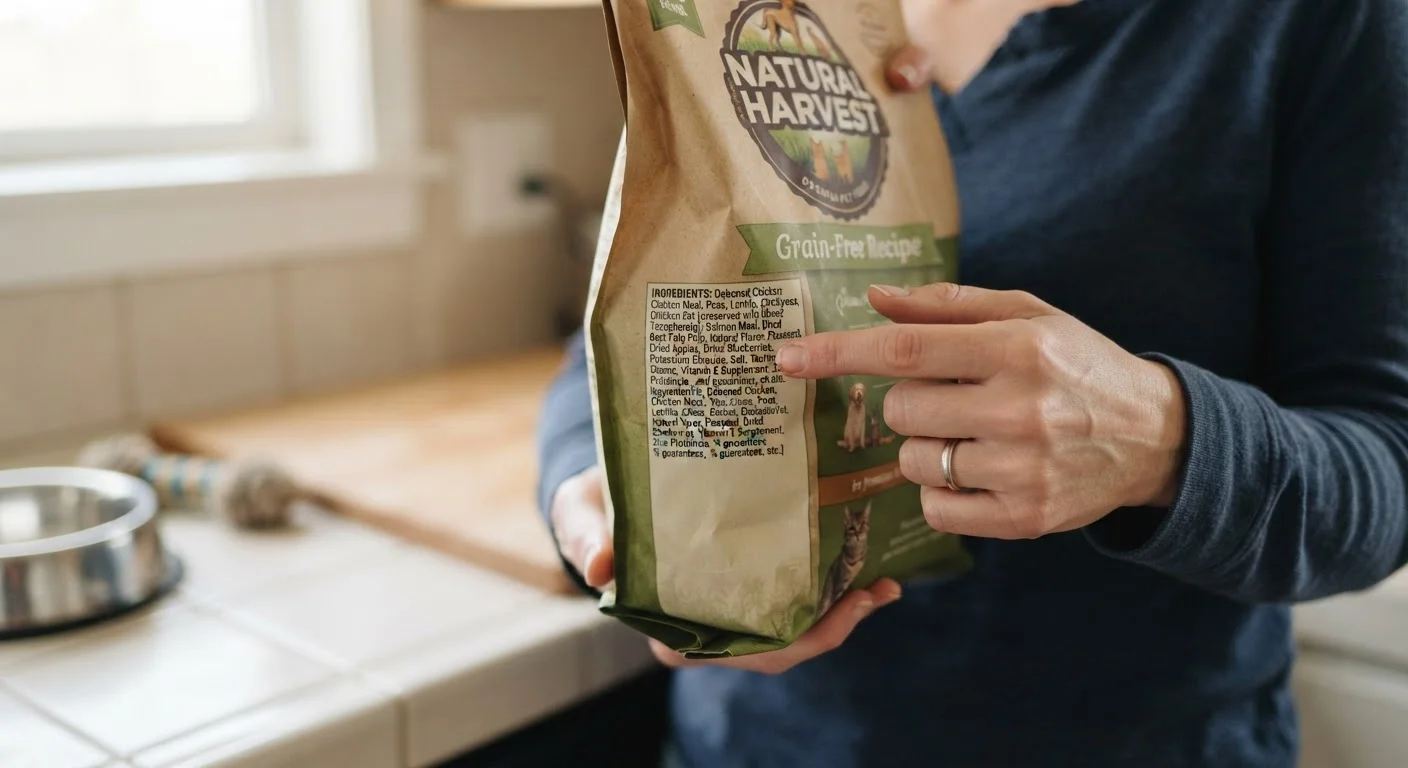
A pet food label is the regulated information printed on commercial pet food packaging. It includes the product name, ingredient list, guaranteed analysis, feeding guidelines, and a nutritional adequacy statement. Together, these sections tell you what's in the food, how much of each nutrient it provides, and whether it's formulated to meet established nutritional standards.
In the United States, pet food labeling is governed by the FDA and guided by model regulations set by the Association of American Feed Control Officials (AAFCO). Individual states may adopt AAFCO guidelines, so compliance can vary slightly by jurisdiction.
Why the Ingredient List Doesn't Tell the Whole Story
Most pet owners instinctively go straight to the ingredient list when evaluating a new food. That's a reasonable starting point, but the ingredient list alone is one of the most misunderstood sections on the bag. Ingredients are listed in descending order by pre-cooking weight - meaning moisture content influences ranking as much as nutritional contribution does.
Fresh chicken, for example, is roughly 70% water. It may appear first on the list, but after moisture is cooked off during processing, the actual protein contribution may be smaller than a dry ingredient listed lower down. This doesn't make fresh chicken a bad ingredient - it simply means ingredient position isn't a straightforward proxy for nutritional quality.
"Meat meal" ingredients - such as chicken meal, salmon meal, or turkey meal - are rendered and dehydrated, concentrating protein into a denser form. A food with chicken meal as its second ingredient may deliver more total protein than one with fresh chicken listed first. Understanding this distinction helps you evaluate labels more accurately without being misled by positioning alone.
"Natural" and "Organic" Have Limits
The term "natural" on a pet food label has a definition under AAFCO guidelines - it generally means ingredients derived solely from plant, animal, or mined sources without chemically synthetic processes. However, "holistic," "premium," and similar terms have no regulated definition and carry no nutritional guarantee. Don't let front-of-pack marketing language substitute for reading the regulated back panel.
The AAFCO Statement: The Most Important Line on the Label
Tucked near the bottom of most pet food labels is a statement that many owners overlook entirely - and it's arguably the most important piece of information on the package. The AAFCO nutritional adequacy statement tells you whether the food is formulated to be complete and balanced for a specific life stage.
There are two ways a manufacturer can earn this statement. The first is by formulating the food to meet AAFCO's published nutrient profiles for a given life stage. The second - considered a higher standard by many veterinary nutritionists - is completing AAFCO feeding trials, which involve actually feeding the food to animals over a defined period and monitoring health outcomes.
The statement also specifies the applicable life stage: growth (puppies or kittens), maintenance (adult animals), reproduction, or all life stages. A food labeled for "all life stages" must meet the nutrient requirements for the most demanding stage - growth - which means it may contain higher levels of certain nutrients than a healthy adult animal needs.
Check the Life Stage Before You Buy
Always verify that the AAFCO statement matches your pet's current life stage before purchasing a new food. A food formulated for 'all life stages' is designed to meet the requirements of the most nutritionally demanding stage - growth - and may not be the most appropriate choice for a healthy, non-reproducing adult. When transitioning foods or life stages, your veterinarian can help confirm the right choice for your specific pet.
For guidance on how diet format interacts with nutritional content, see our overview of dry, wet, and raw diet trade-offs.
Decoding the Guaranteed Analysis
The guaranteed analysis panel lists four core nutrients: crude protein (minimum), crude fat (minimum), crude fiber (maximum), and moisture (maximum). These are regulatory figures - they tell you the floor or ceiling for each nutrient, not the precise amount in every bag.
One important limitation: because wet and dry foods have very different moisture levels, comparing guaranteed analysis numbers directly between the two formats is misleading. To make a fair comparison, nutritionists use a calculation called dry matter basis - which removes moisture from the equation and expresses nutrients as a percentage of the dry content only.
70-82%
Typical moisture content in canned pet food
According to AAFCO guidelines, canned (wet) pet foods commonly contain 70-82% moisture, versus roughly 10% in dry kibble - a key reason guaranteed analysis figures can't be compared directly between formats.
2
AAFCO methods for nutritional adequacy claims
A manufacturer may demonstrate nutritional adequacy either by formulating to AAFCO nutrient profiles or by conducting AAFCO feeding trials - two distinct standards with different levels of real-world validation.
The guaranteed analysis doesn't measure digestibility, bioavailability, or ingredient quality - only nutrient levels. Two foods with identical guaranteed analysis numbers may differ significantly in how well a pet absorbs and uses those nutrients. This is one reason a veterinarian's input is valuable when selecting a diet for a pet with specific health needs. If your pet has a diagnosed condition, our article on prescription diets versus over-the-counter options explains when standard commercial food may not be sufficient.
Putting It All Together as a Label Reader
Reading a pet food label confidently means using all three major sections together - ingredient list, AAFCO statement, and guaranteed analysis - rather than relying on any one in isolation. The ingredient list gives you a general sense of the food's primary protein and carbohydrate sources. The AAFCO statement confirms nutritional completeness and life stage appropriateness. The guaranteed analysis allows rough nutrient comparisons across products.
Marketing language on the front of the package - words like "natural," "holistic," or "premium" - carries no regulated nutritional meaning in most jurisdictions. Focus on the back panel where the regulated information lives. Similarly, the order of ingredients matters less than whether the food as a whole meets your pet's life stage requirements as validated by AAFCO.
Your veterinarian is the best resource for evaluating whether a specific diet is appropriate for your individual pet, especially if they have health conditions, weight concerns, or are at a sensitive life stage. For a broader look at responsible pet ownership decisions, including how nutrition fits into overall care, explore our pet ownership hub. You can also find more pet health guidance covering wellness, vet care, and common conditions.
This article is for general informational and educational purposes only and is not a substitute for professional veterinary advice. Consult your veterinarian for guidance tailored to your pet's individual health needs.