

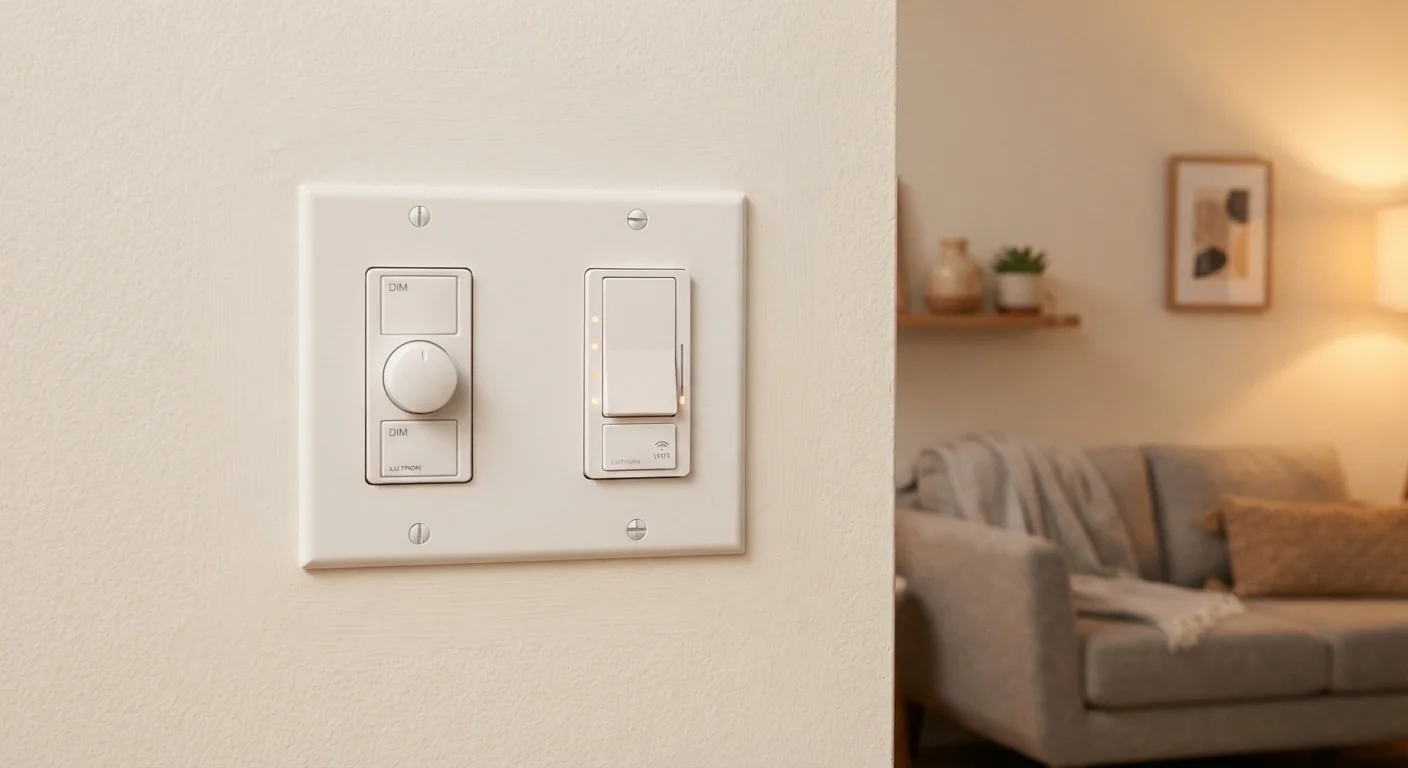
Key Takeaways
Option A
Smart Lighting (Smart Bulbs & Smart Switches)
The connected, app-controlled approach to home lighting.
Best for: Homeowners who want scheduling, voice control, remote access, and scene automation.
Option B
Traditional Dimmer Switches
The reliable, standalone analog dimming solution.
Best for: Homeowners who want simple, dependable dimming without apps, Wi-Fi, or extra devices.
If you want simple, set-it-and-forget-it dimming
Traditional Dimmer Switches
A compatible dimmer and bulb combination gives you reliable, intuitive control with no apps, accounts, or internet dependency.
If you want to control lights from your phone or by voice
Smart Lighting (Smart Bulbs & Smart Switches)
Smart lighting integrates with voice assistants and smartphone apps, letting you adjust or automate lights from anywhere.
If you live in an older home with limited wiring
Traditional Dimmer Switches
Older homes may lack the neutral wire that many smart switches require, making a traditional dimmer the simpler drop-in option.
If you want to automate lighting schedules or create scenes
Smart Lighting (Smart Bulbs & Smart Switches)
Smart lighting allows time-based schedules, motion triggers, and multi-room scenes that no traditional dimmer can match.
If you want a lower-cost, lower-maintenance solution long-term
Traditional Dimmer Switches
Dimmers have no software to update, no hub to maintain, and no subscription service to worry about - just a switch on a wall.
How Each System Actually Controls Light
A traditional dimmer switch works by reducing the voltage delivered to a bulb, which lowers its brightness. Most modern dimmers use a method called phase-cut dimming - they rapidly interrupt the electrical current to simulate lower power. This is a purely hardware-based process: no software, no network, just electricity and physics.
Smart lighting takes a fundamentally different approach. Smart bulbs contain their own internal dimming electronics and receive instructions wirelessly - via Wi-Fi, Zigbee, or Z-Wave (see our plain-language glossary of smart home terms for what those protocols mean). The bulb itself manages how much light it produces. Smart switches, on the other hand, look like a regular wall switch but send digital commands rather than physically cutting power.
This distinction matters more than it might seem. When you put a smart bulb on a traditional dimmer circuit, the dimmer is interrupting power at the wall while the bulb's internal circuitry is trying to manage its own dimming - the two systems conflict. The typical result is flickering, buzzing, or premature bulb burnout.
| Criterion | Smart Lighting | Traditional Dimmer |
|---|---|---|
| Dimming method | Internal electronics or digital command | Phase-cut voltage reduction |
| Requires internet/Wi-Fi | Yes (for remote/app features) | No |
| Neutral wire needed | Often (smart switches) | Rarely |
| Compatible with LED bulbs | Yes (designed for them) | Requires dimmer-rated LED |
| Scheduling & automation | Yes | No |
| Voice assistant control | Yes | No |
| Works during outages | Limited (no app/remote) | Yes (if power is on) |
| Installation complexity | Moderate to high | Low to moderate |
Wiring, Installation, and What Your Home Needs
Swapping out a standard on/off switch for a traditional dimmer is usually a straightforward task for someone comfortable with basic electrical work - though if you have any doubts, a licensed electrician is always the right call. Most dimmers need only a live wire, a load wire, and a ground. That matches what most switch boxes already have.
Smart switches are more demanding. The majority require a neutral wire - a white wire that completes the circuit back to the electrical panel. Homes built before roughly the 1980s commonly lack neutral wires at switch boxes, because older wiring ran power only to the switch, not back from it. No neutral wire means most smart switches simply will not work without additional wiring work.
Smart bulbs sidestep this problem entirely, because they screw into a standard fixture and connect wirelessly. But they introduce a different constraint: the wall switch controlling that fixture should stay permanently on. If someone flips it off, the bulb loses power and becomes unreachable by any app or voice command until power is restored manually.
When to Call a Licensed Electrician
If your switch box lacks a neutral wire, or if you're unsure what wiring you have, don't guess. Opening a switch box and misidentifying wires can create shock hazards or damage equipment. A licensed electrician can assess your wiring in under an hour and confirm whether a smart switch is viable - or advise on alternatives. Permits may be required for wiring changes depending on your local code.
For a broader look at how these choices fit into a larger home setup, the guide to starting a smart home without overcomplicating it walks through practical first steps.
Everyday Convenience: What Actually Changes
A traditional dimmer's value is in its simplicity. You turn the dial or slide the lever, the light changes, and that's the entire interaction. There's nothing to update, no account to log into, and it works the same during a Wi-Fi outage as it does any other time.
Smart lighting changes the relationship between you and your lights in ways that go beyond dimming. You can set lights to turn on at sunset, dim automatically during movie time, or switch off every light in the house from a single tap before bed. If you're traveling, you can simulate occupancy. Integration with voice assistants means you may not need to touch a switch at all.
~40%
Energy savings from smart lighting controls
The U.S. Department of Energy estimates that advanced lighting controls, including occupancy sensing and scheduling, can reduce lighting energy use by roughly 40% compared to manual switching.
30-50%
LED lifespan increase from proper dimming
According to lighting industry guidance, LEDs dimmed using compatible, purpose-built controls can last significantly longer than those run at full load continuously or paired with incompatible dimmers.
The trade-off is real, though. Smart lighting depends on a functioning wireless network, a working app, and sometimes a hub or bridge device. If the internet is down or the app has an outage, some functions may be unavailable. Ecosystems also matter - devices from different manufacturers don't always work together smoothly. The guide to avoiding ecosystem lock-in covers how to evaluate this before you buy.
Neither approach is objectively superior. What changes is how much control you want - and how much complexity you're willing to manage to get it. For concerns about your home's underlying wiring before making any switch, the signs your electrical system needs inspection is worth reviewing first.