

Key Takeaways
Option A
Timing Belt
The scheduled-replacement, rubber-and-fiber workhorse.
Best for: Drivers who want a lighter, quieter engine and are comfortable following a strict replacement interval.
Option B
Timing Chain
The long-lived, metal alternative designed to last the engine's lifetime.
Best for: Drivers who prioritize reduced scheduled maintenance and plan to keep a vehicle well past 100,000 miles.
If you drive a vehicle with a rubber timing belt
Timing Belt Replacement Schedule
Follow the manufacturer's replacement interval precisely. Skipping or delaying this service risks sudden belt failure and potentially severe engine damage.
If you own a high-mileage vehicle with a timing chain
Consistent Oil Change Intervals
Timing chains depend on clean, properly pressurized oil for lubrication. Neglected oil changes are the leading cause of premature chain wear and stretch.
If you're buying a used car and aren't sure which system it has
Owner's Manual and Service Records Review
Confirm the system type before purchase and check whether belt replacement is overdue. A missed interval on a belt-driven engine is a significant risk factor.
What Each Component Actually Does
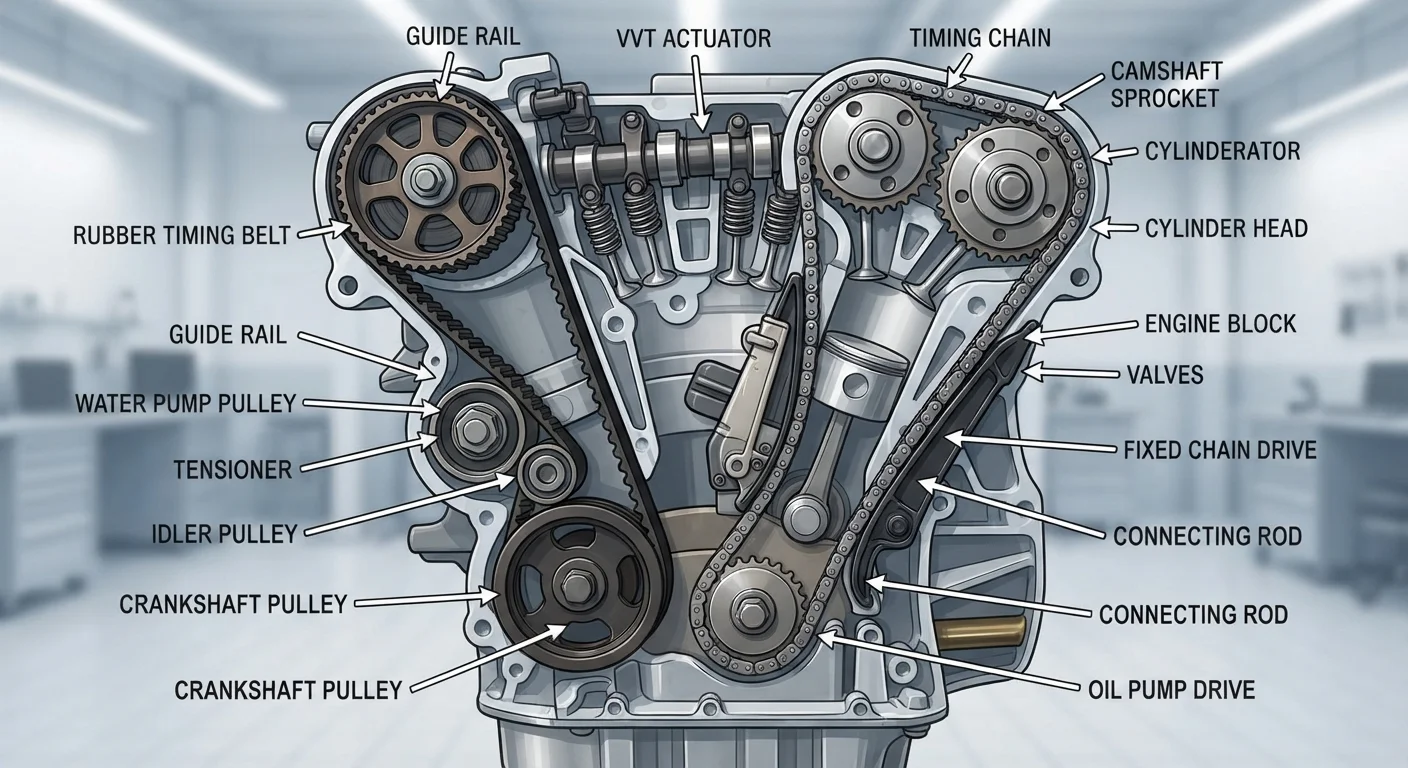
Both the timing belt and the timing chain serve the same fundamental purpose: they synchronize the rotation of the crankshaft and the camshaft (or camshafts) so that the engine's valves open and close at precisely the right moment relative to the pistons. Get that timing wrong - even slightly - and the engine runs poorly or not at all. Get it catastrophically wrong, and valves and pistons can collide inside the engine.
The difference lies in the material and design. A timing belt is made from reinforced rubber - typically with fiberglass or Kevlar cords embedded for strength. It runs quietly and requires no lubrication because it operates outside the oil system. A timing chain, by contrast, is a metal roller chain similar in concept to a bicycle chain, running inside the engine and bathed in oil. Each approach has real engineering trade-offs.
| Criterion | Timing Belt | Timing Chain |
|---|---|---|
| Material | Reinforced rubber | Metal roller chain |
| Location in engine | Outside oil system | Inside engine, oil-bathed |
| Noise level | Quieter operation | Slightly more audible |
| Scheduled replacement | Yes - every 60K-100K miles | Generally not required |
| Failure warning signs | Rarely - often fails suddenly | Rattling, rough idle, warning lights |
| Cost if neglected | Potentially catastrophic engine damage | Serious damage if chain failure is ignored |
| Key maintenance dependency | Mileage and age intervals | Regular oil changes |
Maintenance: Where the Real Difference Shows Up
The single most important practical distinction is maintenance schedule. Timing belts are a wear item - they degrade with heat, mileage, and age regardless of how well you maintain your engine. Most manufacturers specify replacement every 60,000 to 100,000 miles, though some intervals fall outside that range. The key point: this is a time- and mileage-based service that cannot be skipped.
Timing chains are designed to last the life of the engine. There is generally no scheduled replacement interval. However, they are not indestructible. Timing chains stretch gradually, and inadequate lubrication - caused by neglected oil changes or low oil level - accelerates that wear significantly. A stretched or worn chain can cause a rattling noise on startup, rough idling, or trigger a check engine light related to camshaft timing. These are signals that deserve prompt professional attention.
60K-100K
Typical timing belt replacement interval (miles)
Most manufacturers specify a replacement window in this range, though the exact interval varies by engine design - always consult your owner's manual.
~$500-$1,000+
Estimated timing belt service cost (labor included)
Replacement cost varies widely by vehicle, region, and whether related components like the water pump are serviced at the same time - common practice since access is already open.
Because timing chains live inside the oiled engine, they benefit directly from consistent routine maintenance - especially regular oil and filter changes. This connection between oil health and chain longevity is one reason high-mileage maintenance priorities often emphasize oil discipline above almost everything else.
What Happens When Each One Fails
Timing belt failure is where the stakes become very high. Many modern engines are interference engines - meaning the pistons and valves share overlapping space in the cylinder, relying entirely on precise timing to avoid contact. If a timing belt snaps in an interference engine, the result is typically bent valves, damaged pistons, or both. Repairs routinely run into thousands of dollars. In non-interference engines, a snapped belt will simply stall the engine without internal damage - but non-interference designs are increasingly uncommon.
Critically, timing belts often fail without warning. Unlike a worn brake pad that squeals, a rubber belt nearing the end of its life may look acceptable on visual inspection while being internally compromised. This is why adhering strictly to the manufacturer's replacement interval - not guessing by appearance - is essential.
Timing chain failure, by comparison, is slower and usually announces itself. Rattling, rough idling, or illuminated warning lights give drivers a window to seek service before complete failure. That said, ignoring those signals long enough can still result in serious engine damage, so early attention matters.
Keeping accurate vehicle maintenance records is especially valuable for timing belt service - documenting when the belt was last replaced removes any guesswork and protects you if you sell the vehicle.
Timing Belt Service Often Bundles Other Work
Because accessing the timing belt requires significant disassembly, many mechanics recommend replacing the water pump, tensioner, and idler pulleys at the same time. These components are often driven by the belt and share similar lifespans. Doing them together avoids paying for the same labor twice if one of those parts fails shortly after.
How to Find Out Which One Your Vehicle Has
The simplest approach is to check your owner's manual. Look in the scheduled maintenance section - if a timing belt replacement interval is listed, you have a belt. If no such interval appears, a timing chain is likely. A qualified mechanic can also confirm this during a routine inspection.
Some general patterns exist by vehicle type, though they are not universal: many four-cylinder economy cars have historically used belts, while a number of V6 and V8 engines have used chains. Automakers have also shifted manufacturing strategies over time, so the same brand may use different systems in different model years. Never assume - verify.
Understanding which system you have is a meaningful part of understanding what factors affect your vehicle's long-term reliability. Timing system knowledge belongs in every driver's maintenance awareness, alongside basics like tire rotation and alignment.