

Key Takeaways
Auto Insurance Policy
An auto insurance policy is a legal contract between you and an insurance company. In exchange for your premium payments, the insurer agrees to pay for certain financial losses related to your vehicle - such as accident damage, theft, or injuries - up to specified limits. The policy document spells out exactly what is covered, what is excluded, and under what conditions the coverage applies.
Policies are typically divided into a declarations page (the summary) and the policy form (the detailed terms). State insurance regulations govern minimum required language and consumer protections, but specifics vary by insurer and jurisdiction.
Start With the Declarations Page
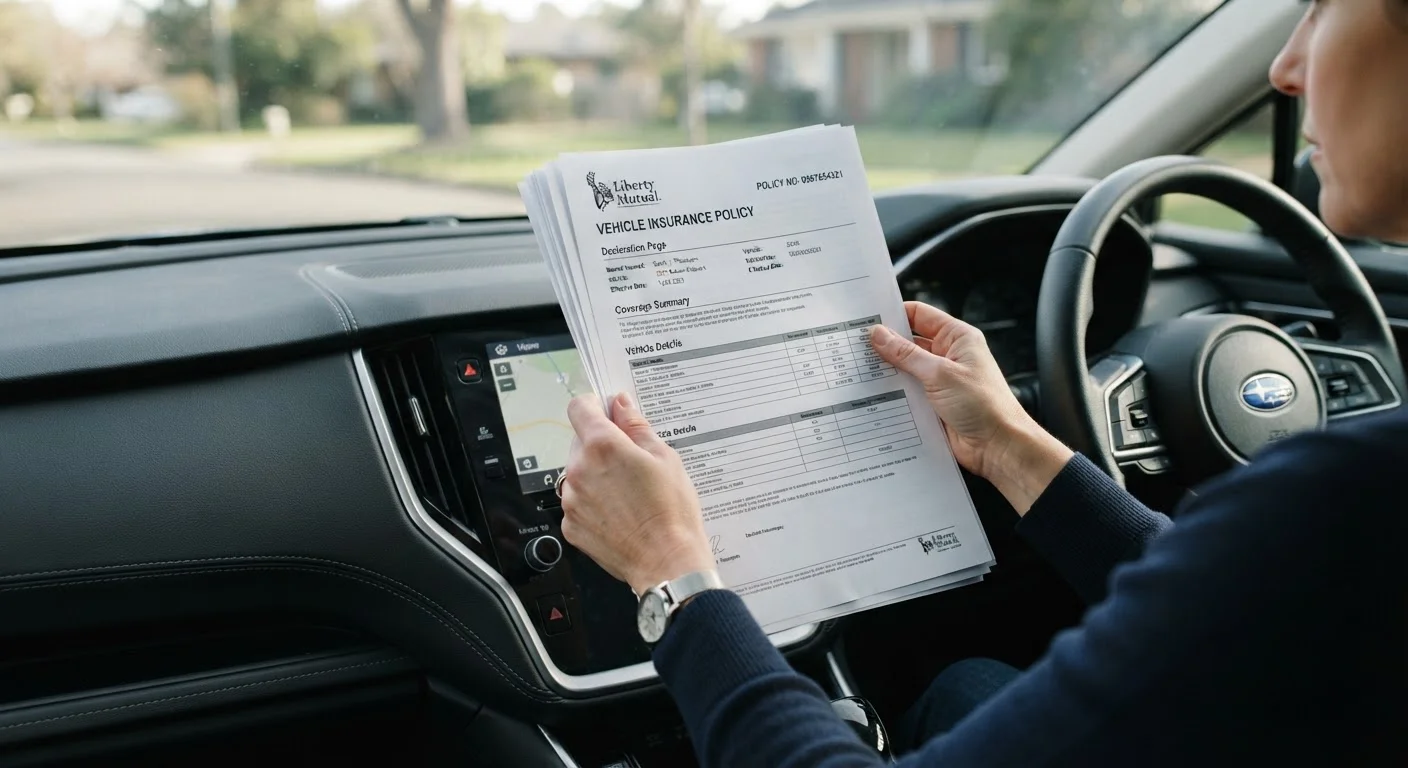
Before diving into dense policy language, locate the declarations page - it's almost always the first page of your policy packet. Think of it as the cover sheet that translates the entire contract into plain numbers. It tells you who is insured, which vehicles are covered, the policy effective dates, and a line-by-line list of your coverages with their corresponding limits and deductibles.
The coverage types listed there - liability, collision, comprehensive, personal injury protection, uninsured motorist - each correspond to a longer section deeper in the policy document. For a detailed breakdown of what each line item means, see our guide to coverage types on your auto insurance declaration page.
~13%
U.S. drivers estimated to be uninsured
According to the Insurance Research Council, roughly 1 in 8 U.S. drivers is estimated to be uninsured, underscoring why UM/UIM coverage matters.
50 + D.C.
Jurisdictions with distinct minimum coverage laws
Every U.S. state and the District of Columbia sets its own minimum liability requirements, meaning what's legally sufficient varies depending on where you register your vehicle.
$500-$1,000
Most common deductible range for collision coverage
Industry data shows most drivers select deductibles in this range, balancing premium savings against manageable out-of-pocket costs at claim time.
The Four Core Coverage Types, Briefly Defined
Liability coverage is the foundation of nearly every personal auto policy and is legally required in most states. It pays for bodily injury and property damage you cause to other people. It does not pay for your own injuries or vehicle. Liability limits are typically written as three numbers - for example, 25/50/25 - representing per-person injury, per-accident injury, and property damage maximums in thousands of dollars.
Collision coverage pays to repair or replace your vehicle after a crash with another car or object, regardless of fault. It carries its own deductible.
Comprehensive coverage handles non-collision losses: theft, vandalism, fire, falling objects, and weather-related damage. It also has a separate deductible.
Personal injury protection (PIP) and medical payments (MedPay) cover medical expenses for you and your passengers after an accident, regardless of who was at fault. Whether these are required or optional depends on your state.
For a side-by-side comparison of liability-only versus full coverage structures, see our article on liability vs. full coverage auto insurance.
Review Your Dec Page at Every Renewal
Insurers can adjust coverage terms, limits, or pricing at renewal. Taking five minutes to compare your new declarations page against the prior term helps you spot changes before they affect a claim. Pay particular attention to any coverage that has been dropped or whose limit has changed.
Limits, Deductibles, and What They Mean for Your Wallet
Every coverage type has a limit - the maximum your insurer will pay for a single covered claim. Costs that exceed your limit are your financial responsibility. Choosing limits that are too low can leave you personally liable for the difference after a serious accident.
Deductibles apply to first-party coverages (collision and comprehensive, for example). When you file a claim, you pay your deductible first, and the insurer covers the rest up to the policy limit. A higher deductible typically means a lower premium, but it also means more out-of-pocket cost at claim time.
These trade-offs are worth thinking through annually. Your state sets minimum liability requirements - see our state-by-state auto insurance requirements reference for what's legally mandated where you drive.
How to Read the Exclusions Section
The exclusions section is where many policyholders are caught off guard at claim time. Exclusions define the specific circumstances under which your insurer will not pay - even when the loss looks, on the surface, like it should be covered.
Common exclusions in personal auto policies include: intentional acts, regular use of your vehicle for commercial deliveries or rideshare without an endorsement, mechanical or electrical breakdown unrelated to a covered accident, and personal property left inside the vehicle. If you use your car for work purposes, this distinction matters significantly - our article on personal vs. commercial auto insurance explains where that line is drawn.
Endorsements Can Fill Coverage Gaps
An endorsement (sometimes called a rider) is an amendment that modifies your base policy - either adding coverage the standard form excludes or adjusting existing terms. Common examples include rental reimbursement, roadside assistance, and rideshare coverage endorsements. Ask your insurer which endorsements are available if you identify a gap in your base policy.
Reading exclusions is not about distrust - it's about accuracy. Knowing what isn't covered helps you identify coverage gaps you might want to fill with endorsements (add-ons to the base policy) or separate policies.
Uninsured and Underinsured Motorist Coverage: Don't Skip It
One of the most overlooked sections of any auto policy covers what happens when the other driver doesn't have adequate insurance. Uninsured motorist (UM) coverage pays for your injuries and sometimes vehicle damage when the at-fault driver carries no insurance. Underinsured motorist (UIM) coverage applies when the other driver has insurance, but their limits are too low to cover your actual losses.
Because a notable share of drivers on U.S. roads are either uninsured or carry only minimum coverage, skipping UM/UIM coverage carries real financial risk. For a thorough look at this often-overlooked protection, see our article on uninsured and underinsured motorist coverage.
This article is for general informational purposes only and does not constitute personalized insurance or legal advice. Coverage terms, exclusions, and requirements vary by insurer and by state. Review your actual policy documents and consult a licensed insurance professional for guidance specific to your situation.