

Key Takeaways
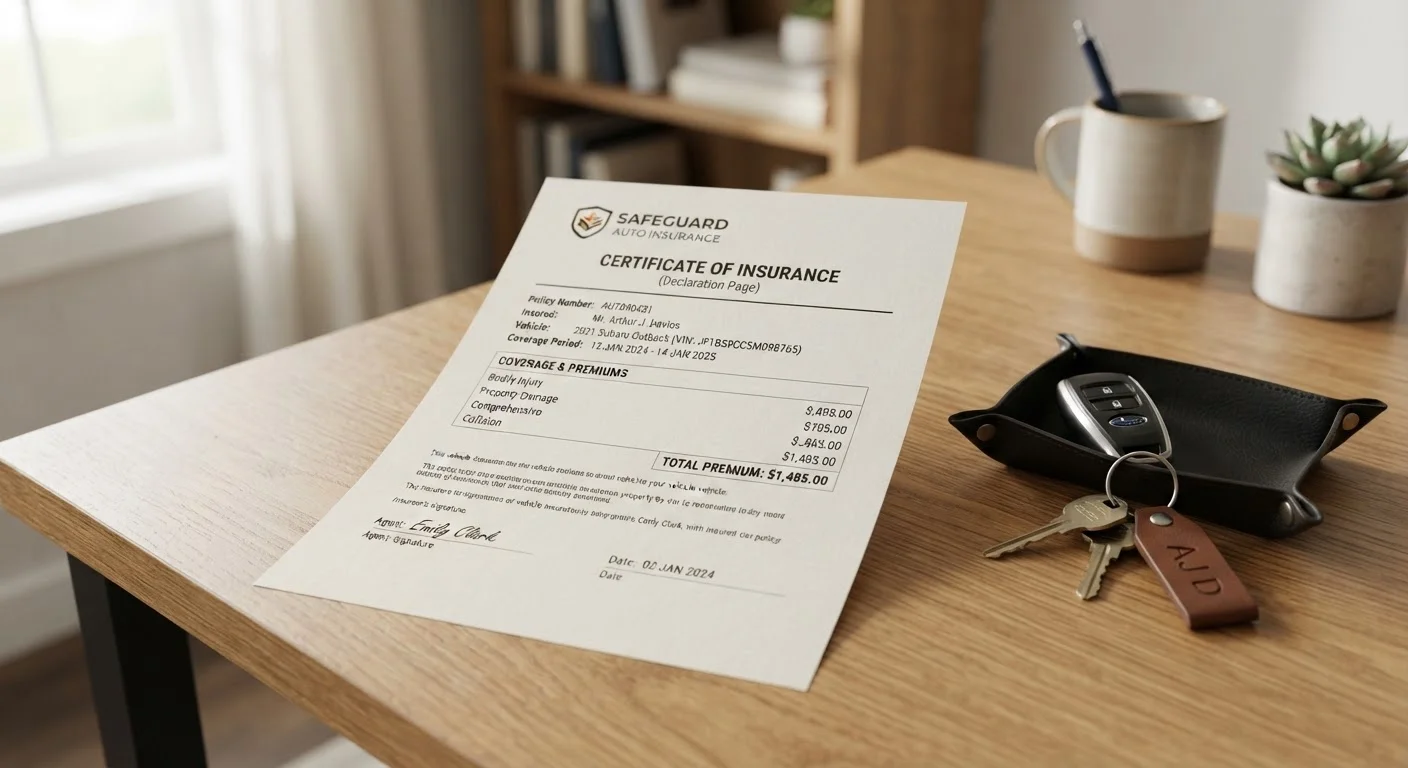
Auto Insurance Declaration Page
The declarations page (often called the "dec page") is the summary sheet at the front of your auto insurance policy. It lists who is covered, which vehicles are insured, the policy period, your coverage types, their limits, and your deductibles - all on one or two pages. Think of it as a snapshot of your entire policy in plain table form.
The dec page is legally binding and is the document most commonly requested by lenders, lienholders, and state motor vehicle agencies as proof of coverage.
How to Read the Coverage Section of Your Dec Page
When you pull up your declarations page, you'll see a table with coverage names in one column, dollar limits in another, and sometimes a deductible column. Each row is a separate coverage type - and each one responds to a different kind of loss. Knowing what each row actually does is the fastest way to spot gaps or unnecessary overlap in your policy.
Your dec page is also the right starting point before comparing quotes or updating your coverage after a major life change. For a broader look at how to navigate your full policy document, this plain-language guide to reading your car insurance policy walks through the fine print section by section.
~1 in 8
U.S. drivers estimated to be uninsured
Industry research consistently estimates that roughly 12-13% of drivers on U.S. roads carry no liability insurance.
49 states
States requiring some form of liability coverage
New Hampshire is the only state that does not mandate auto liability insurance, though drivers there must still demonstrate financial responsibility.
12+
No-fault states requiring PIP coverage
More than a dozen states operate under a no-fault system, requiring drivers to carry Personal Injury Protection as part of their policy.
Liability Coverage: What You Owe Others
Liability is the foundation of almost every personal auto policy and is required by law in nearly every U.S. state. It breaks into two parts:
- Bodily injury liability (BI): Pays for medical expenses, lost wages, and legal costs if you injure someone else in an at-fault accident.
- Property damage liability (PD): Pays to repair or replace another person's vehicle or property - a fence, a storefront - that you damage.
Limits appear as a three-number string, such as 25/50/25. That means $25,000 per injured person, $50,000 per accident for all injuries combined, and $25,000 for property damage. Anything above your limits becomes your personal financial responsibility, which is why many advisers suggest carrying limits above the state minimum.
Liability coverage does not pay for your own injuries or your own car's damage. Those require separate coverages.
Review Your Limits, Not Just Your Premium
Many drivers focus on the monthly cost of their policy without checking whether their liability limits are adequate. State minimums are often lower than the cost of a serious accident. As your assets grow, increasing your limits - or adding an umbrella policy - is generally worth the relatively small additional cost. Keeping your auto policy in good shape over time covers when and how to revisit your coverage.
Collision and Comprehensive: Protecting Your Own Vehicle
These two coverages both repair or replace your car, but they respond to completely different events.
- Collision: Pays when your vehicle hits another car or object - a guardrail, a parking bollard - or rolls over. Fault doesn't matter; if your car is damaged in a crash, collision applies.
- Comprehensive: Pays for damage from events outside a collision - theft, vandalism, hail, flooding, a deer strike, or a falling tree branch.
Both coverages carry a deductible you select when you buy the policy. Neither is legally required by state law, but lenders and leaseholders almost always require both if you're financing the vehicle. A side-by-side comparison of collision vs. comprehensive can help you decide whether carrying both makes sense for your situation.
Medical Coverages: PIP and MedPay
Regardless of who caused an accident, you and your passengers may need immediate medical care. Two coverages address this:
- Personal Injury Protection (PIP): Required in no-fault states, PIP covers medical expenses, a portion of lost wages, and sometimes services like childcare or household help while you recover. It pays regardless of fault.
- Medical Payments (MedPay): Available in most states, MedPay covers medical and funeral expenses for you and your passengers after an accident, also regardless of fault. It's narrower than PIP - typically no wage replacement - but can supplement your health insurance deductible.
Whether your state requires PIP, makes it optional, or offers MedPay instead varies significantly. Check your state's Department of Insurance website for the rules that apply to you.
Uninsured and Underinsured Motorist Coverage
Roughly one in eight U.S. drivers carries no liability insurance, according to industry estimates. Uninsured motorist (UM) and underinsured motorist (UIM) coverage protect you when the at-fault driver either has no policy or doesn't have enough coverage to pay your full damages.
- UM Bodily Injury: Pays your medical costs and lost wages if an uninsured driver hits you.
- UM Property Damage: Pays to repair your car when damaged by an uninsured driver (subject to a small deductible in some states).
- UIM Bodily Injury: Kicks in when the other driver's liability limits are too low to cover your actual losses.
Some states mandate UM/UIM coverage; others make it optional. Even where optional, it tends to be one of the more cost-effective additions to a policy given the risk it addresses.
This article provides general information about auto insurance coverage types and is not personalized insurance, financial, or legal advice. Coverage availability, requirements, and terms vary by state and insurer. Always read your actual policy documents and consult a licensed insurance agent for guidance specific to your situation.