
Distracted Driving vs. Impaired Driving: Understanding Two Distinct Road Risks

Key Takeaways
Option A
Distracted Driving
The attention thief hiding in plain sight.
Best for: Understanding how cognitive and visual diversions - phones, passengers, GPS - pull focus away from the road.
Option B
Impaired Driving
A chemical compromise of judgment and control.
Best for: Understanding how alcohol, drugs, or extreme fatigue chemically degrade the brain functions needed for safe operation.
If you want to understand why phone use behind the wheel is so dangerous
Distracted Driving
Distracted driving research explains how even a brief visual or cognitive shift can cause a driver to miss critical hazards in seconds.
If you're concerned about the effects of alcohol or medication on driving ability
Impaired Driving
Impaired driving covers how substances alter reaction time, judgment, and coordination at a neurological level - effects a driver may not even perceive.
If you want to build an overall safe driving mindset
Distracted Driving
Since distraction is a daily temptation for virtually every driver, understanding and managing it has broad, immediate practical value for most people.
How Each Risk Works Against You
Distracted driving and impaired driving are often grouped together in road safety conversations - and for good reason. Both raise crash risk substantially. But they operate through entirely different mechanisms, and conflating them can obscure what drivers actually need to do to protect themselves and others.
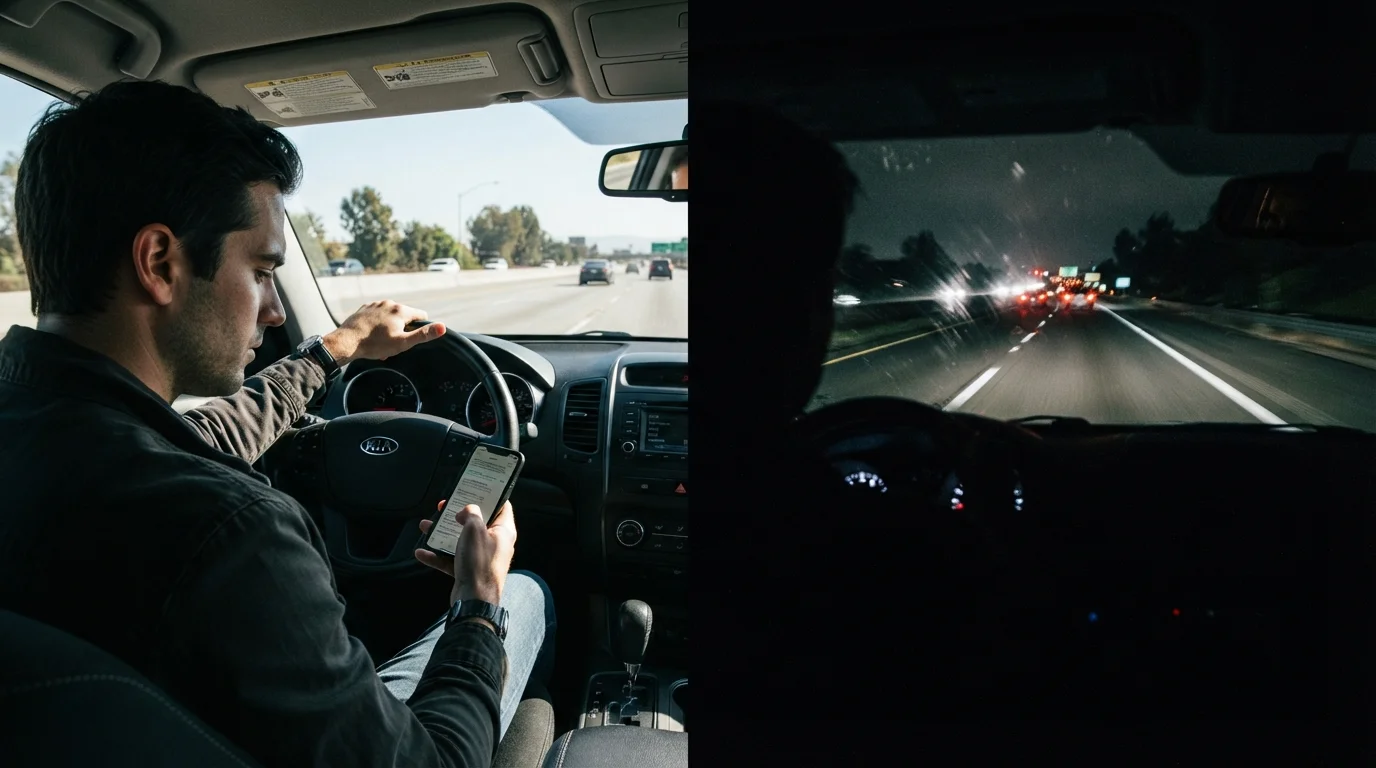
Distracted driving is an interruption problem. It temporarily redirects a driver's visual attention, manual control, or cognitive focus away from the driving task. The driver's underlying faculties remain intact - they can still process information correctly - but the information simply isn't reaching them. A text message, a navigation prompt, or a conversation can pull eyes off the road for several seconds. At 55 mph, that's the length of a football field traveled without meaningful awareness of what's ahead.
Impaired driving is a capability problem. Alcohol, certain prescription and over-the-counter medications, illicit substances, and severe fatigue don't just redirect attention - they chemically alter the brain's ability to perceive, judge, and react. Slowed reaction time, impaired depth perception, compromised decision-making, and reduced coordination are hallmarks. Crucially, impaired drivers often cannot accurately assess their own level of impairment - the very systems needed to recognize a problem are themselves affected.
Defensive driving principles address both risks, but require knowing which threat you're managing at any given moment.
| Criterion | Distracted Driving | Impaired Driving |
|---|---|---|
| Core mechanism | Diverts attention from the task | Degrades cognitive and physical capability |
| Driver awareness of risk | Often recognized if driver reflects | Frequently underestimated or unrecognized |
| Common causes | Phone, GPS, passengers, eating | Alcohol, drugs, medications, fatigue |
| Immediately reversible? | Yes - refocus restores capability | No - requires time or intervention |
| Legal framework | Varies widely by state | Defined criminal statutes in all states |
| Reaction time impact | Delayed by attention gaps | Slowed neurologically throughout impairment |
| Judgment affected? | Judgment intact; information missed | Judgment itself is compromised |
Legal and Practical Consequences
From a legal standpoint, impaired driving - particularly alcohol-related - carries the most clearly defined and severe consequences. DUI (Driving Under the Influence) laws exist in every U.S. state, with criminal penalties that can include license suspension, fines, mandatory programs, and incarceration. Specific thresholds (such as blood alcohol concentration limits) are legally defined, and enforcement relies on chemical testing.
Distracted driving laws vary considerably by state. Many states ban handheld phone use while driving, and some have broader restrictions, but enforcement is inherently more difficult. Civil liability, however, can be severe in both cases - particularly when a crash causes injury.
~3,000
Annual U.S. distraction-related traffic deaths
The NHTSA estimates approximately 3,000 people are killed annually in crashes involving distracted drivers in the United States.
~10,000
Annual U.S. alcohol-impaired driving fatalities
According to NHTSA data, roughly 10,000 people die each year in alcohol-impaired driving crashes, representing about 28% of all U.S. traffic deaths.
~25x
Increased crash risk while texting and driving
Research from the Virginia Tech Transportation Institute found that texting while driving raises crash risk approximately 23-25 times compared to undistracted driving.
The practical consequences extend beyond courts. Both types of driving behavior affect your insurance risk profile, and incidents on your record can influence premiums over time. The habits that quietly erode safe driving often begin with normalized distraction or underestimating the effect of substances.
Correcting Course: What Each Requires
One meaningful difference between these two risks is reversibility in the moment. Distraction is typically correctable - put the phone down, refocus, and full driving capacity is restored immediately. This doesn't make distraction trivial; crashes happen in fractions of seconds. But a driver who recognizes the distraction can act on it right away.
Impairment is not correctable in the moment. There is no shortcut to sobriety - not coffee, not fresh air, not a brief rest. The only solution is time, or in some cases medical intervention. A driver who is impaired and gets behind the wheel has already compromised the decision-making needed to recognize that choice was wrong.
Fatigue-based impairment deserves special mention. Drowsy driving shares characteristics with both categories - it's a physiological state that degrades capability similarly to alcohol impairment, yet drivers often underestimate how severely their performance has declined. This is particularly relevant for night driving, when fatigue compounds reduced visibility.
Fatigue Is a Form of Impairment
Many drivers don't consider drowsiness a serious impairment, but research consistently shows that driving after 18-20 hours without sleep produces cognitive deficits comparable to a blood alcohol concentration above the legal limit. Unlike alcohol impairment, fatigue impairment has no chemical test, making it harder to enforce - but no less dangerous. If you're struggling to stay alert, pulling over safely is the only responsible choice.
Drivers committed to safety need strategies for both. Managing distraction means creating deliberate friction - silencing notifications, using do-not-disturb modes, establishing pre-trip habits. Managing impairment risk means planning ahead: designating a sober driver, using rideshare services, or simply waiting. Neither requires extraordinary effort, only intention. For a broader framework on anticipating road hazards, understanding how driving environments differ adds another layer of practical context.
This article is for general informational and educational purposes only. It does not constitute legal advice. Traffic laws vary by state; consult local regulations or a qualified legal professional for guidance specific to your situation.