

Key Takeaways
Our Verdict
Neither highway nor city driving is inherently more dangerous - each presents a distinct risk profile that calls for a different cognitive and physical skill set. Drivers who recognize and adapt to these differences are better equipped to stay safe in both environments.
| Best for | Recommended |
|---|---|
| Drivers who frequently commute through dense urban areas | City Driving Skills |
| Drivers who regularly travel long distances on interstates or expressways | Highway Driving Skills |
| New drivers building foundational road awareness | City Driving Skills |
| Drivers seeking to reduce fatigue and maintain alertness on long trips | Highway Driving Skills |
Two Roads, Two Risk Profiles
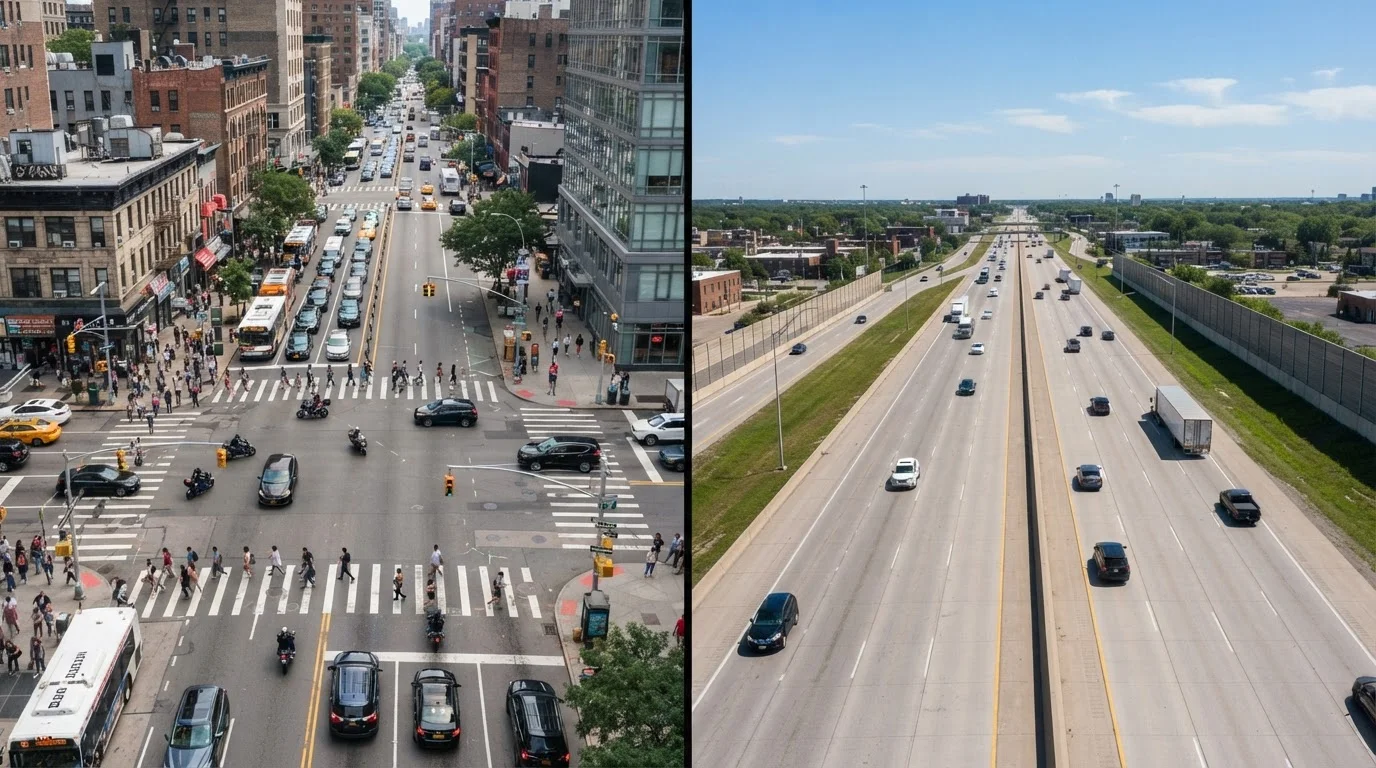
Most drivers switch between city streets and highways without giving either environment a second thought. But treating them as interchangeable is a mistake. The hazards, required reaction times, and mental demands of urban and highway driving are fundamentally different - and the gap between the two is where many crashes occur.
According to the National Highway Traffic Safety Administration (NHTSA), a significant share of serious crashes happen at intersections - a predominantly urban hazard. At the same time, highway crashes, while fewer in total count, tend to involve higher speeds and therefore greater severity. Understanding what each environment actually asks of you is the starting point for safer driving across both. See our complete guide to safer driving for a broader look at defensive techniques that apply everywhere.
City Driving: Managing Constant Complexity
Urban driving is characterized by high density and low predictability. Within a single city block, a driver may encounter traffic signals, crosswalks, cyclists, double-parked vehicles, delivery trucks, and pedestrians stepping off curbs - often simultaneously.
The Core Demands
- Intersection awareness: Intersections are the most statistically dangerous points in urban driving. Treat every green light as a conditional right-of-way and scan cross-traffic before proceeding.
- Reduced following distance windows: Stop-and-go traffic means vehicles ahead can brake hard with little warning. Maintaining at least a two-second gap - more in congestion - gives you room to respond.
- Vulnerable road user attention: Pedestrians and cyclists are far more present in cities. Assume they may appear from blind spots, especially near parked cars and bus stops.
- Speed management in tight spaces: Lower posted limits exist because stopping distances are short and hazards are close. Driving at the limit - not above it - is non-negotiable.
City driving rewards a wide visual field. Rather than fixating on the car directly ahead, practiced urban drivers scan several vehicles deep and check side streets, sidewalks, and mirrors in a regular rotation. Hazard-spotting techniques like these give you extra fractions of a second - often enough to avoid a collision entirely.
Scan Further Ahead in City Traffic
In dense urban areas, try to keep your eyes moving across a zone that extends two to three car lengths beyond the vehicle directly in front of you. Check your mirrors every five to eight seconds and make a habit of glancing down side streets and between parked cars before passing them. This wider awareness gives you more time to react before a hazard becomes a crisis.
Highway Driving: Managing Speed and Sustained Attention
On the surface, highways appear simpler - fewer variables, no pedestrians, no traffic signals. In reality, they introduce a different category of risk: the consequences of errors are amplified by speed, and the monotony of long stretches actively degrades driver alertness.
The Core Demands
- Following distance at speed: At 65 mph, your vehicle travels roughly 95 feet per second. The standard three-second following rule is a minimum; increase it in heavy traffic or poor weather.
- Lane discipline: Keep right except to pass. Unnecessary lane straddling or slow travel in the left lane creates friction and raises crash risk for everyone around you.
- Merging and blind spots: Entry ramps require drivers to match highway speed before merging - not after. Check mirrors and blind spots carefully; large vehicles have significantly larger blind zones than passenger cars.
- Fatigue management: Highway hypnosis - a trance-like state caused by monotonous driving - is a genuine risk on long trips. Stop every two hours, avoid driving during your body's natural sleep window, and never rely solely on caffeine to compensate for drowsiness.
The risks of distraction and impairment are particularly acute at highway speeds, where reaction time matters most. Distracted and impaired driving reduce your reaction window in ways that may be manageable at 25 mph but catastrophic at 70.
| City Driving | Highway Driving | |
|---|---|---|
| Primary hazard type | Intersections, pedestrians, cyclists | Speed, fatigue, merging conflicts |
| Typical speed range | 15-45 mph | 55-75 mph |
| Decision frequency | Very high - constant micro-decisions | Lower - but higher-stakes decisions |
| Following distance needed | 2+ seconds minimum | 3+ seconds minimum |
| Key mental skill | Wide visual scanning, anticipation | Speed calibration, sustained alertness |
| Fatigue risk | Moderate - stimulating but demanding | High - monotony accelerates fatigue |
| Error consequence severity | Moderate - lower speeds reduce impact | High - speed amplifies crash severity |
Adapting When You Switch Environments
One underappreciated danger is the transition itself. A driver coming off an hour on the interstate may underestimate city speeds because everything feels slow by comparison - a phenomenon called speed adaptation. Conversely, a driver moving from dense urban traffic onto a highway may not recognize how quickly following distance becomes inadequate as speeds rise.
Deliberately recalibrating your mindset at transitions matters. Slow down consciously when entering urban areas. Actively increase following distance when accelerating onto a highway. Give yourself a few minutes to mentally reset rather than carrying the habits of one environment into the other.
Habits formed in one setting can quietly undermine safety in another. Gradual behavioral drift - where drivers become desensitized to risks they encounter repeatedly - is especially common among experienced drivers who feel competent in their primary environment.
This article is for general informational purposes only and does not constitute professional driving instruction or legal advice. Always follow applicable traffic laws and consult a qualified driving professional for individualized guidance.
~40%
Of U.S. traffic fatalities at intersections
The Federal Highway Administration estimates that intersection-related crashes account for roughly 40% of all traffic fatalities, underscoring the outsized risk of urban driving environments.
95 ft/sec
Distance traveled at 65 mph per second
At highway speeds, a vehicle covers approximately 95 feet every second - illustrating why following distance and reaction time are critical at high speed.