

Key Takeaways
Tailgating
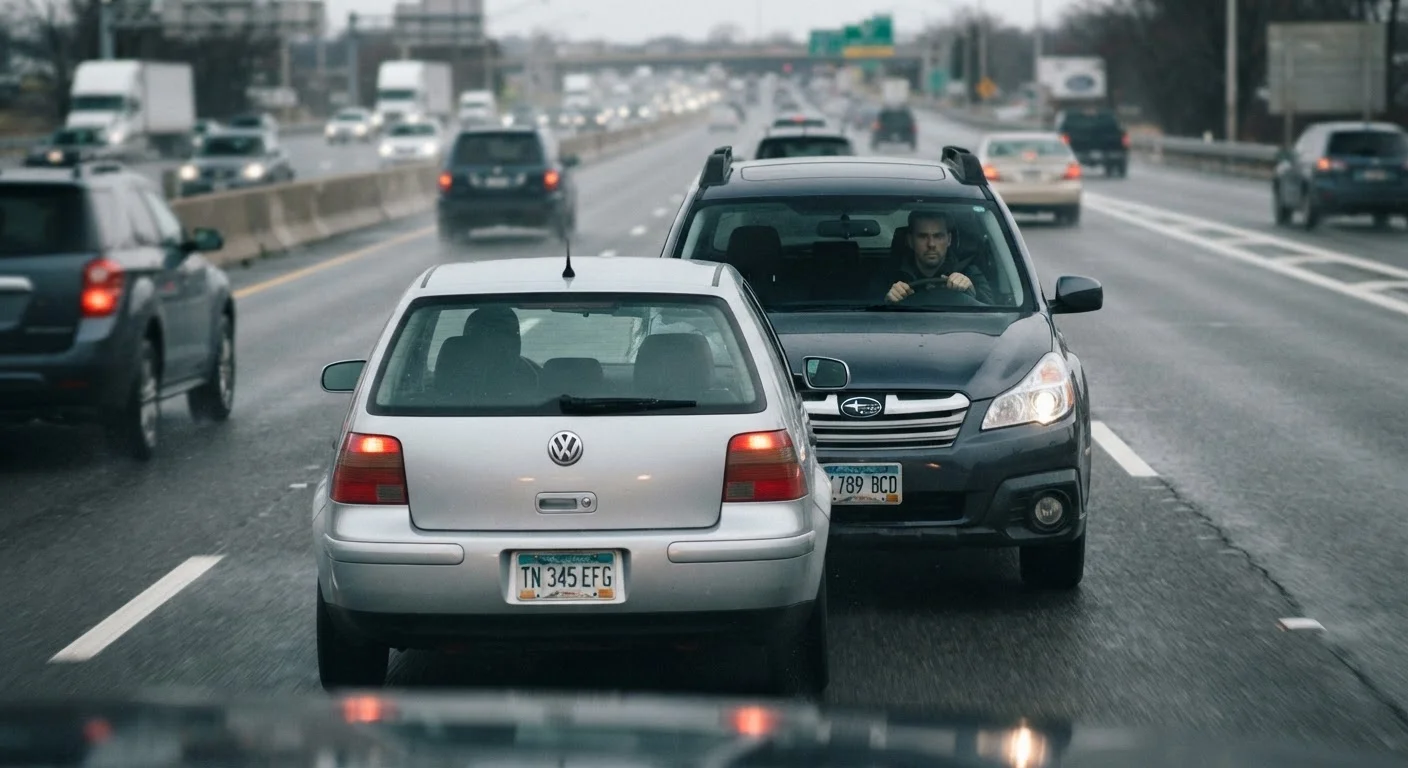
Tailgating means following another vehicle too closely - leaving less space between your car and the one ahead than you need to stop safely. It is one of the most common and preventable causes of rear-end collisions. Because human reaction time and braking physics are fixed, the gap you leave is your only cushion when the unexpected happens.
Traffic engineers and safety researchers typically define an inadequate following distance as anything less than the distance a vehicle travels during the driver's perception-reaction time plus full braking distance - a combined figure that grows sharply with speed.
Why Following Distance Is a Physics Problem, Not Just a Courtesy Issue
Most drivers who tailgate don't think of themselves as reckless - they're simply keeping pace with traffic, running late, or reacting to congestion. But following too closely isn't a matter of etiquette. It's a collision waiting for a trigger.
Physics sets the rules. When a car ahead brakes, two time periods must pass before your vehicle slows: your perception time (how long it takes your brain to register the hazard) and your reaction time (how long it takes to physically move your foot to the brake). Combined, these average about 1.5 seconds for most drivers. At 60 mph, that's 132 feet - roughly half the length of a standard city block - traveled before braking even begins.
Stopping distance then adds to that figure. At 60 mph on dry pavement, a typical passenger car needs an additional 180 feet or more to come to a complete stop after braking starts. That's over 300 feet of total stopping distance. If you're following at three car lengths - a common but dangerously short gap - you simply do not have the space to stop in time.
~29%
Of all U.S. crashes that are rear-end collisions
According to the National Highway Traffic Safety Administration (NHTSA), rear-end crashes consistently represent one of the largest crash type categories on U.S. roads.
1.5 sec
Average driver perception-reaction time
Traffic safety research consistently places average perception-reaction time between 1.5 and 2.5 seconds, varying by driver alertness and condition.
300+ ft
Total stopping distance at 60 mph on dry pavement
Combining perception-reaction distance and braking distance, many standard passenger vehicles require over 300 feet to fully stop from 60 mph under ideal conditions.
This is why stopping distance and speed limits aren't arbitrary: they're grounded in these exact physics relationships.
The Three-Second Rule - and When It Isn't Enough
The three-second rule is the standard minimum guideline taught in driver education across the U.S. To use it: watch for the vehicle ahead to pass a fixed landmark - a sign, a shadow, a crack in the road. Count slowly to three. If you pass that same landmark before you finish counting, you're following too closely.
Three seconds provides roughly 264 feet of buffer at 60 mph - enough to cover perception, reaction, and most of your braking distance under ideal conditions. But ideal conditions are the exception, not the rule.
Adjust Your Gap When Conditions Change
Don't wait until you feel unsafe to increase your following distance. Make it a habit to consciously extend your gap at the start of rain, when entering fog, or when road surfaces look slick. By the time the road feels dangerous, you've already lost critical stopping margin.
Rain, snow, fog, worn tires, a heavily loaded vehicle, or driving behind a large truck all extend your required stopping distance. In wet conditions, the gap should expand to at least four seconds. In ice or snow, six seconds or more is a reasonable target. Large commercial trucks need even more distance due to their mass and braking characteristics.
Heavy traffic creates another trap: drivers unconsciously close gaps to avoid being "cut off," which is precisely when adequate spacing matters most. As part of a broader defensive driving approach, maintaining your gap - even when others exploit it - is an active safety decision, not passivity.
How Tailgating Becomes a Habit Without Drivers Noticing
One of tailgating's most insidious qualities is that it normalizes itself. Drivers who routinely follow closely develop a distorted sense of what a safe gap looks like. A four-second buffer starts to feel exaggerated; two seconds feels natural. This is the same mechanism behind many dangerous driving habits - gradual normalization that erodes safe behavior over time.
Brake lights compound this problem. By design, they activate after the driver has already pressed the brake pedal - meaning you're seeing a delayed signal of deceleration that's already underway. The closer you follow, the less processing time you have between seeing that light and needing to have your own vehicle stopped.
“Drivers often underestimate how much of their safety margin is consumed before they ever touch the brake pedal. Reaction time is not a small factor - at highway speeds, it's often the largest one.”
— Traffic Safety Research Community, General consensus position among road safety educators and crash investigators
Tailgating also limits your forward sightlines. Following closely behind a large vehicle - an SUV, van, or truck - can completely block your view of conditions ahead. Scanning ahead for hazards requires the visual access that only adequate following distance provides. When you're two car lengths behind a pickup truck, you're essentially driving blind to anything beyond it.
Practical Steps to Maintain Safe Following Distance Consistently
Knowing the rule and consistently applying it are different skills. A few habits help bridge the gap:
- Use landmarks actively. Practice the three-second count until it becomes automatic, especially on highways. Re-check it when speeds change.
- Recalibrate in adverse conditions. Make a deliberate mental note when weather or road conditions worsen, and intentionally increase your gap before you feel you need to.
- Resist social pressure. When traffic is dense and drivers are weaving for position, it can feel wasteful to maintain a cushion. Treat that gap as structural - it exists for physics, not preference.
- Position matters too. Following at a slight offset from the vehicle ahead (within your lane) can improve your forward sightlines and give you a fraction more reaction time.
Tailgating rarely feels dangerous in the moment - which is exactly what makes it so hazardous. The crash that following distance prevents is invisible; you never see what you avoided. That invisibility makes it easy to underestimate the margin you're actually depending on every time you drive.
This article is for general informational and educational purposes only. Always follow the traffic laws of your state and exercise judgment appropriate to actual road conditions.