

The Physics Behind Every Posted Number
When you see a speed limit sign, you're not looking at a bureaucratic guess. You're looking at the result of traffic engineers applying physics - specifically the relationship between velocity, kinetic energy, and stopping distance - to a specific stretch of road.
The core principle is straightforward: kinetic energy increases with the square of speed, not linearly. A vehicle traveling at 60 mph doesn't carry twice the energy of one going 30 mph - it carries four times as much. That energy has to go somewhere during a crash or a stop, and the consequences scale accordingly.
Stopping distance has two components that engineers must account for:
- Reaction distance - how far your vehicle travels during the roughly 1.5 seconds it takes the average driver to perceive a hazard and move their foot to the brake.
- Braking distance - how far the vehicle continues after the brakes engage, governed by speed, tire grip, and road surface.
At 30 mph, total stopping distance for an alert driver on dry pavement is roughly 75 feet. At 60 mph, that figure climbs to approximately 240 feet - more than three times as long, not twice. This is the physics that speed limits are designed to keep manageable.
How Road Design Sets the Ceiling
Speed limits don't exist in isolation from the roads they govern. Engineers consider sight distance (how far ahead a driver can see unobstructed), curve radius, lane width, intersection density, and the presence of pedestrians or cyclists when recommending a limit for a given corridor.
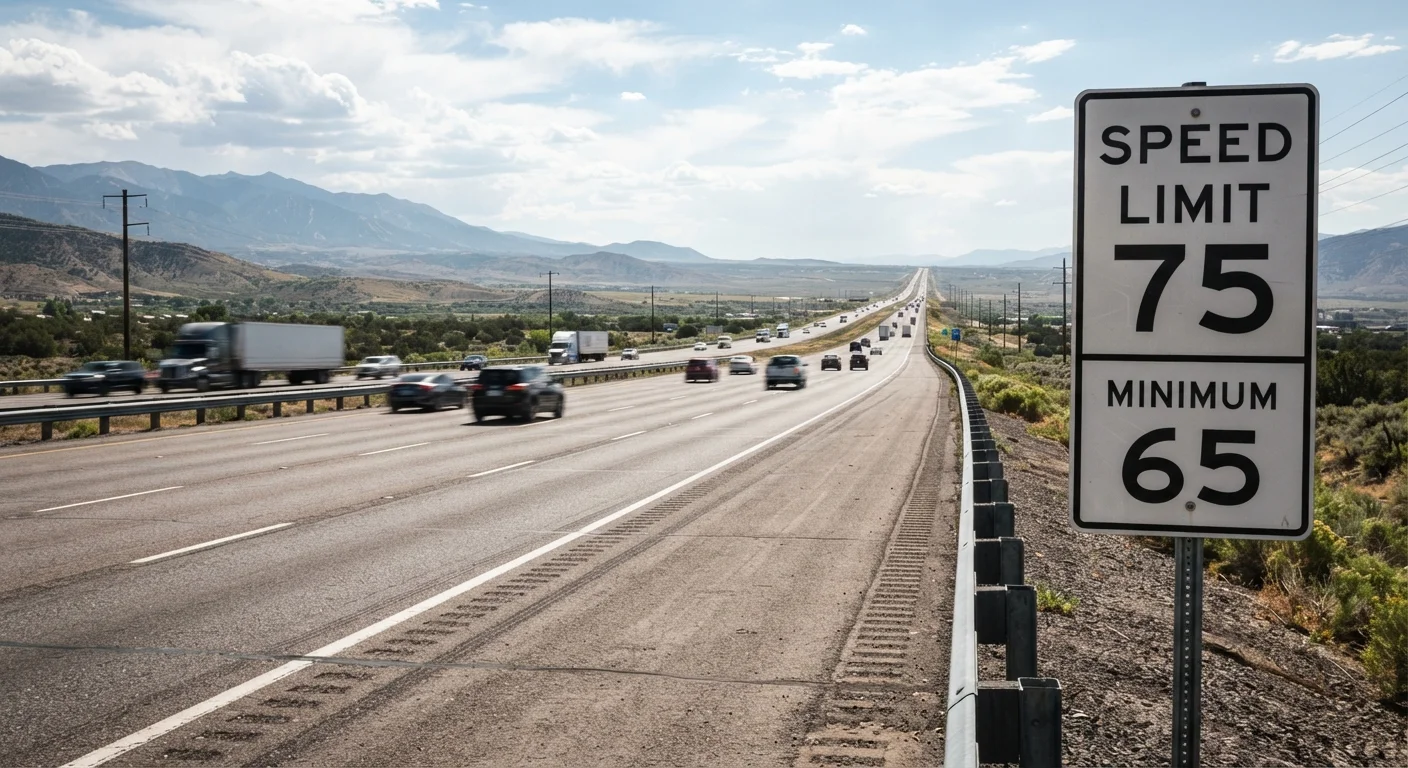
A sweeping rural interstate with long sightlines and wide lanes can safely accommodate higher speeds because drivers have more time and space to react. A residential street with driveways every 50 feet, parked cars narrowing sightlines, and children present is a different engineering environment entirely - hence the 25 mph typical limit.
School zones and pedestrian-heavy areas receive even lower limits because crash severity for vulnerable road users increases sharply above certain thresholds. Research consistently shows that a pedestrian struck at 40 mph faces a dramatically higher fatality risk than one struck at 20 mph - a relationship rooted in the same energy physics described above.
For a broader look at how environment shapes safe driving behavior, see our guide to highway vs. city driving.
Reaction distance
The distance a vehicle travels between the moment a driver perceives a hazard and the moment they actually apply the brakes. At highway speeds, even 1.5 seconds of reaction time translates to dozens of feet of uncontrolled travel.
Braking distance
The distance required for a vehicle to come to a complete stop after the brakes are fully applied. It is determined by vehicle speed, tire condition, road surface, and brake quality - and increases exponentially with speed.
Kinetic energy
The energy a moving object possesses due to its motion, calculated as one-half times mass times velocity squared. Because velocity is squared, small increases in speed produce large increases in energy - and crash force.
Sight distance
The length of road ahead that a driver can see clearly and without obstruction. Traffic engineers use sight distance to determine whether a speed limit, curve, or intersection is safe for drivers to navigate effectively.
Design speed
The maximum speed at which a road's geometric features - curves, grades, sight lines - are engineered to function safely. Posted speed limits are typically set at or below the design speed.
Why Speed Matters Even When You Feel in Control
A common driver belief is that personal skill compensates for speed - that an experienced, attentive driver can safely exceed posted limits. The physics disagrees. Reaction time is relatively fixed across healthy adults; what changes with excess speed is how much road disappears beneath your tires while you're reacting.
Following distance compounds the problem. The faster you travel, the greater the gap you need ahead to stop safely, yet many drivers maintain the same physical space regardless of speed. Our article on tailgating covers the science of safe following distances in detail.
Unexpected hazards - a deer crossing, a tire blowout, a child darting from between parked cars - don't announce themselves. The margin between seeing a hazard and reaching it shrinks rapidly as speed climbs. That margin is what speed limits are designed to protect.
Understanding these principles is a foundation of defensive driving, which treats posted limits not as suggestions but as engineering minimums for safe road use. Combine that mindset with scanning ahead for hazards and you meaningfully reduce your risk exposure on every trip.
4×
Energy increase when speed doubles
Because kinetic energy scales with the square of velocity, doubling your speed quadruples the energy that must be absorbed in a crash or stop.
~240 ft
Stopping distance at 60 mph on dry pavement
Based on AASHTO stopping sight distance standards for an alert driver under normal conditions.
3×+
Stopping distance increase from 30 to 60 mph
Despite only doubling in speed, total stopping distance more than triples due to the non-linear relationship between speed and braking distance.