
Fitness for Adults Over 50: What Changes, What Stays the Same, and What to Prioritize

Key Takeaways
How the Body Changes After 50
Understanding what physically shifts after 50 helps explain why certain exercise priorities deserve more attention - and why others remain exactly as important as ever.
The most significant changes involve three interconnected systems:
- Muscle mass (sarcopenia): Adults can lose 3-8% of muscle mass per decade after 30, with the rate accelerating after 60. This affects strength, metabolism, and the ability to perform everyday tasks.
- Bone density: Peak bone mass occurs in early adulthood. After 50, bone loss can accelerate - particularly for postmenopausal women - increasing fracture risk if left unaddressed.
- Balance and proprioception: The body's ability to sense its own position in space (proprioception) declines gradually, contributing to a higher fall risk in older adults.
Recovery also slows. Inflammation after exercise takes longer to resolve, and soft tissues - tendons, ligaments, and cartilage - become less resilient to high-impact stress. This doesn't mean avoiding intensity; it means building in adequate recovery time.
3-8%
Muscle mass lost per decade after age 30
According to research published in the Journal of Cachexia, Sarcopenia and Muscle, this rate typically accelerates after age 60.
2x
Fall risk reduction with balance training
A Cochrane review of exercise interventions found that balance and functional training can reduce fall rates among older adults by roughly half.
150 min
Weekly moderate aerobic activity recommended
The U.S. Department of Health and Human Services Physical Activity Guidelines for Americans recommend at least 150 minutes of moderate-intensity aerobic activity weekly for adults.
These changes are real, but none are inevitable in their severity. Research consistently shows that physically active adults over 50 retain significantly more muscle, bone density, and functional capacity than sedentary peers of the same age.
What Stays the Same: Core Fitness Principles That Don't Expire
Age changes what to emphasize and how to manage load - but the foundational rules of exercise science remain intact.
- Progressive overload still works: The body adapts to increasing challenge. Whether you're 25 or 65, gradually increasing resistance, duration, or complexity is still what drives improvement.
- Consistency beats intensity: Three moderate sessions per week over a year outperforms three intense weeks followed by injury or burnout. This is true at every age.
- Rest is productive: Muscle is built during recovery, not during the workout itself. Sleep and rest days are components of the program, not gaps in it.
- Nutrition supports training: Protein intake is particularly relevant for preserving muscle. See our guide to nutritional needs across life stages for how dietary priorities shift in older adulthood.
It's also worth challenging the assumption that high-impact or vigorous exercise is off-limits after 50. Many adults in their 50s, 60s, and beyond run, lift weights, cycle competitively, and practice martial arts. The starting point matters more than the age. Our article on common fitness myths addresses several misconceptions that discourage older adults unnecessarily.
When designing a program for adults over 50, prioritize movement quality before load. Getting the mechanics right under light resistance first prevents compensatory patterns that lead to injury when weights increase.
Poor movement mechanics under low load become unsafe movement mechanics under heavy load - a risk that's amplified when tissue resilience has decreased.
Schedule recovery days as deliberately as training days. Marking them in a calendar - rather than treating rest as 'nothing' - reinforces that recovery is an active part of making progress.
Adults over 50 often need 48-72 hours between sessions targeting the same muscle groups, and treating rest as intentional rather than passive improves adherence to the full program.
What to Prioritize: The Four Pillars of Fitness After 50
Most adults benefit from balancing four categories of physical activity. After 50, each carries slightly different weight in the overall program.
1. Strength Training
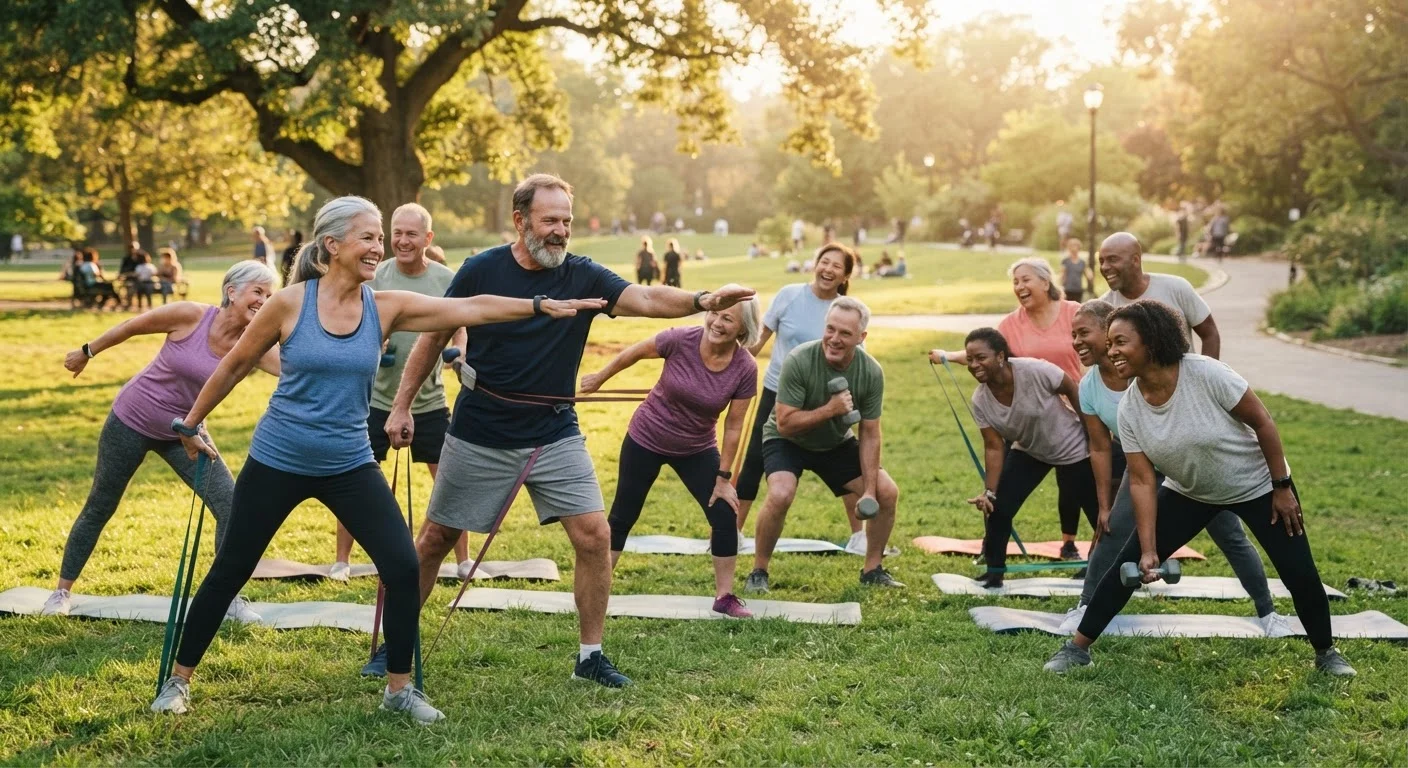
Resistance exercise is arguably the most impactful modality for adults over 50. It directly counters sarcopenia, supports bone density, improves insulin sensitivity, and helps maintain a healthy body composition. Two sessions per week targeting major muscle groups is a widely supported starting point, though individual capacity varies considerably. Bodyweight exercises, resistance bands, free weights, and machines can all be effective.
2. Balance and Stability Work
Falls are a leading cause of injury-related hospitalizations among older adults. Targeted balance training - single-leg exercises, stability challenges, tai chi, yoga - improves proprioception and reduces fall risk meaningfully. This category is frequently underrepresented in most people's routines.
3. Cardiovascular Activity
Aerobic fitness supports heart health, cognitive function, mood, and longevity. Walking remains one of the most accessible and evidence-supported options - our deep dive on walking's health benefits outlines just how broad its impact can be. Swimming, cycling, and low-impact group fitness are excellent alternatives for those with joint sensitivities.
4. Flexibility and Mobility
Joints and connective tissue lose range of motion with age and disuse. Regular stretching, yoga, or mobility work helps maintain function and reduces injury risk during other activities. Even 10 minutes of daily mobility work can produce noticeable improvement over weeks.
Mix Modalities Each Week
Rather than specializing in only one type of exercise, aim to touch all four pillars - strength, balance, cardio, and flexibility - across the week. Even brief sessions count. A 10-minute balance and mobility routine in the morning combined with a 30-minute walk and two strength sessions per week covers the essentials without requiring hours of gym time.
Common Barriers and How to Work Around Them
Adults over 50 often face real obstacles that younger exercisers don't encounter with the same frequency. Acknowledging these honestly - rather than minimizing them - leads to more sustainable solutions.
- Joint pain or arthritis
- Low-impact activities like water exercise, cycling, and elliptical training significantly reduce joint stress while maintaining cardiovascular and muscular benefits. A physical therapist can help identify appropriate modifications.
- A history of injury or surgery
- Prior injuries don't disqualify exercise - they require tailoring it. Working with a qualified professional to identify movement patterns that are safe and productive is worth the investment.
- Long periods of inactivity
- Starting from a sedentary baseline is extremely common. Beginning with shorter, gentler sessions and building gradually is both safe and effective. The strategies for sedentary workers article offers approaches that translate well to anyone rebuilding a movement habit.
- Motivation and accountability
- Group classes, walking groups, or exercise partners meaningfully improve adherence. Exercise also has well-documented benefits for mood and stress resilience - explored in our guide to mental well-being across adulthood.
Watch for Overtraining Signs
Persistent fatigue that doesn't resolve with rest, declining performance, disrupted sleep, or increased joint pain can all signal that training load is too high. These signals deserve attention rather than willpower. Scaling back temporarily and allowing fuller recovery is a smarter long-term strategy than pushing through warning signs - especially after 50, when recovery timelines are longer.
Getting Started Safely
Before beginning any new exercise program - especially after a period of inactivity or with existing health conditions - a conversation with a qualified healthcare provider is strongly recommended. This is general health information, not personalized medical guidance, and individual circumstances vary widely.
A few practical starting principles:
- Start below your perceived capacity. Most people overestimate what's sustainable in week one and underestimate what's possible in month six. Beginning conservatively protects against early injury and keeps motivation intact.
- Track how you feel, not just what you do. Fatigue levels, sleep quality, and joint comfort are all informative signals. If recovery feels insufficient, pulling back is a sign of good judgment, not failure.
- Seek qualified guidance when possible. A certified personal trainer with experience in older adult fitness, or a physical therapist, can provide individualized programming that's both safe and efficient.
- Build movement into daily life. Structured exercise sessions matter, but incidental activity - taking stairs, walking to errands, gardening - adds up significantly across a week.
“Exercise is the closest thing we have to a wonder drug. Even modest increases in physical activity can produce meaningful improvements in health outcomes across multiple body systems.”
— Robert Butler, Founding Director, National Institute on Aging
Fitness after 50 isn't about chasing what was possible at 30. It's about building and protecting the capacity to live well - with energy, independence, and resilience - for decades to come.
This article is for general informational purposes only and does not constitute medical advice. Always consult a qualified healthcare professional before beginning a new exercise program or making changes to your physical activity routine, particularly if you have existing health conditions or concerns.