

Key Takeaways
Option A
Free Weights
The versatile, skill-building classic.
Best for: Lifters who want to build functional strength, improve coordination, and train with flexibility across exercises.
Option B
Resistance Machines
The guided, targeted training tool.
Best for: People learning movement patterns, rehabilitating injuries, or isolating specific muscle groups safely.
If you're new to strength training
Resistance Machines
Machines guide your range of motion, making it easier to learn movement patterns and build initial strength without requiring advanced technique.
If you want to build functional, real-world strength
Free Weights
Free weights require balance and coordination, training the stabilizer muscles that translate directly to everyday physical tasks and athletic performance.
If you're recovering from an injury
Resistance Machines
The controlled movement paths on machines can reduce stress on vulnerable joints. Always consult a healthcare professional before resuming training after injury.
If you're training at home or on a budget
Free Weights
A modest set of dumbbells or a barbell offers enormous exercise variety at a fraction of the cost and space of commercial resistance machines.
If you want maximum muscle isolation for hypertrophy
Resistance Machines
Cable machines and pin-loaded machines let you fatigue a target muscle without demanding stabilization effort, which can be useful in a muscle-building program.
What's Actually Different Between the Two
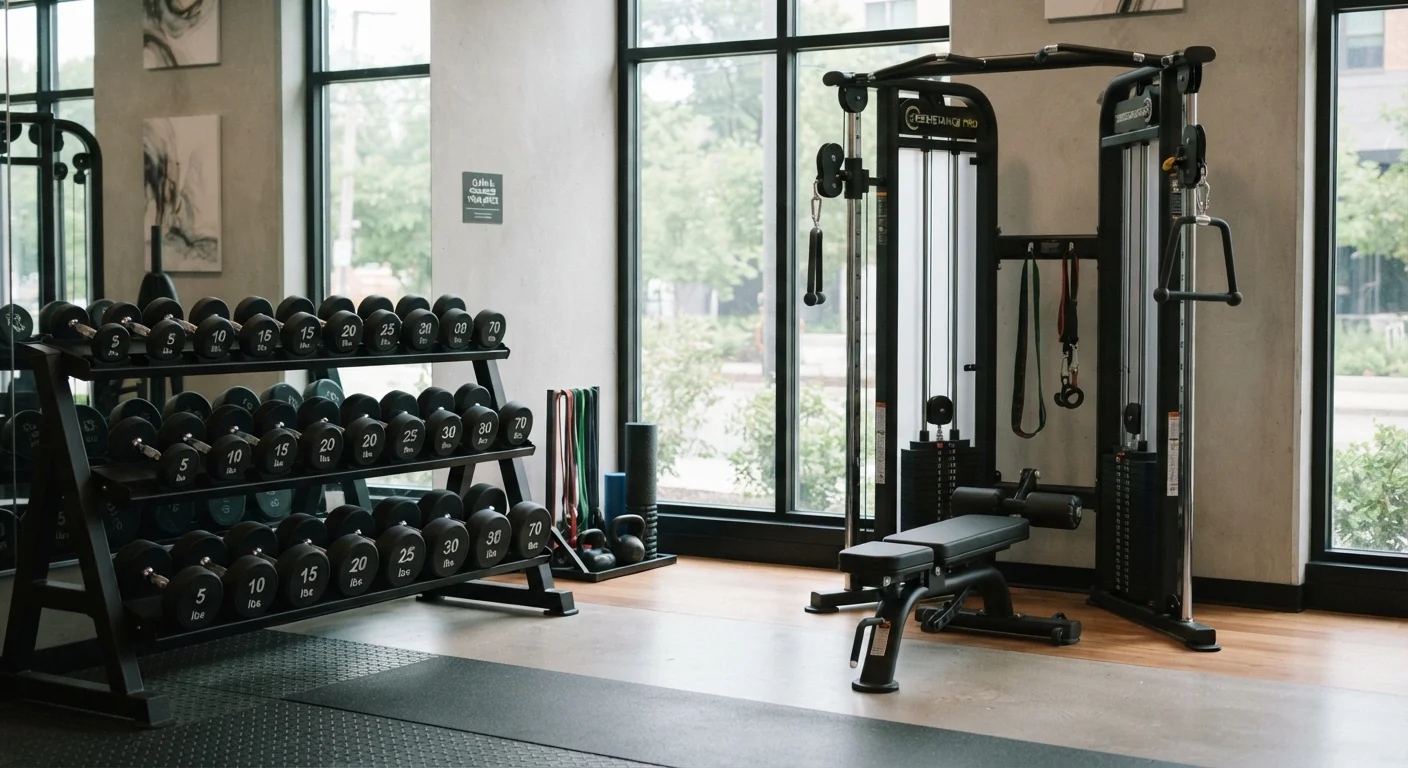
Free weights - dumbbells, barbells, kettlebells, and similar tools - require you to control the load through three-dimensional space. That demand engages not just the primary target muscles but also the surrounding stabilizers that coordinate and balance the movement. Machines, by contrast, fix the movement path for you, concentrating effort on a single muscle group or motion pattern.
This distinction isn't about one being harder or more legitimate than the other. It's about what each tool is optimized to do. Free weights train movement; machines often train muscles. Both are valid goals depending on where you are in your training and what you're working toward.
Understanding what strength training does physiologically can help clarify why these distinctions matter for your overall fitness plan.
| Criterion | Free Weights | Resistance Machines |
|---|---|---|
| Stabilizer muscle engagement | High - requires active balance | Low - movement is guided |
| Learning curve | Steeper; technique is critical | Gentle; easier to start safely |
| Exercise variety | Very high with minimal equipment | Limited to machine's design |
| Injury rehabilitation suitability | Requires careful progression | Often preferred; controlled path |
| Cost and space | Lower cost, compact options | Higher cost, larger footprint |
| Muscle isolation | Possible but less precise | High - targets specific muscles |
| Functional strength transfer | Strong real-world carryover | More limited carryover |
The Case for Free Weights
Free weights shine when the goal is functional strength - the kind that carries over to sports, physical labor, or daily activities like carrying groceries or climbing stairs. Compound movements such as squats, deadlifts, and presses with barbells or dumbbells develop coordination and proprioception (your body's sense of its own position in space) alongside raw strength.
Research consistently supports that multi-joint free weight exercises produce high levels of muscle activation across both primary movers and stabilizers. They also offer enormous variety - a single pair of adjustable dumbbells can support dozens of different exercises, making them practical for home training environments. See our guide to building a home workout space for practical setup ideas.
The trade-off is a steeper learning curve. Performing a barbell squat or overhead press with poor technique increases the risk of injury, particularly to the spine and shoulders. Beginners investing in a few sessions with a qualified personal trainer to establish form fundamentals will typically see better and safer long-term results.
~43%
Greater core activation with free weights
Studies comparing free weight squats to machine leg press have found meaningfully higher activation of core stabilizers with the free weight variation.
~80%
Of gym-goers use both tools
Survey data from fitness industry research suggests most regular gym members use a combination of free weights and machines within their weekly routine.
The Case for Resistance Machines
Machines earn their place in gyms for good reasons. For someone new to resistance training, the guided range of motion removes a significant layer of complexity - you can focus on effort and learning the sensation of muscular work without simultaneously managing balance and coordination under load.
For those returning from injury or managing chronic joint issues, machines allow targeted loading while limiting stress on adjacent structures. A leg press, for example, can build quadriceps strength with less spinal loading than a barbell squat, which may matter for someone managing a lower back condition. (That said, anyone training around an injury should do so under guidance from a physical therapist or physician.)
Machines also allow precise isolation for hypertrophy (muscle growth) goals - a common aim in bodybuilding-style training. Cable machines are particularly versatile, providing constant tension through the full range of a movement in ways free weights cannot always replicate.
A Note on Training Around Injuries
Machines are often recommended as a safer starting point for those with joint pain or post-injury reconditioning needs. However, 'safer' is context-dependent - incorrect machine setup (seat height, pad position) can place joints under awkward loads. Always have a trainer or physical therapist show you correct machine configuration, and obtain clearance from a healthcare provider before training through any injury or chronic condition.
How to Build a Balanced Approach
The most effective training programs for most people aren't built around one tool exclusively. A common and well-supported structure is to anchor sessions with compound free weight movements - which deliver the greatest return on time invested - and supplement with machines for additional volume on specific muscles or to train safely around limitations.
Beginners often do well starting on machines to build a base of strength and body awareness before progressing to free weight compounds. Intermediate and advanced lifters frequently use machines strategically for isolation work while keeping free weights central to their programming.
It's also worth noting that many common fitness beliefs don't hold up to scrutiny - including the idea that one training style is inherently superior. The best equipment is whichever you'll use consistently, with good technique and progressive effort over time.
If you're weighing the social and motivational dimensions of your training setup, comparing group classes to solo training may also help you think through what environment supports your consistency.
This article is for general informational and educational purposes only and does not constitute medical or fitness advice. Consult a qualified healthcare professional or certified fitness professional before beginning or modifying any exercise program, particularly if you have existing health conditions or injuries.