

Key Takeaways
Option A
Whole Foods
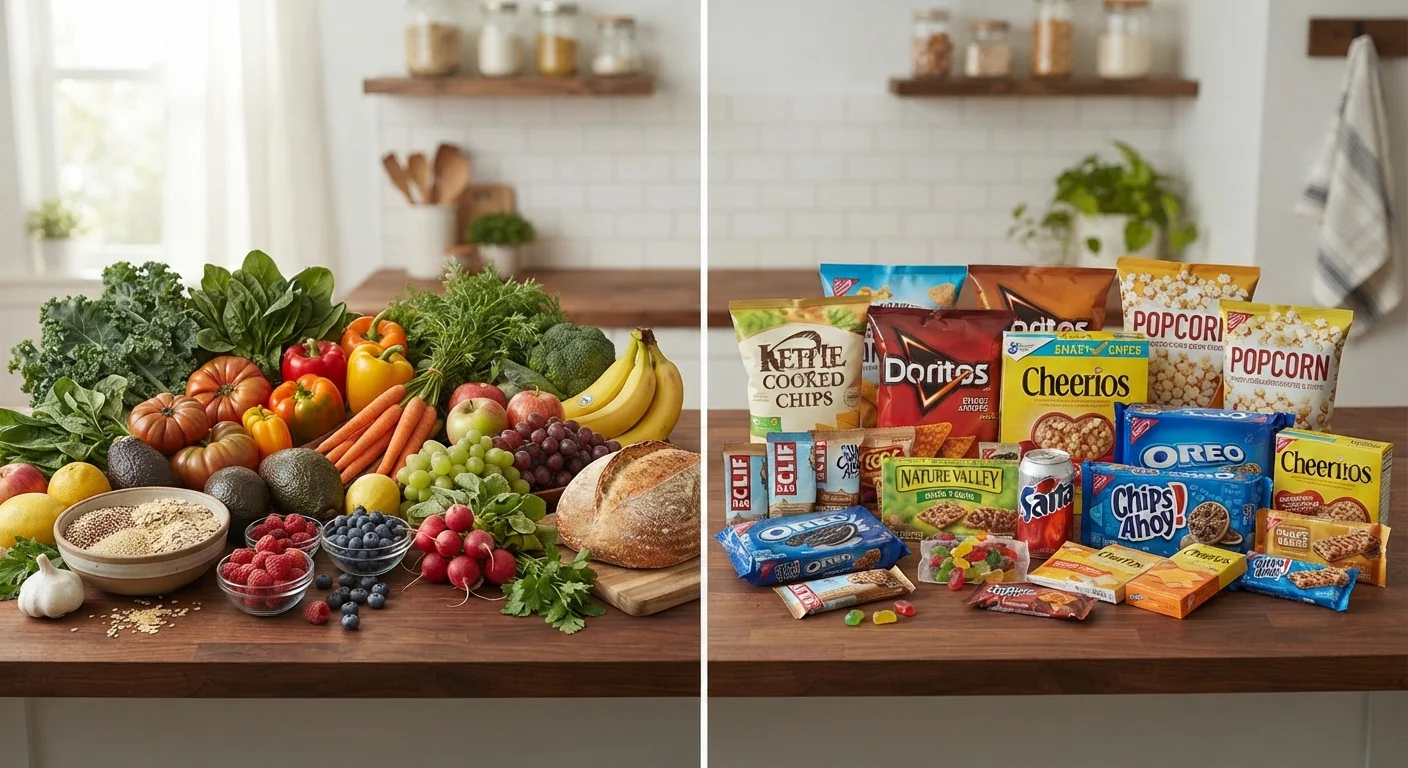
Foods in their natural or minimally altered state.
Best for: People who want to maximize nutrient density and minimize added ingredients across most of their meals.
Option B
Processed Foods
Foods that have undergone some form of industrial or culinary transformation.
Best for: Anyone seeking convenience, shelf stability, or affordable access to nutrition - depending heavily on the degree of processing involved.
If you want to maximize nutrient density in your daily diet
Whole Foods
Whole foods are generally richer in fiber, vitamins, and minerals with fewer added ingredients that dilute nutritional quality.
If convenience and shelf life are priorities without sacrificing nutrition entirely
Processed Foods
Minimally processed options like canned legumes, frozen vegetables, or plain Greek yogurt can be nutritionally comparable to fresh alternatives.
If you're building a realistic, long-term eating pattern
Whole Foods
Anchoring meals in whole foods while allowing for some processed items tends to be more sustainable than rigid elimination of all packaged products.
If you need affordable, accessible food options on a tight budget
Processed Foods
Certain minimally processed staples - canned fish, dried beans, frozen produce - offer strong nutrition at lower cost and longer shelf life.
What 'Processing' Actually Means
The word 'processed' carries significant baggage in popular nutrition conversations, but it describes a vast range of techniques - not a single category of harmful food. At its most basic, food processing includes any step that alters food from its raw state: washing, cutting, cooking, fermenting, freezing, canning, or adding ingredients.
Public health researchers, including those who developed the widely referenced NOVA classification system, divide foods into four groups based on the extent and purpose of processing. Group 1 covers unprocessed or minimally processed foods (fresh fruit, plain oats, unsalted nuts). Group 2 includes culinary ingredients derived from whole foods, like olive oil or flour. Group 3 covers processed foods that add salt, sugar, or preservation to recognizable ingredients - think canned tomatoes or cured meats. Group 4, labeled ultra-processed foods, describes industrial formulations designed primarily for palatability, shelf life, and profit, often containing additives with no culinary equivalent.
The critical distinction, then, is not simply 'processed vs. unprocessed' but rather how extensively a food has been reformulated and what has been added or removed in the process.
Not All Processing Is Equal
Pasteurized milk, plain yogurt, and frozen spinach are all technically processed, yet they retain most of their original nutritional value. The NOVA classification system is a useful research tool, but it isn't a simple 'good/bad' label for every food decision. Context, degree of alteration, and what was added or removed all matter more than the word 'processed' alone.
Nutritional Trade-Offs: A Side-by-Side Look
Whole foods tend to deliver nutrition in its most intact form. An apple provides fiber, vitamin C, and polyphenols as a package deal. Brown rice retains its bran layer, offering more magnesium and fiber than its white counterpart. Minimally processed foods generally preserve these nutritional profiles with little interference.
Ultra-processed foods, however, are frequently engineered to be energy-dense and low in fiber - a combination associated in observational research with higher risks of obesity, cardiovascular disease, and type 2 diabetes. This doesn't mean every item in a package is harmful; the nutritional gap between plain frozen edamame and a cheese-flavored snack chip is enormous, even though both are technically 'processed.'
| Criterion | Whole Foods | Processed Foods |
|---|---|---|
| Definition | Unaltered or minimally changed from natural state | Altered by industrial or culinary methods |
| Fiber content | Generally higher | Often reduced, especially in ultra-processed items |
| Added sugars & sodium | Naturally low or absent | Varies widely; often higher in ultra-processed foods |
| Micronutrient density | High; vitamins and minerals largely intact | Variable; some are fortified, others are depleted |
| Convenience & shelf life | Perishable; requires preparation | Longer shelf life; often ready to eat |
| Cost accessibility | Can be higher for fresh produce | Often lower-cost; canned/frozen options affordable |
| Additives & preservatives | None to minimal | Common, especially in ultra-processed category |
Understanding what's been added or removed from a food is one of the most practical skills you can develop as a consumer. Our guide on reading a nutrition label without getting confused walks through how to spot added sugars, sodium, and fiber content in any packaged product.
Building a Practical Eating Framework
An all-or-nothing approach to whole versus processed food rarely holds up in real life. Cooking from scratch every day isn't feasible for most households, and categorically avoiding packaged food can introduce unnecessary stress around eating - which carries its own health costs.
A more grounded approach centers meals on whole or minimally processed foods - vegetables, legumes, whole grains, lean proteins, fruits - while treating heavily processed items as occasional rather than habitual. This isn't a rigid prescription; it's a general orientation supported by consistent findings across multiple dietary research frameworks.
57%
Share of calories from ultra-processed foods in average U.S. diet
Research published in the BMJ estimated that ultra-processed foods account for more than half of daily caloric intake for many American adults.
2x
Fiber gap between whole and refined grains
Whole grains typically contain roughly twice the dietary fiber of their refined counterparts, according to USDA nutritional databases.
When choosing packaged foods, prioritizing shorter ingredient lists, recognizable components, and lower added sugar and sodium levels can guide you toward better options without requiring perfect food choices. For a broader view of how different eating patterns compare, our analysis of plant-based and omnivorous diets explores how food quality - not just food type - shapes health outcomes. And if added sugar in packaged foods is a concern, the sugar debate unpacks what the evidence actually says.
This article is for general informational and educational purposes only and does not constitute medical or dietary advice. Please consult a qualified healthcare professional or registered dietitian for guidance tailored to your individual health needs.