

Key Takeaways
Why Rug Mistakes Are So Common
Area rugs are one of the most impactful - and most frequently misused - elements in home decorating. They define zones, anchor furniture, add warmth, and introduce texture and color. Yet a surprising number of rooms have rugs that undermine all of those goals, usually because of a handful of very predictable errors.
Most of these mistakes aren't about taste. They're about proportion, placement logic, and understanding how a rug functions within a room's layout. Once you know what to look for, the fixes are often straightforward. If you're starting fresh, our guide for new homeowners decorating from scratch covers foundational decisions room by room - rugs included.
Choosing a rug that's too small for the room or seating group.
Why it happens: Standard rug sizes like 5×7 or 6×9 are widely available and seem large in a showroom or online, but they frequently float in the middle of a room without connecting to any furniture.
Positioning the rug so no furniture legs rest on it.
Why it happens: Homeowners often center the rug in an open area of the floor, treating it like a decorative mat rather than an anchor for the furniture arrangement.
Using the wrong pile height for the room's function.
Why it happens: High-pile rugs are associated with luxury and comfort, so buyers gravitate toward them regardless of where the rug will actually live.
Sizing a dining room rug too small for the table and chairs.
Why it happens: Buyers size the rug to the table itself, forgetting that chairs extend significantly beyond the table edge when occupied or pushed back.
Ignoring rug pad thickness and grip, especially on hard floors.
Why it happens: Rug pads are often seen as an optional accessory rather than a functional necessity, so they get skipped to save money.
Choosing a pattern or color that competes with everything else in the room.
Why it happens: Rugs are often selected in isolation - in a store or online - without accounting for the existing visual weight of furniture, drapes, and wall color.
Room-Specific Rules That Make a Real Difference
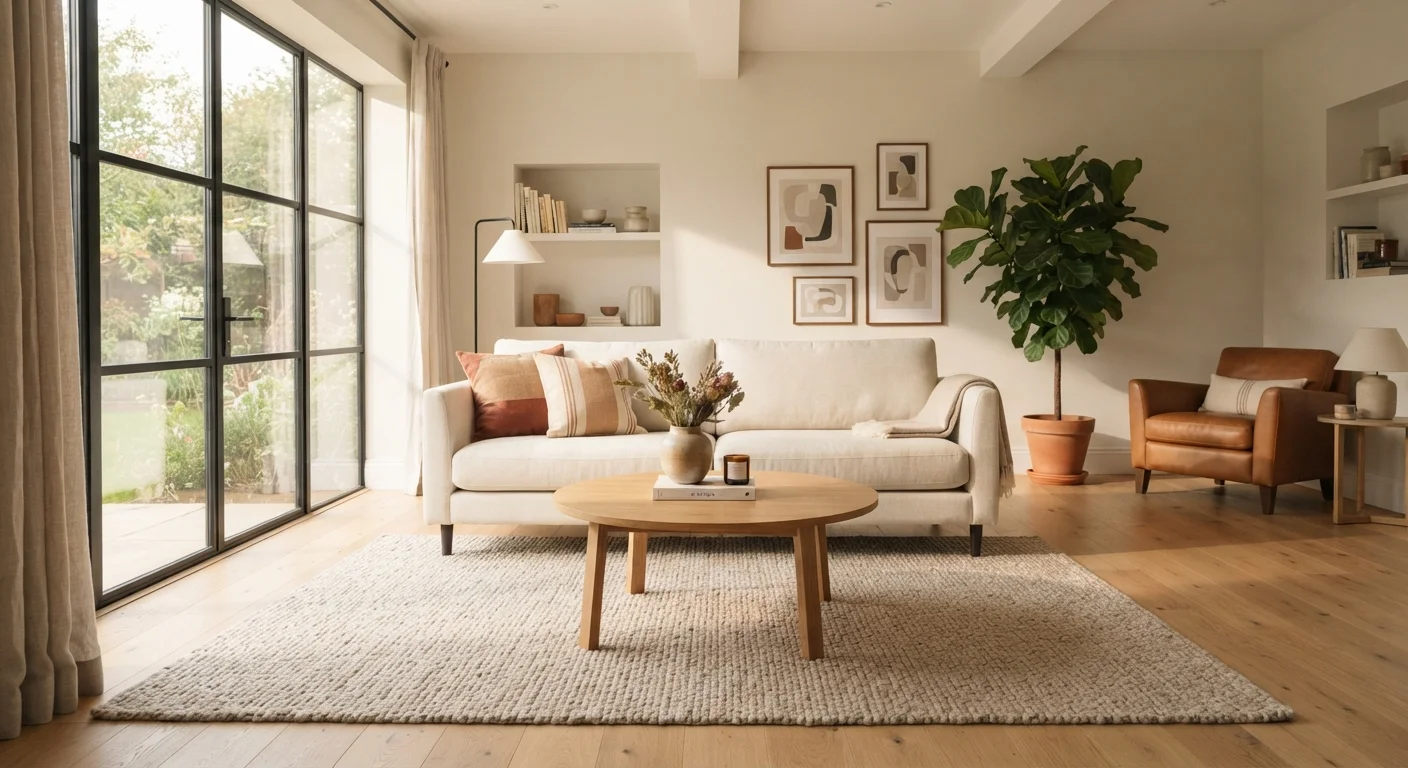
Different rooms have different demands, and a one-size-fits-all approach to rugs rarely works. In living rooms, the goal is to unify the seating arrangement - which means sizing up until all front legs (at minimum) land on the rug. In dining rooms, the rule is even stricter: every chair leg must stay on the rug even when a chair is pulled out from the table. That typically requires adding 24 inches to each side of the table's footprint.
Bedrooms are more forgiving but still benefit from intention. A common approach is to run a large rug under the lower two-thirds of the bed so it extends visibly on the sides and foot - providing a soft landing when you step out in the morning. Alternatively, runners on each side of the bed can serve the same comfort function at a lower cost.
8×10
Minimum rug size for most living rooms
Interior designers broadly recommend an 8×10 ft rug as the starting point for standard living rooms; many spaces benefit from going up to 9×12.
24 in
Extra rug clearance needed per dining table side
Design guidelines consistently call for at least 24 inches of rug beyond each edge of the dining table to keep chair legs on the rug when pulled out.
For those working with compact spaces, the principles are similar but the margin for error is smaller. See our advice on decorating a small living room without sacrificing function for layout strategies that account for rug sizing in tighter footprints.
Rug Slippage Is a Safety Issue
An unsecured area rug on a hard floor - hardwood, tile, or laminate - is a slip-and-fall hazard for everyone in the household, including children and older adults. Always use a non-slip rug pad sized to your rug, and periodically check that it hasn't shifted or degraded. Do not rely on rug tape alone as a long-term solution on high-traffic floors.
Pile height is another room-specific consideration. Low-pile or flat-weave rugs hold up better under dining chairs and in entryways where heavy foot traffic would mat down a shag rug quickly. High-pile options work beautifully in bedrooms and reading nooks where comfort is the priority and foot traffic is minimal. When a room still feels off despite a well-sized rug, it may be a broader design balance issue - foundational design principles can help diagnose what's out of sync.