

Key Takeaways
Why Small Living Rooms Fail - and How to Fix That
Most small living rooms underperform not because of their size but because of decisions made without the room's proportions in mind: furniture that is too large, rugs that are too small, storage that sprawls horizontally instead of rising vertically, and color choices that flatten rather than open the space.
The good news is that nearly every one of these problems is reversible without renovation. The strategies in this guide focus on spatial planning, smart furniture selection, and visual techniques that work in any small living room - whether you own or rent. If you rent, see our companion piece on reversible decorating changes for renters for deposit-safe approaches.
Measure Before You Buy Anything
The single most common mistake in small living rooms is purchasing furniture without verified measurements. Always measure your room's length, width, and any architectural interruptions - doorways, radiators, outlets - before acquiring a single piece. Furniture that looks modest in a showroom can completely block circulation paths at home.
Before working through the steps below, gather your room measurements and take stock of what you have. The tools listed here will make the planning stage significantly faster.
Tape measure
Measure room dimensions and furniture footprints accurately before arranging or purchasing pieces.
Graph paper or free room-planning app
Sketch furniture arrangements to scale before physically moving anything.
Painter's tape
Mark furniture outlines on the floor to visualize placement without lifting heavy objects.
Stud finder
Locate wall studs to safely mount shelving or heavy wall-hung mirrors.
Step-by-Step: Transforming a Small Living Room
Follow these steps in order - the early planning stages will save you significant time and effort later. Each step builds on the one before it.
What you will need
Map the Room Before Moving Anything
Sketch your room to scale on graph paper or use a free room-planning app. Mark every fixed element: windows, doors, outlets, vents, and any architectural features. Then cut out to-scale representations of your current or intended furniture and move them around on paper. This prevents the exhausting cycle of physically repositioning heavy pieces.
Pay attention to traffic flow - there should be at least 30 to 36 inches of clear walking path between major furniture pieces and doorways.
Edit Your Furniture Down to What the Room Actually Needs
Resist the impulse to fill every corner. A small living room typically needs one primary seating piece (a sofa or loveseat), one or two chairs, a coffee table or ottoman, and a surface for storage or display. Every additional piece beyond that needs to justify its presence functionally.
If your current sofa is oversized for the space, consider whether a loveseat or a pair of chairs might serve the same seating capacity with a smaller footprint. See our guide to making a room feel finished for how scale and proportion affect the whole composition.
Choose Multi-Functional Pieces Wherever Possible
In a small living room, every piece should ideally do more than one job. An upholstered storage ottoman can serve as a coffee table, extra seating, and hidden storage simultaneously. A console table behind a sofa doubles as a display surface and a spot to stow baskets underneath.
Nesting tables are another reliable option - they occupy minimal space at rest but expand when you need surface area for guests. The goal is to increase the room's functional capacity without increasing its visual weight.
Get the Rug Size and Placement Right
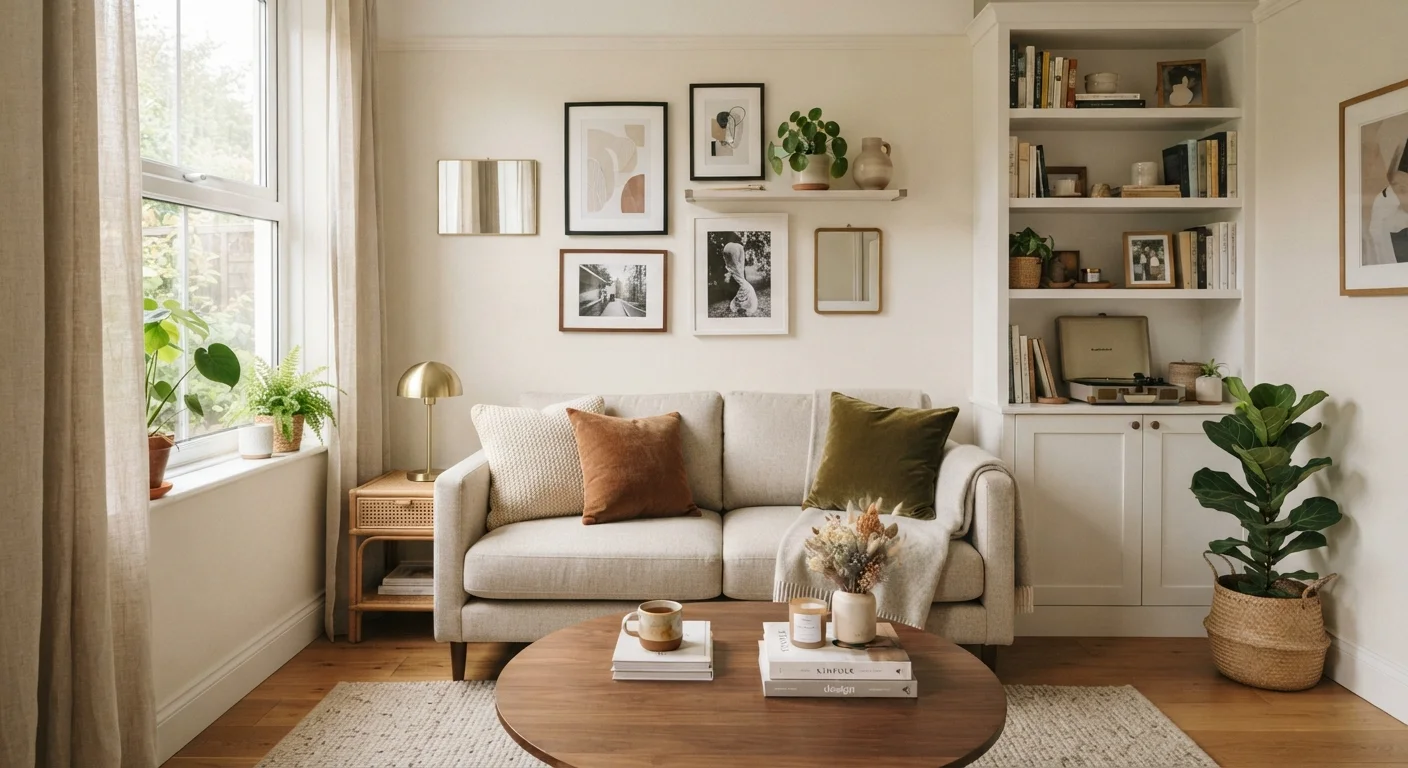
Undersized rugs are among the most common missteps in small living rooms - a rug that is too small actually makes a room feel more cramped, not less. In a typical small living room arrangement, the front legs of all seating pieces should rest on the rug, anchoring the grouping as a unified zone.
For more on this, our article on area rug sizing and placement covers the most common errors and how to correct them.
Use Color and Light to Expand the Space Visually
A cohesive, light palette - soft whites, warm off-whites, pale greiges - on walls and large furniture pieces makes boundaries feel less hard. This does not mean the room must be monochrome; contrast and texture still matter, but introducing them through accessories and soft goods rather than large surfaces keeps the room feeling open.
Hang curtains as close to the ceiling as possible and extend the rod well past the window frame on both sides. This makes windows look larger and ceilings taller - at essentially no structural cost. Natural light should be maximized wherever possible; sheer panels that filter rather than block light are generally a better choice than heavy drapes in a small space.
Build Upward With Vertical Storage and Display
Floor space is finite in a small room, but wall space - especially vertical wall space - is often underused. Floating shelves installed high on the wall draw the eye upward and provide display and storage without eating into the footprint. Tall, narrow bookcases serve the same purpose.
When styling shelves, leave intentional breathing room between objects. Our article on using negative space as a design tool explains why emptiness on a shelf is often as important as what you place on it.
Use Mirrors Strategically, Not Randomly
A well-placed mirror - ideally positioned to reflect a window or a light source - can genuinely amplify brightness and perceived depth. One large mirror tends to work better than several small ones, which can feel busy. Lean a floor mirror in a corner or hang one directly across from your main light source for the best effect.
Avoid Pushing All Furniture Against Walls
It feels intuitive to push sofas and chairs to the perimeter to free up floor space, but this often makes a small room feel more hollow and disconnected. A slight float - even just a few inches from the wall - creates a more purposeful, finished arrangement. Grouping seating around a central point like a coffee table anchors the room far more effectively.
If you're weighing budget trade-offs as you make furniture and decor decisions, our article on where to spend more in home decor offers a useful framework for prioritizing. And if you're thinking about mixing furniture styles as you build the room out, mixing furniture styles without chaos walks through the principles that keep eclectic combinations intentional.