

Key Takeaways
Why These Rules Stuck Around
Interior design "rules" spread the way most household wisdom does: someone said it confidently, it sounded logical, and it got repeated for decades. Some guidelines have genuine merit. Many others are oversimplifications that once served a specific style era or a nervous retailer's sales floor and never quite left the cultural conversation.
The result is that everyday homeowners often second-guess perfectly sound instincts — avoiding a bold wall color, overmatching their furniture, or refusing to layer a brass lamp next to chrome hardware. Understanding which rules hold up (and why) versus which ones simply calcified into myth is the first step toward a home that actually reflects how you live.
For a broader look at how misapplied principles can make a decorated room still feel wrong, see why your room might feel off even after you've followed the rules.
Myth
You should never mix metals in a room — all your hardware, fixtures, and accents need to match.
Fact
Mixing metals is widely practiced by professional designers and, when done with intention, creates depth and visual interest.
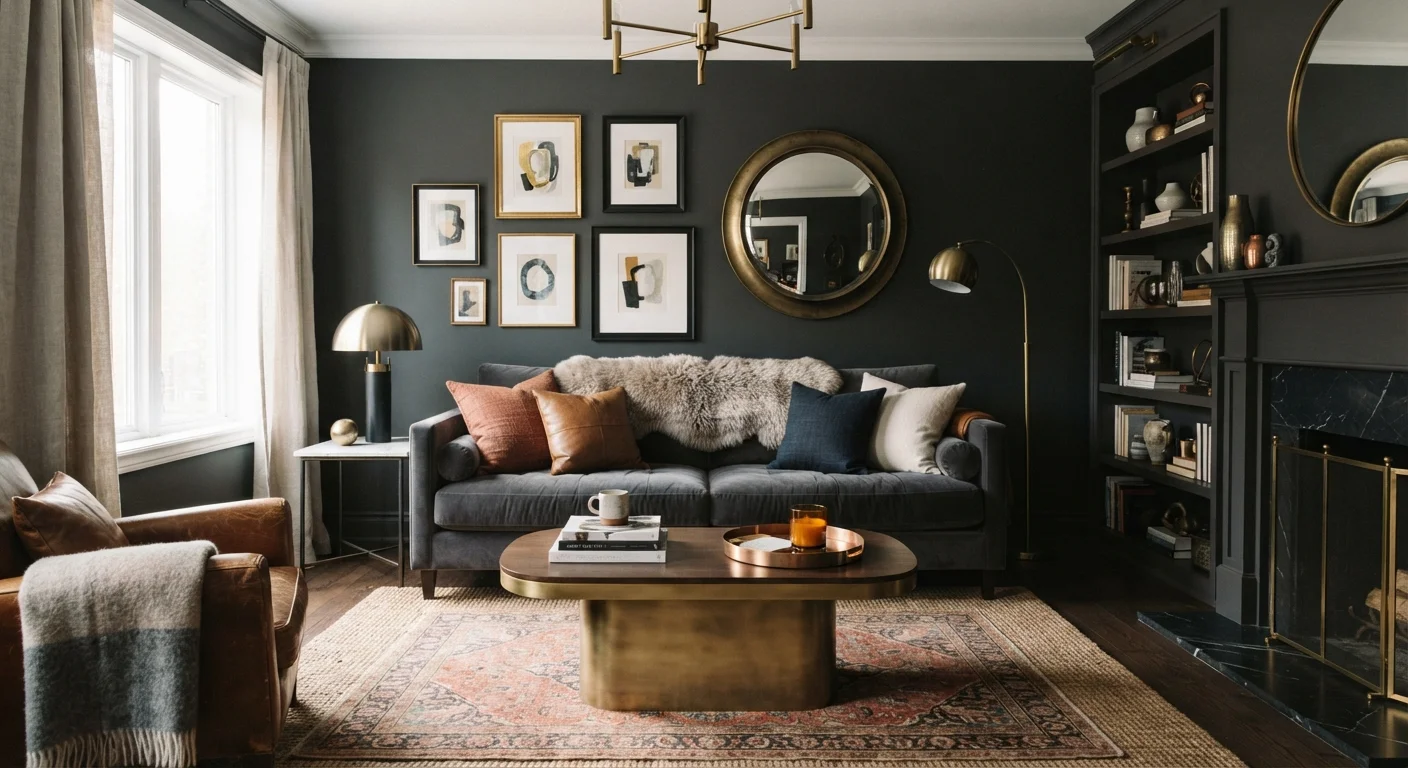
This rule likely emerged from a period when matching sets dominated furniture showrooms. In practice, the most visually dynamic spaces often combine two or three metals — say, a matte black light fixture alongside warm brass cabinet pulls and brushed nickel faucets. The key is repetition: use each metal in at least two places so the combination reads as deliberate rather than accidental. Warm metals (brass, gold, copper) tend to pair well together, as do cool ones (chrome, nickel, pewter). Mixing across the warm-cool divide works too, but benefits from a dominant metal and a smaller accent role for the second.
Myth
Small rooms must be painted light colors to make them feel larger.
Fact
Dark, saturated colors can make a small room feel more intentional and cocooning rather than simply smaller.
Light colors do reflect more light, which can open up a space visually — but that's only one dimension of how a room feels. A small room painted a deep navy or forest green can feel like a considered, intimate space rather than a cramped one. The effect depends heavily on how much natural light the room receives, what the furniture scale is, and what mood is intended. A small home office in charcoal can feel focused and professional; the same room in pale beige might feel unresolved. Context, not the color alone, determines the outcome.
Myth
All furniture in a room should match — same wood tone, same finish, same style.
Fact
Matching everything is considered a dated approach; varied pieces with a unifying thread tend to create more interesting, livable spaces.
The "matchy-matchy" room became a staple of mid-century furniture retail, where coordinated suites were sold as complete solutions. Today, designers typically recommend anchoring a room with one or two statement pieces and building around them with complementary but distinct items. The goal is cohesion, not uniformity — achieved through consistent color palette, repeated materials, or aligned visual weight rather than identical finishes. If you're working through how to combine styles without chaos, mixing furniture styles intentionally covers the guiding principles in depth.
Myth
More accessories and décor always make a room feel more finished and personal.
Fact
Overcrowding surfaces and shelves often produces visual noise; restraint and negative space are active design choices, not signs of an unfinished room.
There's a common anxiety around empty space — shelves with breathing room can feel "not done yet" to a homeowner who's used to seeing styled magazine spreads. But negative space is what allows the eye to rest on and appreciate the objects that are there. A shelf with five well-chosen items reads more confidently than the same shelf crammed with twenty. This doesn't mean minimalism is required — it means that curation, not accumulation, is what makes a space feel resolved. For more on how rooms come to feel finished, the answer rarely involves adding more objects.
Myth
Open floor plans always feel larger and more inviting than divided spaces.
Fact
Open plans can feel cavernous and acoustically challenging; strategic zone definition often makes large open spaces more livable.
Open floor plans became enormously popular partly for practical reasons — they allow natural light to travel further and make supervision of children easier. But an undivided large space can also feel echo-prone, difficult to heat or cool efficiently, and lacking in the distinct "rooms" that give a home psychological variety. Design elements like area rugs, furniture arrangement, lighting zones, and partial shelving units can define distinct areas within an open plan without closing off walls — giving the space both visual openness and functional definition.
Putting the Principles Into Practice
Debunking these myths isn't a license to ignore everything — a handful of design principles genuinely do make spaces feel more cohesive and livable. Scale, proportion, and light layering are concepts that designers return to constantly, not because of tradition but because they're observable and repeatable.
68%
Homeowners who regret a décor decision
According to survey data cited by home improvement research groups, the most commonly regretted decisions involve paint color choices and furniture scale — both areas where myths often lead buyers astray.
3x
Impact of layered lighting vs. single overhead source
Interior design educators consistently note that layered lighting — combining ambient, task, and accent sources — is among the highest-impact, lower-cost changes available to any room.
One principle worth internalizing: every room benefits from multiple light sources at different heights. A single overhead fixture, however attractive, creates flat, shadowless illumination that flattens a space. Layering ambient, task, and accent lighting is one of the most effective — and underused — tools available to any homeowner.
Similarly, rug sizing is one of the most commonly mishandled elements in a room. Most people default to rugs that are too small, which fragments the floor plan and makes seating areas look disconnected. Our guide to area rug sizing and placement walks through the most frequent errors and how to correct them. And if you're curious about how intentional empty space can work as hard as the objects in a room, using negative space as a design tool is worth exploring.
Don't Mistake Trend Cycles for Timeless Rules
Some "rules" circulating online today are simply current trends repackaged as universal truths — the aesthetic consensus of a particular moment, not durable design principle. Before anchoring a renovation decision to a rule you've read recently, ask whether it's describing a proven concept (scale, proportion, light) or a style that's currently popular. For a grounded look at how renovation myths specifically can affect project outcomes, see renovation myths that derail projects.
Design rules that feel restrictive often are. The more useful question isn't "am I breaking a rule?" — it's "does this serve the function and feeling I want in this space?" That reframe tends to produce better results than any checklist.