

| Number of common warning lights | Typically 50-100+ depending on vehicle |
| Color indicating immediate danger | Red - stop or seek help promptly |
| Color indicating caution | Amber/Yellow - monitor and schedule service |
| Color indicating information only | Green or Blue - system active, no action needed |
| TPMS threshold for alert | 25% below recommended PSI (federally mandated) (National Highway Traffic Safety Administration (NHTSA)) |
| Safe to drive with check engine light? | Usually yes if not flashing; schedule service soon |
The Color-Code System: What Light Colors Mean
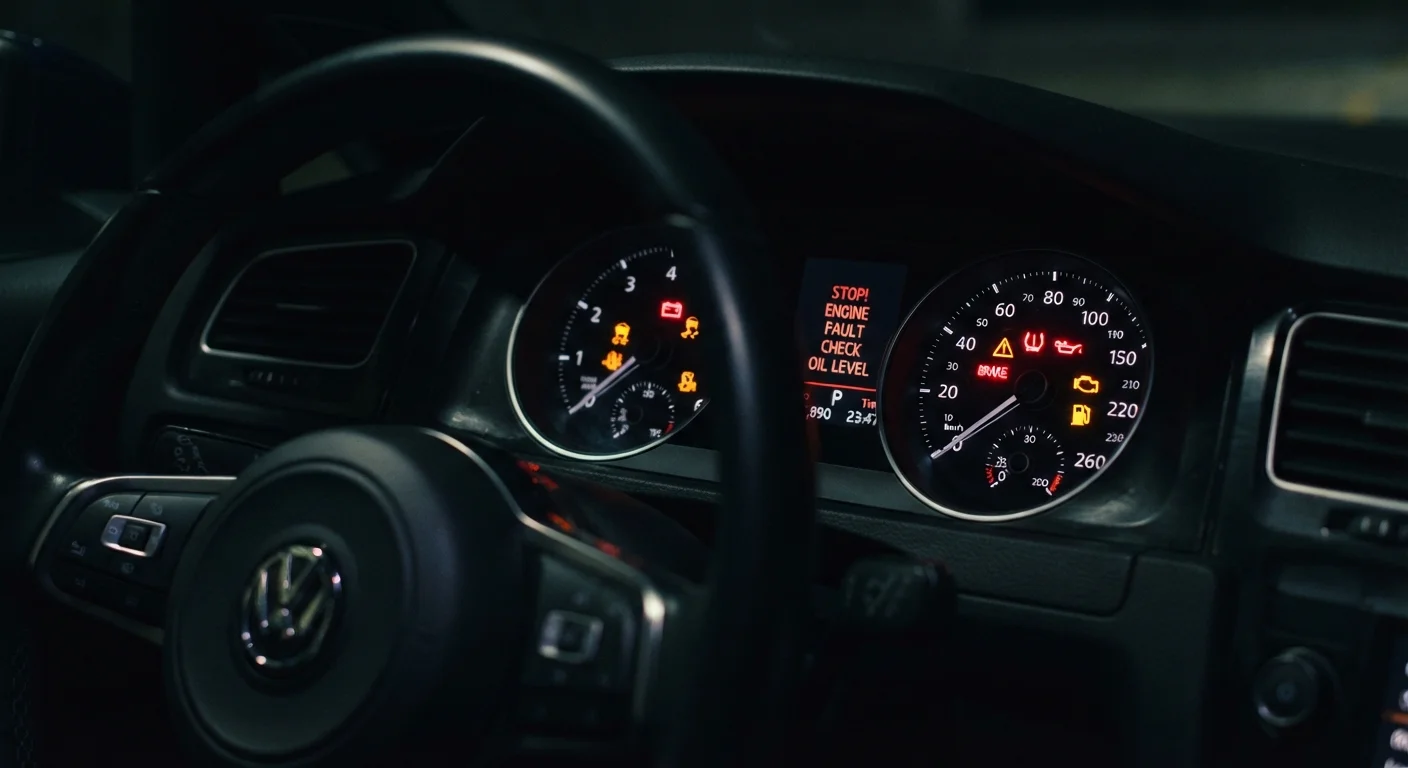
Your dashboard uses a traffic-light-style color system to signal urgency. Understanding this framework lets you make an immediate, informed decision before you even identify the specific symbol.
- Red: Indicates a serious or potentially dangerous condition. Pull over safely when traffic allows and do not continue driving until you understand the cause. Common red lights include low oil pressure, engine temperature, and brake system warnings.
- Amber or Yellow: A caution signal. The vehicle can typically still be driven, but you should schedule a service appointment soon. Ignoring amber lights too long can allow a manageable problem to become expensive.
- Green or Blue: Informational only - a feature is active (e.g., high beams, turn signal, cruise control). No action required.
- White: Some manufacturers use white for driver-assist system notifications, such as lane-keep assist being active or paused.
| Number of common warning lights | Typically 50-100+ depending on vehicle |
| Color indicating immediate danger | Red - stop or seek help promptly |
| Color indicating caution | Amber/Yellow - monitor and schedule service |
| Color indicating information only | Green or Blue - system active, no action needed |
| TPMS threshold for alert | 25% below recommended PSI (federally mandated) (National Highway Traffic Safety Administration (NHTSA)) |
| Safe to drive with check engine light? | Usually yes if not flashing; schedule service soon |
The Most Important Warning Lights Explained
Below are the most frequently misunderstood - or ignored - warning lights, along with what they actually indicate and how urgently you should respond.
OBD-II
On-Board Diagnostics II - a standardized system built into most vehicles sold after 1996 that monitors engine and emissions performance and stores fault codes when a problem is detected.
Malfunction Indicator Lamp (MIL)
The technical name for the check engine light. It illuminates when the OBD-II system detects a fault that affects emissions or engine operation.
Fault Code (DTC)
A Diagnostic Trouble Code stored by your vehicle's computer when a sensor reading falls outside normal range. A mechanic reads these with a scan tool to identify the specific issue.
TPMS
Tire Pressure Monitoring System - a sensor-based system that alerts the driver when one or more tires drops significantly below the recommended inflation pressure.
ABS
Anti-lock Braking System - a safety feature that prevents wheels from locking up during hard braking, helping the driver maintain steering control.
Limp Mode
A reduced-power state the vehicle's computer enters to protect the engine or transmission from further damage when a serious fault is detected.
Check Engine Light (MIL)
A steady amber check engine light means the vehicle's computer has detected an emissions- or engine-related fault. This does not always mean something catastrophic - a loose gas cap is enough to trigger it. However, a flashing check engine light signals a misfire that could damage the catalytic converter. In that case, reduce speed, avoid hard acceleration, and have the vehicle inspected as soon as possible. A qualified mechanic can read the stored fault code (DTC) with a scan tool to pinpoint the cause.
Oil Pressure Warning
This red light - typically an oil can icon - means your engine is not receiving adequate oil pressure. Continuing to drive can cause severe, irreversible engine damage within minutes. Pull over safely, shut off the engine, and check the oil level once the engine has cooled. If oil level is normal, do not restart; the problem may be a failed pump or sensor, both requiring professional diagnosis. See our guide to car fluids for context on what engine oil does.
Coolant Temperature Warning
A red thermometer icon or the temperature gauge peaking into the red zone means the engine is overheating. Turn off air conditioning immediately to reduce engine load, and if the gauge continues to rise, pull over safely and shut down the engine. Driving on an overheated engine can warp cylinder heads - a repair that often costs more than the engine is worth on older vehicles.
Battery or Charging System
This amber or red battery icon indicates the vehicle is running off battery power alone rather than the alternator. Electrical systems will begin failing within minutes. Drive directly to a repair facility if nearby, minimizing power use (turn off AC, radio, and other accessories). Do not shut off the engine if you can avoid it - it may not restart.
Brake System Warning
An exclamation point inside a circle can indicate the parking brake is engaged, brake fluid is low, or the hydraulic brake system has a fault. Confirm the parking brake is released first. If the light persists, brake performance may be compromised - understanding your braking system can help you recognize what's at stake. Have it inspected before driving further if fluid looks low or braking feels unusual.
ABS Warning
This light means the anti-lock braking system has a fault. Your regular brakes will still work, but ABS will not activate during a hard stop. Avoid emergency-braking situations if possible and schedule prompt service.
TPMS (Tire Pressure) Warning
An exclamation point inside a flat-bottomed U-shape means at least one tire is 25% or more below its recommended pressure. Check all four tires with a gauge - the warning light alone doesn't tell you which tire is low or how low it is. Driving on severely underinflated tires increases blowout risk and reduces fuel efficiency. See your door jamb sticker for the manufacturer's recommended PSI.
~77 million
Vehicles with an active check engine light
Estimated by CarMD's annual Vehicle Health Index as vehicles on U.S. roads carrying an unaddressed fault code.
25%
PSI drop that triggers TPMS warning
Federal law (NHTSA FMVSS No. 138) requires TPMS to alert drivers when tire pressure falls 25% below the placard-recommended level.
~40%
Of check engine lights tied to oxygen sensor or gas cap
According to CarMD vehicle health data, loose or faulty gas caps and oxygen sensors are among the most common MIL triggers nationally.
For broader context on staying alert to vehicle problems while driving, see our guide to spotting road hazards early.
Your Owner's Manual Is the Definitive Reference
Dashboard symbols are not fully standardized across all manufacturers. While many icons follow ISO conventions, some automakers use proprietary variations. Always consult your vehicle's owner's manual to confirm what a specific light means for your make, model, and year. A digital copy is often available through the manufacturer's website if the printed version isn't on hand.
When to Drive On vs. When to Stop Immediately
Not every warning light demands you pull over on the spot - but some do. Use this framework to decide:
| Light | Drive On? | Action |
|---|---|---|
| Check engine (steady) | Yes, cautiously | Schedule diagnostics within a few days |
| Check engine (flashing) | Reduce speed only | Service ASAP - catalyst damage risk |
| Oil pressure (red) | No | Stop safely, shut off engine |
| Coolant temperature (red) | No | Stop safely, let engine cool |
| Battery/charging | Brief distance only | Head directly to service |
| Brake system | Only if parking brake issue | Inspect before driving if persists |
| TPMS | Yes, to nearest air source | Check and inflate tires promptly |
| ABS | Yes, with care | Schedule service; avoid hard stops |
When in doubt, the safest approach is always to have the vehicle diagnosed by a qualified mechanic before continuing to drive. Driving with an active warning light can, in some cases, affect your vehicle warranty or complicate an insurance claim. For a broader understanding of your coverage obligations, the plain-language breakdown of auto insurance policies is a useful reference.