

Key Takeaways
Creates a clear focal point in the room
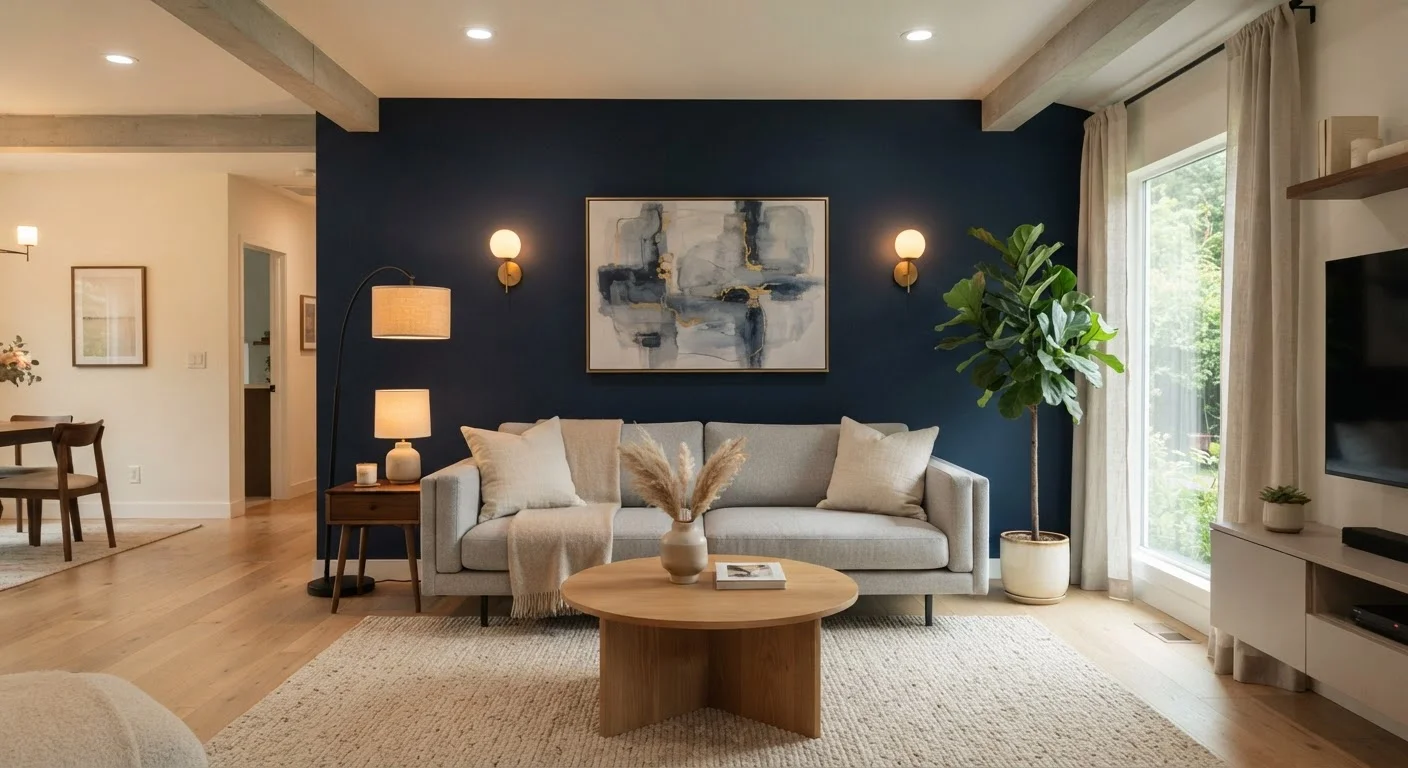
A well-placed accent wall directs the eye toward the room's most intentional feature, whether that's a bed, a fireplace, or a dining table. This reduces visual noise and gives the space a sense of composition.
Lower cost than repainting the entire room
Treating one wall uses a fraction of the materials required for a full repaint, making it one of the more budget-accessible ways to dramatically shift a room's feel.
Can improve spatial proportion in elongated rooms
A darker or visually heavier treatment on the far wall of a narrow room creates the optical illusion of bringing that wall closer, making the proportions feel more balanced.
Allows experimentation with bold colors or textures
A single wall is a contained canvas for trying a color, material, or pattern that would feel overwhelming across all four walls - lowering the risk of a commitment you'll regret.
Defines zones in open-plan spaces
In homes where living, dining, and kitchen areas share one large room, an accent wall can visually anchor each zone without the need for physical partitions.
Arbitrary placement looks decoratively random
When there's no architectural reason to highlight a particular wall, the accent can feel like a design afterthought rather than an intentional choice, which undermines the room's overall cohesion.
Dark colors can shrink light-starved rooms
Without sufficient natural or layered artificial lighting, a heavily saturated accent wall absorbs rather than reflects light, making a small or dim room feel noticeably more confined.
Can clash with existing patterns or art
Bold wallpaper or graphic paint treatments compete directly with patterned upholstery, large artwork, or gallery walls, potentially making the room feel visually fragmented.
May not suit square or unusual room proportions
In a roughly square room, accenting one wall emphasizes asymmetry without the spatial payoff that the technique offers in rectangular spaces, sometimes making the room feel off-balance.
Trendy execution dates quickly
Certain material trends - shiplap, peel-and-stick geometric tile, novelty murals - cycle in and out of favor faster than classic paint or neutral texture, potentially dating an interior within a few years.
Our Verdict
Accent walls are neither outdated nor automatically effective - their success depends almost entirely on execution. When they align with a room's architecture, scale, and existing color palette, they add depth and visual purpose. When they're added as an afterthought, they can fragment a space and draw attention to its weaknesses.
Best for homeowners and renters who want to add visual interest or define a space without committing to a full room repaint or renovation.
The Case for Accent Walls
An accent wall - one wall treated differently from the rest through paint, wallpaper, wood paneling, tile, or texture - has been a go-to design move for decades. And despite periodic declarations that the trend is dead, interior designers continue to use the technique. The reason is straightforward: when done well, it works.
The core benefit is focal point creation. Every well-designed room benefits from a visual anchor - something the eye lands on first. An accent wall can serve that role efficiently, especially in open-plan spaces where furniture alone may not be enough to define a zone. A dining area separated from a living room by a single contrasting wall can feel intentional rather than ambiguous.
Accent walls are also one of the more affordable ways to change a room's character. A single wall requires far less paint, wallpaper, or paneling than four walls, lowering both material and labor costs. For renters who can paint, it's a practical way to personalize a space without a full commitment. For homeowners, it's a low-stakes way to test a bold color or material before going all in.
Creates a clear focal point in the room
A well-placed accent wall directs the eye toward the room's most intentional feature, whether that's a bed, a fireplace, or a dining table. This reduces visual noise and gives the space a sense of composition.
Lower cost than repainting the entire room
Treating one wall uses a fraction of the materials required for a full repaint, making it one of the more budget-accessible ways to dramatically shift a room's feel.
Can improve spatial proportion in elongated rooms
A darker or visually heavier treatment on the far wall of a narrow room creates the optical illusion of bringing that wall closer, making the proportions feel more balanced.
Allows experimentation with bold colors or textures
A single wall is a contained canvas for trying a color, material, or pattern that would feel overwhelming across all four walls - lowering the risk of a commitment you'll regret.
Defines zones in open-plan spaces
In homes where living, dining, and kitchen areas share one large room, an accent wall can visually anchor each zone without the need for physical partitions.
There's also a spatial dimension worth noting. A darker or visually heavier accent wall on the far end of a long, narrow room can make the space feel more proportional by appearing to bring that wall forward. Used this way, the technique does genuine design work - not just decorative work. This connects to broader principles covered in our guide to what makes a room feel finished.
Where Accent Walls Go Wrong
The same technique that adds cohesion in one room can undermine another. The most common failure mode is arbitrary placement - picking a wall simply because it seemed like the right move, rather than because the room's architecture supports it. An accent wall that doesn't align with any natural focal point (a fireplace, a bed headboard wall, a built-in bookcase) can feel decoratively random, drawing attention to an otherwise unremarkable surface.
Color choice compounds the problem. A deeply saturated accent wall in a small room without adequate layered lighting can make the space feel compressed and dim. Dark colors absorb light rather than reflect it, and a single accent wall won't compensate for a room that lacks ambient, task, and accent lighting working together.
Arbitrary placement looks decoratively random
When there's no architectural reason to highlight a particular wall, the accent can feel like a design afterthought rather than an intentional choice, which undermines the room's overall cohesion.
Dark colors can shrink light-starved rooms
Without sufficient natural or layered artificial lighting, a heavily saturated accent wall absorbs rather than reflects light, making a small or dim room feel noticeably more confined.
Can clash with existing patterns or art
Bold wallpaper or graphic paint treatments compete directly with patterned upholstery, large artwork, or gallery walls, potentially making the room feel visually fragmented.
May not suit square or unusual room proportions
In a roughly square room, accenting one wall emphasizes asymmetry without the spatial payoff that the technique offers in rectangular spaces, sometimes making the room feel off-balance.
Trendy execution dates quickly
Certain material trends - shiplap, peel-and-stick geometric tile, novelty murals - cycle in and out of favor faster than classic paint or neutral texture, potentially dating an interior within a few years.
Pattern-based accent walls - bold wallpaper, geometric murals, shiplap - carry additional risk. They can clash with existing furniture or art, making the room feel visually chaotic. As our piece on mixing furniture styles without chaos explains, intention and restraint are what separate an eclectic room from a cluttered one. The same logic applies here: one bold statement competes with every other bold statement in the room.
Renters should also verify lease terms before painting or applying removable wallpaper, since policies vary significantly by landlord and property.
How to Decide If an Accent Wall Is Right for Your Room
Before committing to a treatment, ask a few diagnostic questions about the room itself.
- Is there an obvious architectural feature to reinforce? A fireplace wall, the wall a bed sits against, or a wall with a built-in niche are natural candidates. If no such feature exists, an accent wall may feel imposed rather than discovered.
- What is the room's primary light source? Rooms with strong natural light or well-planned artificial lighting can support darker or more saturated treatments. Dimly lit rooms rarely benefit from further light absorption.
- How much visual complexity already exists? A room with patterned upholstery, a gallery wall, or varied textures may not need another competing element. Conversely, a very neutral room might genuinely benefit from one.
- What is the room's proportion? Square rooms are trickier than rectangular ones. Highlight the wrong wall in a square room and you may make it feel more asymmetrical without any spatial payoff.
Testing Before You Commit
Many paint retailers offer large sample cards or sample-size pots specifically for this reason. Apply a swatch at least 12 inches square and observe it over 24-48 hours under both daylight and your artificial lighting. Peel-and-stick wallpaper is another low-stakes way to preview a pattern before purchasing full rolls. The few dollars spent on a sample can prevent a costly mistake.
When in doubt, test before committing. Large paint swatches or temporary peel-and-stick wallpaper samples let you live with a treatment before it becomes permanent. Observe the wall at different times of day and under artificial light before making a final decision.