

Key Takeaways
Option A
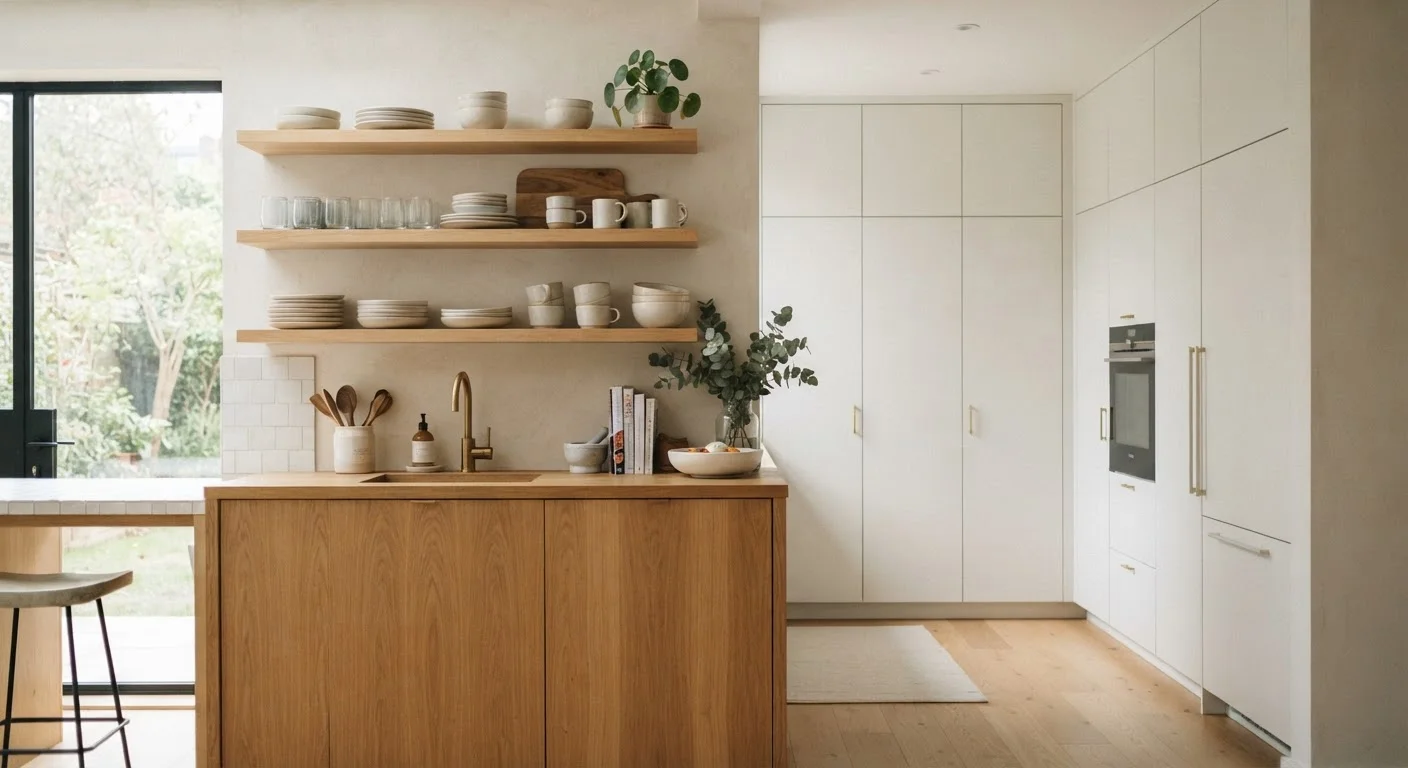
Open Shelving
The airy, display-forward option.
Best for: Homeowners who keep a curated, tidy kitchen and want to create a sense of openness or personalize their space visually.
Option B
Closed Cabinets
The practical, clutter-concealing standard.
Best for: Households that prioritize organized storage, easy cleaning, and a polished look without daily styling effort.
If you cook frequently and need to store a lot of mismatched gear
Closed Cabinets
High-volume cooking produces grease and steam that quickly coat open shelves. Closed doors keep everything protected and visually calm.
If you have a small kitchen and want it to feel larger
Open Shelving
Removing upper cabinet doors opens sightlines and adds visual depth - a well-documented trick for making compact kitchens feel more spacious.
If you have young children or a busy household
Closed Cabinets
Doors keep contents safe from accidents, limit visual disorder, and reduce the daily effort required to maintain a presentable kitchen.
If you want to display ceramics, glassware, or collected items as décor
Open Shelving
Open shelves turn everyday items into a design feature, giving your kitchen personality without additional wall art or accessories.
If you want maximum flexibility with minimal renovation commitment
Open Shelving
Floating shelves are among the more affordable and reversible kitchen updates, making them a lower-stakes way to shift your kitchen's aesthetic.
The Real Difference Between the Two
Open shelving replaces cabinet doors - or cabinetry entirely - with exposed brackets and boards that put your kitchen contents on display. Closed cabinets use doors, drawers, and face frames to keep contents hidden behind a uniform surface. That single structural difference ripples into every aspect of kitchen life: what you store, how often you clean, how the room feels, and how much effort it takes to look put-together.
Neither option is inherently superior. Design publications tend to romanticize open shelves, while renovation contractors often note how quickly clients switch back to doors after a few months of real-world use. The smartest kitchens borrow from both - and the right balance depends almost entirely on how your household actually uses the space.
| Criterion | Open Shelving | Closed Cabinets |
|---|---|---|
| Visual effect | Airy, spacious, decorative | Uniform, polished, contained |
| Dust & grease exposure | High - items exposed daily | Low - contents protected by doors |
| Daily maintenance effort | Higher - tidiness always visible | Lower - clutter hidden easily |
| Access speed | Immediate for everyday items | Requires opening doors/drawers |
| Installation complexity | Generally lower; floating shelves are simpler | Higher; custom work adds significant cost |
| Reversibility | High - easy to adjust or remove | Low - removal leaves walls to repair |
| Works best for | Curated, matched dishware | Varied, everyday household storage |
What Open Shelving Does Well - and Where It Struggles
Open shelves have genuine advantages. They make a kitchen feel more spacious by eliminating the visual bulk of upper cabinet boxes. If you use the same handful of dishes and glasses every day, open shelving provides fast, intuitive access - no doors to swing open, no rummaging in the back of a cabinet. They also give the room personality. A well-arranged shelf of matching ceramics, a few cookbooks, and a plant or two reads as intentional design rather than storage.
The difficulty is maintenance. Kitchens generate grease particles and steam with every meal, and open shelves collect both. Items at the back of a shelf - especially ones you don't reach for daily - gather dust and residue faster than most people expect. If your shelf contents are mismatched or haphazardly arranged, the visual effect works against you. Using intentional negative space on shelves is one approach that helps prevent the overloaded, cluttered look that trips up many open-shelf kitchens.
Open shelving is also less forgiving if your kitchen faces humidity, heavy cooking odors, or a lot of foot traffic from kids and pets.
~65%
Homeowners preferring closed upper cabinets
Industry surveys from kitchen design associations consistently find closed cabinetry remains the majority preference in American kitchen renovations.
2-3×
Faster dust buildup on open shelves near stoves
Home cleaning experts note that surfaces near cooking zones accumulate grease and particulate significantly faster than shelving in lower-traffic kitchen zones.
What Closed Cabinets Do Well - and Their Trade-Offs
Closed cabinetry remains the dominant choice in American kitchens for good reason: it conceals imperfection. Mismatched Tupperware, half-used bags, spare appliances - all of it disappears behind a door. Grease and dust settle on surfaces you wipe down every few weeks rather than on items you'll eventually eat from. In a busy household, this translates directly to less daily upkeep.
Cabinets also protect contents. Glassware stored behind doors stays cleaner and is less susceptible to accidental knocks. For anyone storing spices, oils, or specialty ingredients, cabinet interiors shield products from light degradation.
The trade-offs are space and cost. Standard upper cabinets create visual mass, which can make smaller kitchens feel more enclosed. Understanding what drives kitchen remodel costs matters here: custom cabinetry is one of the most significant line items in any renovation budget, and even semi-custom options add up quickly. Deep cabinets can also create dead zones where items get lost - a real functional problem that requires thoughtful interior organization to solve.
How to Think About a Hybrid Approach
Most real kitchens land somewhere in the middle. A practical hybrid strategy: keep lower cabinets closed (they're more prone to mess and harder to style attractively) and introduce open shelving selectively on upper walls, especially in areas away from the stove. This captures the visual openness of exposed shelving while preserving the practicality of closed storage where it counts most.
Consider which items you actually want displayed. Everyday dishware in a consistent style, glassware, and a few well-chosen objects can look intentional. Cleaning supplies, miscellaneous containers, and baking gear are better stored out of sight. Investing strategically in a few quality pieces for open display - rather than trying to make everything visible look cohesive - is a practical way to get the look without overhauling your entire kitchen storage.
If you're drawn to open shelving but aren't ready to commit, removing cabinet doors on one or two upper sections is a low-cost, reversible experiment. Keep the doors stored so you can rehang them if the maintenance reality doesn't match the design fantasy. For readers working with smaller adjacent spaces, similar visual strategies apply - the principles behind making small rooms feel open and functional translate directly into kitchen thinking.
A Note on Rental and Lease Situations
If you're renting, removing cabinet doors or installing floating shelves typically requires landlord approval and may affect your security deposit. Command strips and freestanding shelving units offer display options that don't involve permanent wall modifications. Always review your lease terms before making any changes to fixed kitchen features.