

| Most widely used U.S. style | Transitional (Consistently cited in National Kitchen & Bath Association surveys) |
| Defining trait of minimalism | Function drives every design decision |
| Key to mixing styles successfully | Shared color palette or material across pieces |
| Styles that blend most naturally | Scandinavian + Japanese (Japandi), Traditional + Transitional |
| Common style identifier | Silhouette, palette, and material - pick two that align |
Why Knowing Your Style Actually Matters
Interior design styles aren't just labels for Pinterest boards. They're shorthand for a coherent set of decisions - about color, proportion, material, and mood - that help a room feel unified rather than accidental. When you understand what defines a style, you can borrow from it selectively, mix it thoughtfully, or commit to it fully.
You don't need a decorator's vocabulary to benefit from this knowledge. Whether you're furnishing a first apartment or refreshing a longtime home, knowing the visual logic behind common styles helps you shop with intention and avoid costly missteps. For a deeper look at how individual elements come together, see what actually makes a room feel finished.
| Most widely used U.S. style | Transitional (Consistently cited in National Kitchen & Bath Association surveys) |
| Defining trait of minimalism | Function drives every design decision |
| Key to mixing styles successfully | Shared color palette or material across pieces |
| Styles that blend most naturally | Scandinavian + Japanese (Japandi), Traditional + Transitional |
| Common style identifier | Silhouette, palette, and material - pick two that align |
The Major Interior Design Styles, Defined
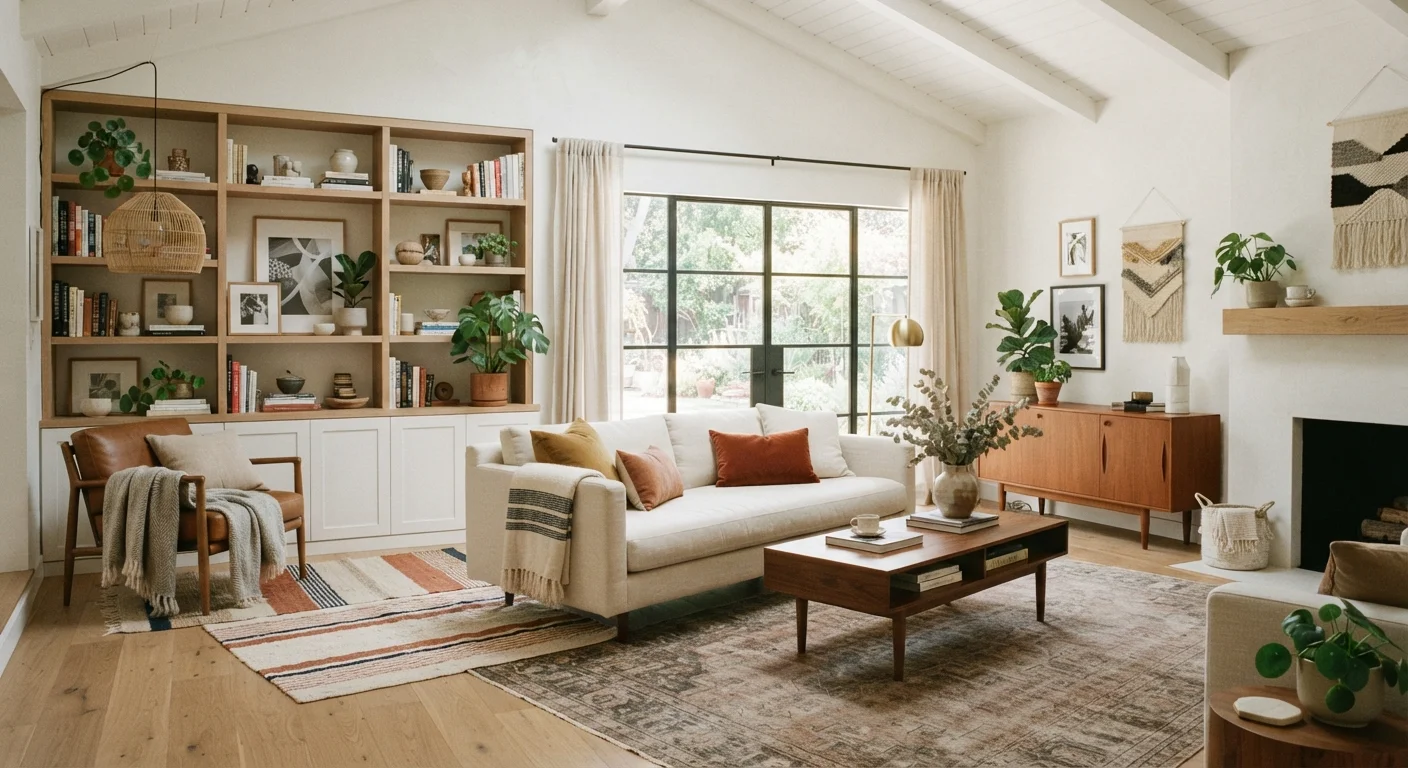
These are the styles you'll encounter most often in design media and furniture retail. Each has a recognizable visual language - once you understand it, you'll see it everywhere.
Scandinavian (Scandi)
Rooted in Nordic design tradition, this style prioritizes function, simplicity, and comfort. Palettes lean toward whites, soft grays, and warm neutrals, with natural wood as the dominant material. Clutter is minimal; every object earns its place.
Mid-Century Modern
Originating in American design roughly from the 1940s through 1960s, mid-century modern features clean lines, organic curves, and a balance of natural and manufactured materials. Tapered legs, warm wood tones, and bold accent colors are signature touches.
Industrial
Inspired by converted warehouses and urban lofts, industrial style celebrates exposed structure - brick walls, concrete floors, steel beams. The palette is dark and neutral; materials are raw and unfinished. Furniture tends to be utilitarian and heavy.
Bohemian (Boho)
An eclectic, globally influenced aesthetic defined by layered textiles, rich warm colors, plants, and an embrace of handcrafted and vintage items. Rules are few; personality is everything. Patterns mix freely.
Traditional / Classic
Draws from European design history - think symmetrical arrangements, ornate millwork, rich fabrics like silk and velvet, and a formal sense of order. Dark wood furniture and antique or reproduction pieces are common anchors.
Transitional
A deliberate blend of traditional and contemporary, transitional style aims for timeless comfort over trend. Silhouettes are cleaner than traditional but softer than modern; palettes are neutral and layered. It's one of the most widely used styles in American homes.
Maximalism
The intentional opposite of minimalism - more is more. Bold colors, layered patterns, abundant objects, and a curated sense of abundance define this style. The key word is intentional: maximalism at its best is deliberate, not simply cluttered.
Contemporary
Often confused with modern, contemporary refers to what's current right now - and it shifts over time. Today it typically means clean profiles, neutral or monochromatic palettes, and an emphasis on texture over pattern. It is flexible by definition.
A Few More Worth Knowing
- Coastal / Nautical: Relaxed and breezy, with weathered woods, natural fibers, soft blues and sandy neutrals. Prioritizes ease over formality.
- Art Deco: Geometric patterns, rich jewel tones, luxurious materials like velvet and lacquer. Glamorous and symmetrical.
- Cottagecore / English Country: Floral prints, mismatched vintage pieces, abundant plants, and a sense of cozy imperfection. Warmth over polish.
- Japanese Minimalism (Japandi): A hybrid of Japanese wabi-sabi and Scandinavian minimalism. Emphasizes imperfect beauty, natural materials, and deliberate emptiness.
No style exists in a vacuum - most homes blend two or more. If you're curious how that works in practice, mixing furniture styles without chaos is a useful next read.
How to Find (and Use) Your Style
Most people don't have a single style - they have a dominant aesthetic with compatible influences. The goal isn't to replicate a style precisely but to use it as a framework for making consistent choices.
A practical starting point: gather images of rooms you're drawn to (from magazines, social media, or real spaces you've visited) and look for patterns. Are the palettes mostly neutral or bold? Are shapes angular or curved? Do materials skew natural or manufactured? Those patterns will point you toward a style family.
Style Labels Are Starting Points, Not Rules
Design styles are descriptive categories, not prescriptions. No interior designer is required to follow a style precisely, and neither are you. Think of each style as a set of tendencies - visual cues that tend to appear together - rather than a checklist. The most successful rooms usually borrow from two or three styles while keeping a consistent underlying logic in color, scale, or material.
Budget is a real factor, but most styles are achievable at various price points. The defining elements of Scandinavian minimalism, for example, are restraint and natural materials - not expensive designer furniture. For a framework on where to invest and where to save, see home decor on a tight budget.
If you're decorating a new home room by room, this room-by-room starting point for new homeowners offers a practical sequence for making decisions without getting overwhelmed. And if you've absorbed some design rules you're not sure are true, common interior design myths worth questioning may surprise you.